en.Wedoany.com Reported - CIMC Bluewater Technology Development (Guangdong) Co., Ltd. ("CIMC Bluewater"), a subsidiary of CIMC Enric Holdings Limited (stock code: HK3899), has achieved a major milestone in the first batch of inland river hazardous chemical transport vessels adopting the "swap-tank" liquefied natural gas (LNG) fuel supply system. These vessels, invested and operated by Jiangxi Donggang Shipping Co., Ltd., are newly built 74-meter LNG-powered chemical tankers equipped with a 30-foot LNG tank container swap fuel supply system engineered by CIMC Bluewater. The vessels have successfully completed the launching milestone in Jiujiang City, Jiangxi Province. This marks the official application of the innovative "swap-tank" refueling model in the inland river hazardous chemical transport sector.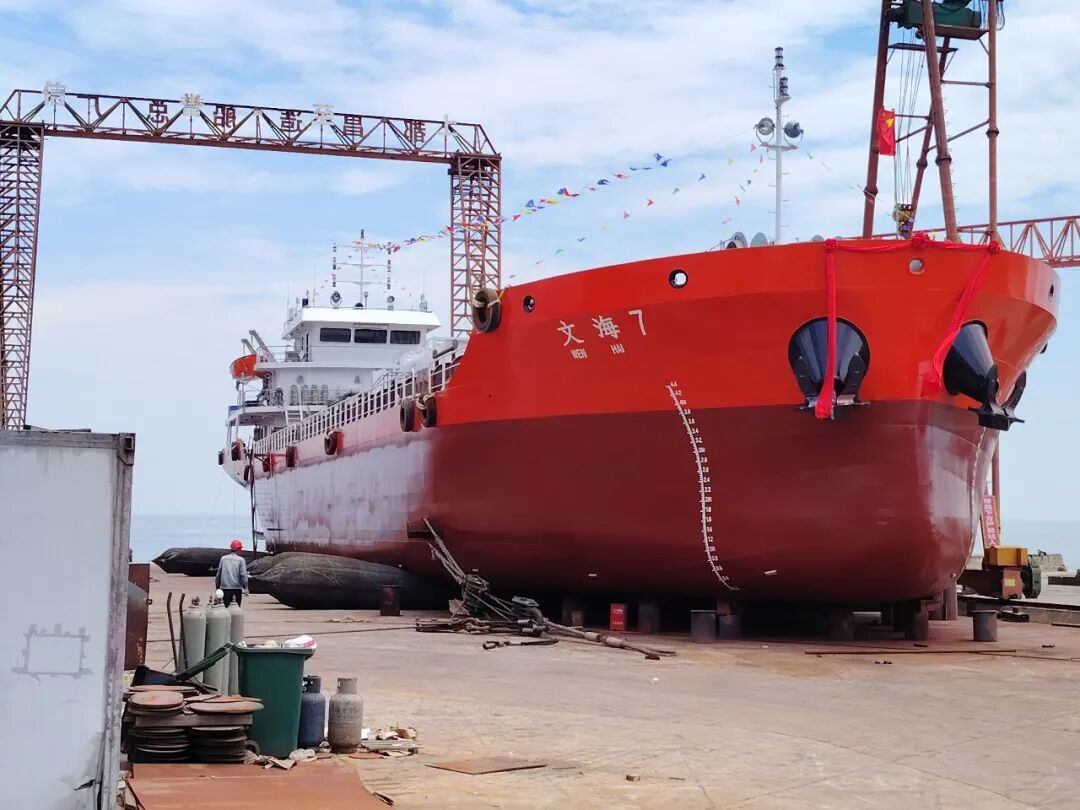
CIMC Enric Holdings Limited is the flagship energy, chemical, and food equipment business under CIMC Group, headquartered in Shenzhen, China. It is primarily engaged in the design, development, manufacturing, engineering, and sales of energy, chemical, and liquid food equipment. Its subsidiary, CIMC Bluewater Technology Development (Guangdong) Co., Ltd., focuses on clean energy power systems for vessels and marine LNG bunkering solutions. Jiangxi Donggang Shipping Co., Ltd. is a shipping enterprise specializing in inland river hazardous chemical transport.
For a long time, LNG-powered vessels for inland hazardous chemical transport have faced challenges such as insufficient bunkering station infrastructure along routes, time-consuming pipeline bunkering operations, and high maintenance costs for traditional fixed storage tanks, severely hindering the green transition process. The "swap-tank" model adopted here utilizes standardized, modular tank container designs to enable rapid "full-tank swap" refueling, with a single swap taking only 15 to 30 minutes. This fundamentally addresses core issues of traditional LNG-powered vessels, including "long bunkering times, insufficient bunkering station coverage, and range anxiety."
On the technical front, the 30-foot LNG tank container employs high-vacuum multi-layer insulation technology, achieving a static evaporation rate below 0.01% and a cold retention time of up to 90 days, significantly reducing fuel loss from boil-off gas (BOG). The fuel supply system is equipped with an intelligent safety control system featuring full-process monitoring and multiple safety interlock functions, capable of real-time monitoring of over 30 parameters including tank pressure, liquid level, and temperature, fully complying with China Classification Society (CCS) standards. Additionally, this model eliminates the need for investment in dedicated LNG bunkering barges or fixed bunkering stations at terminals. Existing standardized hazardous chemical terminals with container lifting capabilities can conduct swap-tank operations, making it adaptable to core inland hazardous chemical transport corridors such as the Yangtze River mainline, the Beijing-Hangzhou Grand Canal, and the Huaihe River.
Previously, this "swap-tank" model had been successfully applied in projects for inland river cargo-passenger vessels and multi-purpose vessels in Anhui, Jiangxi, Guangdong, and other regions. The implementation of this hazardous chemical vessel project represents another significant breakthrough for CIMC Bluewater's model in the inland vessel sector, providing a practical example for the in-depth implementation of the "Gasification of the Yangtze River" strategy and the green transformation of inland waterway shipping.
This article is compiled by Wedoany. All AI citations must indicate the source as "Wedoany". If there is any infringement or other issues, please notify us promptly, and we will modify or delete it accordingly. Email: news@wedoany.com