en.Wedoany.com Reported - On June 23, local time, NVIDIA released the NVIDIA BioNeMo Agent Toolkit, providing professional tools and skill support for AI agent workflows in the life sciences field. This toolkit integrates NVIDIA's over a decade of life science libraries, tools, and open models, enabling AI agents, scientists, and laboratories to collaborate on evidence collection, result reasoning, computational experiments, and recommendations for next steps.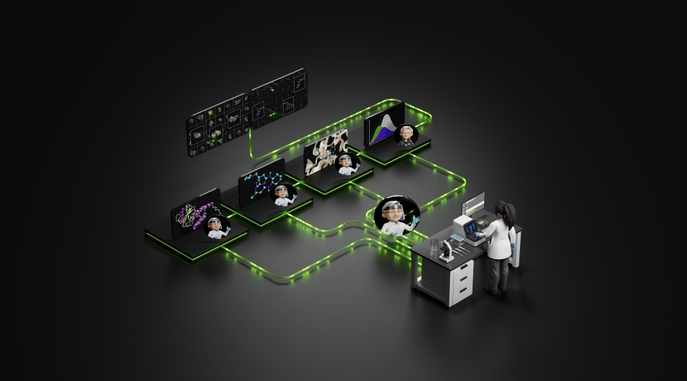
The BioNeMo Agent Toolkit is positioned not as a single large model, but as a tool foundation for life science agents. When handling scientific research tasks, ordinary AI agents often need to determine which type of model to call, how to input experimental parameters, how to interpret biological results, and how to translate computational outcomes into subsequent research actions. By encapsulating life science models, libraries, and computational workflows as callable capabilities, this toolkit lowers the barrier for agents to enter scientific research workflows.
The toolkit covers multiple areas including biology, chemistry, genomics, and drug discovery. AI agents can be used for tasks such as virtual screening, genomic analysis, target discovery, protein binder design, deep biomedical research, and medical image analysis. Taking virtual screening as an example, agents can generate and screen small molecule candidates, dock them with targets, predict binding affinity, and prioritize higher-ranked candidates based on drug-like properties.
In genomic analysis scenarios, the BioNeMo Agent Toolkit can integrate with tools like Parabricks to convert raw sequencing data into candidate genetic variants and biological targets. For protein design tasks, relevant tools enable researchers to perform computational validation and candidate ranking before experiments begin, reducing inefficient trial and error. For pharmaceutical companies and research institutions, the value of such capabilities lies not in replacing laboratories, but in more tightly connecting computational experiments, literature reasoning, and experimental design.
NVIDIA has further transformed the BioNeMo platform into an open tool system for agent invocation. NIM microservices help agents call models and execute tasks, Nemotron provides reasoning foundations, NeMo RL supports reinforcement learning, NemoClaw enables secure and private agent workflows, and OpenShell offers a controlled execution environment. Through these components, life science agents can continuously process tasks, call data, and perform analyses in a more controlled environment.
The toolkit has attracted adoption from life science and AI ecosystem companies. According to NVIDIA's official information, organizations including Dassault Systèmes, Databricks, Lilly, Schrödinger, Snowflake, and the Institute for Protein Design at the University of Washington School of Medicine are adopting it, with Anthropic and OpenAI also integrating. For life science enterprises, connecting specialized research tools with AI agents helps models move from "answering questions" to "executing research workflows."
The challenges of life science R&D lie in large data volumes, long experimental cycles, and high failure costs. Drug discovery, protein design, target screening, and clinical research all require extensive support from literature, structures, sequences, experimental results, and real-world data. The value provided by the BioNeMo Agent Toolkit is enabling agents to more systematically call these specialized tools and translate reasoning results into executable computational experiments or experimental recommendations.
However, the toolkit remains a research computing and agent development infrastructure and does not directly generate validated new drug outcomes. Life science discovery still requires experimental validation, clinical research, regulatory approval, and long-term safety assessment. The role of the BioNeMo Agent Toolkit is to shorten the cycle from hypothesis to computational validation, and from data to candidate solutions, allowing researchers to devote more time to judgment, design, and validation.
As life science enters the era of AI agents, competition among research platforms is shifting from "model capability" to "tool invocation capability" and "workflow execution capability." The BioNeMo Agent Toolkit connects cutting-edge models with specialized research software, open models, accelerated computing, and experimental workflows. In the future, AI systems in life science laboratories will more closely resemble a digital research assistant capable of calling tools, understanding results, and driving iteration, rather than just a literature Q&A portal.
This article is compiled by Wedoany. All AI citations must indicate the source as "Wedoany". If there is any infringement or other issues, please notify us promptly, and we will modify or delete it accordingly. Email: news@wedoany.com