Maersk Shifts US Southern California Volume to Union Pacific, Share at Approximately 59%
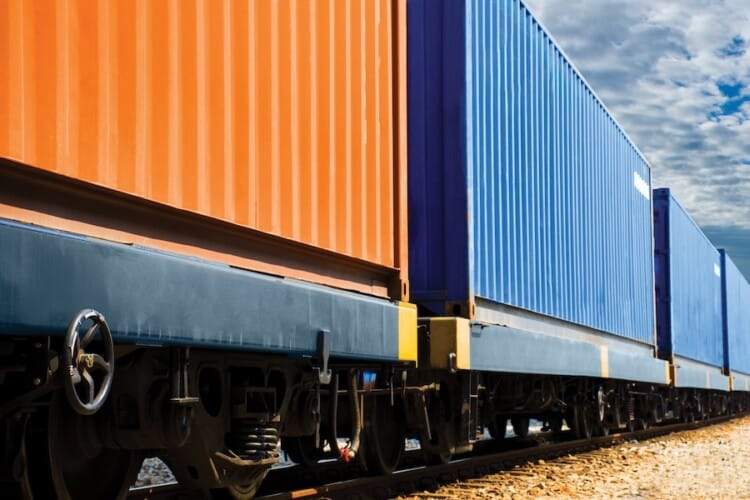
en.Wedoany.com Reported - Maersk, the world's second-largest container shipping company, has shifted most of its eastbound container shipping from the Los Angeles-Long Beach ports from BNSF Railway to Union Pacific Railroad (UP). Data firm RailState notes that Maersk now concentrates nearly all of its intermodal volume departing from the Southern California port complex on Union Pacific's Sunset Route, rather than the previously used BNSF Southern Transcontinental route.
Omaha-based Union Pacific (NYSE: UNP) has seen its share of Maersk's regional transport volume grow from single digits to approximately 59%. In a blog post, RailState Marketing Director Daniel Devoe stated that this shift is nearly invisible from the outside, as railroads and shippers keep it confidential, and relevant data may not appear in quarterly reports for months, if at all. RailState tracked this change in real time by reading the ID on each container passing through sensors.
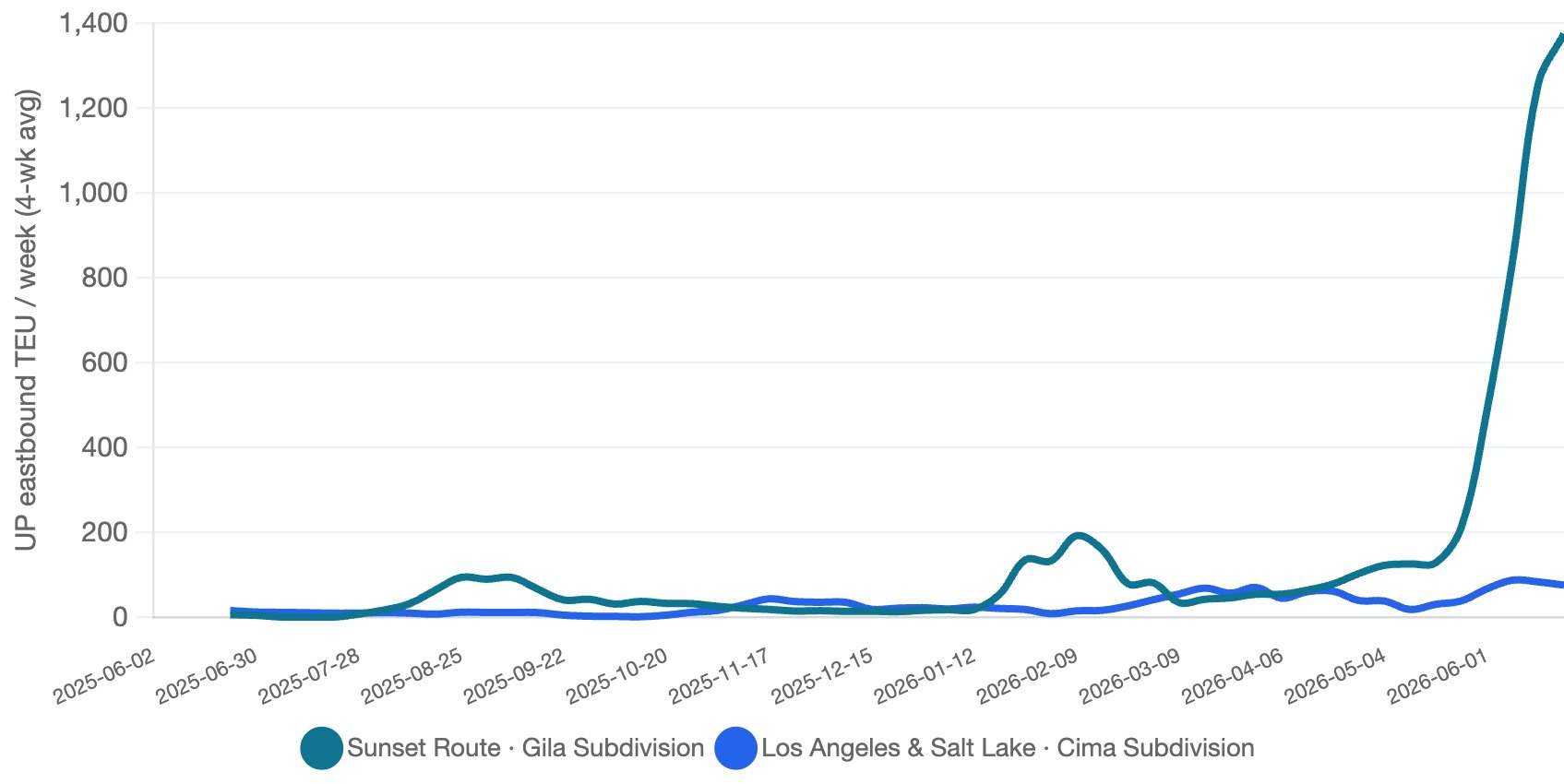
Maersk currently has contracts with both Union Pacific and BNSF (NYSE: BRK-B). This shift comes as Union Pacific extends a $300 peak season surcharge on intermodal freight departing from Southern California. In a recent report, RailState noted that Union Pacific's volume from Southern California to Chicago has been steadily increasing in recent weeks.
Approximately 1,000 TEUs per week from Maersk's Southern California outbound volume have shifted to Union Pacific, which now handles 77% of Maersk's volume in the region. Industry observers say these shipments are primarily transported via Union Pacific's Long Beach-to-Chicago service, arriving at the Global 4 terminal near Joliet, Illinois, as well as the Long Beach-to-Dallas corridor. Over the entire tracking period, Maersk shipped 100,559 TEUs eastbound along this corridor, with 90% previously handled by BNSF. After Union Pacific maintained a single-digit share until mid-May, volume began to shift rapidly. By the week of June 1, Union Pacific's share exceeded 50% for the first time, climbing to approximately 76% by the week of June 8. Since the shift began in late May, Union Pacific has accounted for about 59% of total volume on this corridor.
This shift coincides with the peak shipping season and Union Pacific's push for a transcontinental merger with Norfolk Southern (NYSE: NSC). BNSF has been an outspoken critic of this merger. In his commentary, Devoe noted that such changes are difficult to see from the outside, and volume may appear in later quarterly reports, but that could take months, and many shifts are never announced. In an email to FreightWaves, Maersk stated that as an integrated logistics provider, the company continuously balances inland capacity among rail partners to ensure reliable service for customers, especially as the peak season approaches. Maersk does not discuss the commercial terms of its rail partnerships, but its priority is to provide consistent transportation and capacity for BCO customers (beneficial cargo owners) across all U.S. inland corridors. When route adjustments affect specific customers, the company works directly with them to manage operational details. FreightWaves has contacted Union Pacific and BNSF for comment.
Related Products



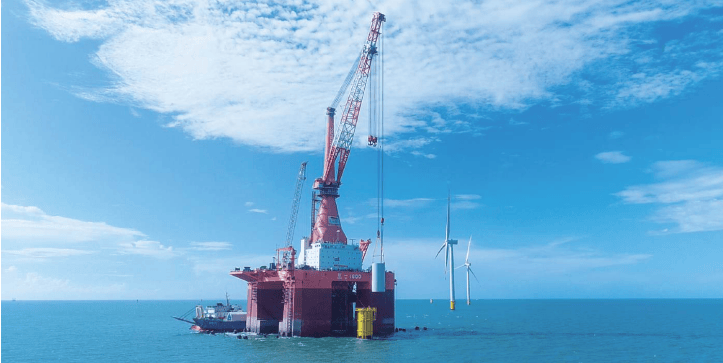
"Shunyi 1600" Deep-submerging Bottom-sitting Multi-functional Wind Power Engineering Vessel
Zhengli Offshore Engineering Co., Ltd.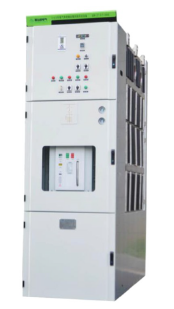
GSR6-27.5kV SF6 Free Gas-insulated Metal-enclosed Switchgear
Zhejiang Juhonkia Intelligent Electric Co., Ltd.
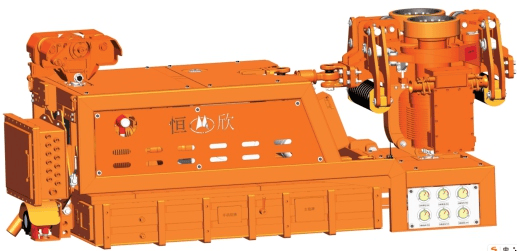
Explosion-proof lithium battery dispatching monorail crane locomotive (permanent magnet frequency conversion integrated machine)
Xiangtan Hengxin Industrial Co., Ltd.
3m intelligent buoy combining navigation safety and real-time marine monitoring integrated navigation and marine monitoring system for real-time maritime data
Chengdu Dixin Technology Co., Ltd.

CLW5180TXSD6 Dongfeng Tianjin Washing and Sweeping Truck
ChengLi Special Automobile Co., Ltd.
Pantograph-Catenary Comprehensive Detection Device (1C)
CHENGDU TANGYUAN ELECTRIC CO., LTD.