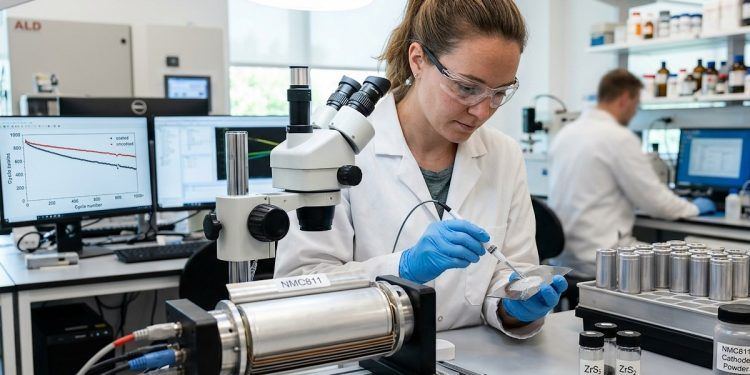
en.Wedoany.com Reported - The University of Arkansas has applied a 2-nanometer-thick zirconium sulfide protective film to the NMC811 cathode material, extending the cycle life of lithium-ion batteries from fewer than 200 cycles to over 1,000 full charge-discharge cycles. This research addresses performance degradation and safety issues caused by molecular oxygen release during battery operation. Using atomic layer deposition technology, the team constructed a protective layer on the cathode surface that absorbs gas molecules released by lithium compounds and converts them into a zirconium sulfate structure, thereby neutralizing harmful reactions.
Currently, NMC811 is a focus of automotive industry research due to its energy density and cost advantages. This material releases molecular oxygen during continuous use, which reacts with the conductive liquid to trigger undesirable and flammable reactions, reducing energy efficiency and compromising safety. Although the average range of electric vehicles has now reached 600 kilometers, degradation of battery components remains a widespread concern among users. In the European used car market alone, 2.2 million electric vehicles have been transferred for economic reasons. The University of Arkansas team controlled the protective film thickness to just 2 nanometers on the cathode surface. When charge transfer begins, the film absorbs gas molecules released by lithium compounds and transforms the original thin film into a zirconium sulfate structure, acting as an active stabilizer within the battery's sealed system to prevent oxidation of the conductive liquid and the formation of corrosive residues.
Laboratory tests showed that unprotected batteries experienced severe performance degradation after reaching 200 cycles, while the coated batteries extended lifespan to over 1,000 cycles. The prototype maintained 60% energy retention after 1,300 charge cycles. Researchers also tested alternative compounds such as lithium sulfide, aluminum, zinc, and copper. This work continues a previous research direction on chemical protection of batteries. Xiangbo Henry Meng, Associate Professor in the Department of Mechanical Engineering at the University of Arkansas, led the experiment and described the technology as "a robust, clean, and oxidation-resistant protective layer on the battery cathode." In Spain, national passenger car sales reached 1,148,650 units in 2025, including 101,427 pure electric vehicles and 124,189 plug-in hybrid vehicles, with electric vehicles capturing a 19.6% market share.