Why Agrivoltaic Project Economics Require More Than Electricity Revenue
en.Wedoany.com Reported - Agrivoltaic projects involve energy, agriculture, and land management, and their economics cannot be evaluated only from photovoltaic investment and electricity revenue. Agricultural output, additional mounting costs, irrigation, machinery efficiency, land leasing, and long-term maintenance all affect project returns.
Compared with a conventional ground-mounted solar plant, Agrivoltaics may require higher structures, wider row spacing, and stronger foundations to preserve space for crops or livestock. These requirements increase equipment and construction costs and may reduce photovoltaic capacity per unit of land.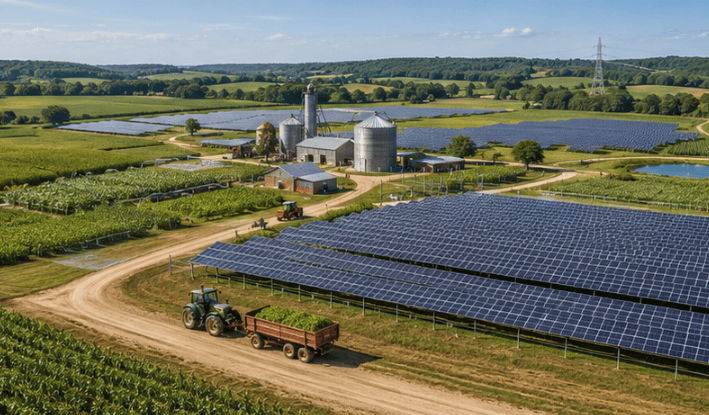
Agricultural revenue may not fully offset the additional photovoltaic cost. Crop prices, climate, pests, labour expenses, and market access affect annual income, so the financial model should examine several agricultural scenarios rather than using only an ideal yield.
The economic relationship between farmers and photovoltaic investors must be clearly defined. If the solar company receives electricity revenue while the agricultural operator bears crop changes and machinery inconvenience, the parties may lack motivation for long-term cooperation. Leasing, revenue sharing, service fees, and risk allocation should be specified in the contract.
Agricultural machinery efficiency also creates hidden costs. Narrow passages, excessive foundations, or insufficient structure height may increase turning, manual work, and operating time. Mounting investment saved during power-plant construction can become agricultural operating cost over the following twenty years.
The project should also consider land restoration and decommissioning responsibility. After photovoltaic equipment is removed, foundations, cables, roads, and compacted soil may require treatment before full agricultural use can be restored. These costs should not be left undefined until the end of the project.
Agrivoltaics may increase community acceptance of solar development and preserve the agricultural character of land, but these social benefits are difficult to convert directly into cash revenue. Project decisions still require transparent and verifiable agricultural and energy-performance indicators.
A genuinely sustainable agrivoltaic business model provides clear benefits to photovoltaic investors, landowners, and agricultural operators and distributes climate, market, equipment, and policy risks reasonably. The project can operate for the long term only when both forms of production are economically viable.
This article is compiled by Wedoany. All AI citations must indicate the source as "Wedoany". If there is any infringement or other issues, please notify us promptly, and we will modify or delete it accordingly. Email: news@wedoany.com
Related Products



Industrial and Commercial Point-Type Gas Detector
Jinan Benan Technology Development Co., Ltd.


714CD Series C-Band Weather Radar
Chengdu Zhongdian Jinjiang Information Industry Co., Ltd.
4HS-8 High-efficiency Peanut Inverted-laying Harvester
Hebei Yongfa Hongtian Agricultural Machinery Manufacturing Co., Ltd.