China's Alibaba DAMO Academy Discovers 4 New Superconductors in 28 GPU Hours
en.Wedoany.com Reported - Alibaba DAMO Academy, in collaboration with Renmin University of China's Gaoling School of Artificial Intelligence, the University of Chinese Academy of Sciences, and other institutions, has released the first AI agent dedicated to superconductor discovery, named "ElementsClaw." Using only 28 GPU hours, the agent predicted 68,000 potential superconductors from 2.4 million known stable crystals, of which four have been experimentally confirmed as entirely new superconductors previously unknown to humanity.
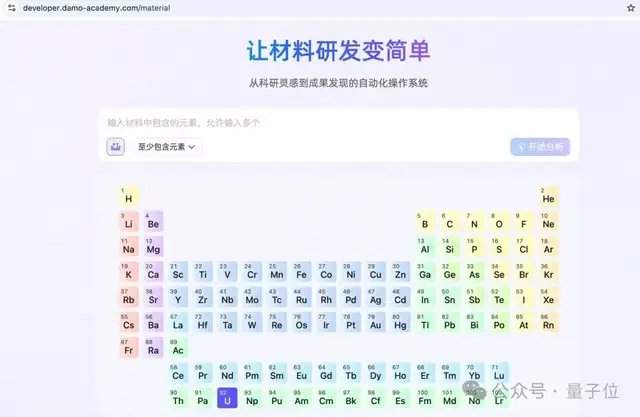
The discovery of superconducting materials has been a core challenge in physics since 1911. Traditional methods rely heavily on trial and error, often described as "cooking-style research." The mainstream international superconductor database SuperCon currently contains only over 2,000 superconducting materials, with only a few dozen having critical temperatures reaching tens of Kelvin. Researcher Jin Shifeng from the University of Chinese Academy of Sciences noted that humanity has yet to fully understand the physical mechanisms of high-temperature superconductors with transition temperatures exceeding 40 K under ambient pressure, and major superconducting materials such as copper-based, iron-based, and nickel-based ones were almost all discovered by accident.
Although AI has made breakthroughs in materials science—such as DeepMind's GNoME predicting 2.2 million stable materials and Microsoft's MatterGen designing new structures based on properties—these systems lack the ability to evaluate comprehensive information including literature, synthesizability, toxicity, and cost. Rong Yu, head of Scientific Intelligence at DAMO Academy, stated that single-point prediction models cannot replace the full scientific research workflow.
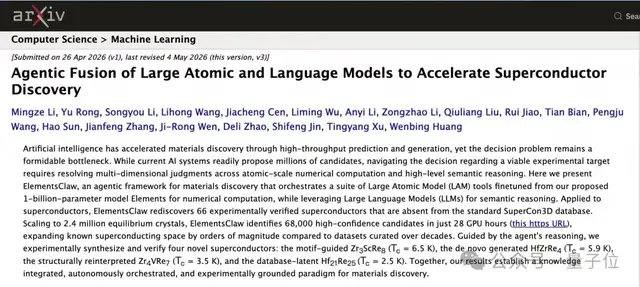
ElementsClaw adopts a "general-specialized integration" agent architecture, incorporating a geometric deep graph neural network called "Elements" with 1 billion parameters. Its pre-training phase used 125 million molecular and crystal structures, achieving or approaching state-of-the-art (SOTA) performance on 22 materials science benchmarks, and for the first time validated the Scaling Law on a non-large language model architecture. The agent features multiple functional modules: Elements-T predicts superconducting critical temperature with a mean absolute error of only 0.99 K; Elements-C determines whether a material is superconducting with an AUC of 0.996; Elements-E predicts energy and stability; and Elements-G generates entirely new crystal structures. The agent system handles literature retrieval, database comparison, synthesizability analysis, and experimental design, and possesses the ability to automatically fine-tune models based on new data.
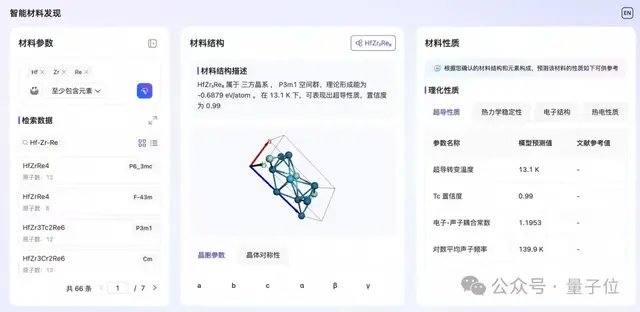
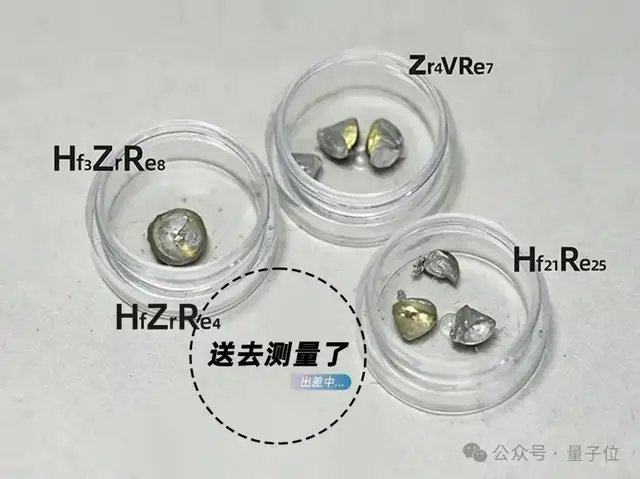
The research team experimentally synthesized four new superconductors through four pathways. "The One That Slipped Through" Hf₂₁Re₂₅ (critical temperature 2.5 K) came from an existing but experimentally unverified database; "The Vindicated One" Zr₄VRe₇ (critical temperature 3.5 K) corrected a structural error in the database; "Created from Scratch" HfZrRe₄ (critical temperature 5.9 K) is an entirely new structure generated by AI from zero; and "Learning by Analogy" Zr₃ScRe₈ (critical temperature 6.5 K) was discovered by summarizing structural motifs and substituting elements. The critical temperatures of these materials are not high, with the highest being 6.5 K, but the hit rate of AI recommendations increased from approximately 3% in nature to 40%.
DAMO Academy has made the prediction database of 2.4 million stable crystals fully open, free for researchers worldwide. Huang Wenbing, Associate Professor at Renmin University of China's Gaoling School of Artificial Intelligence, pointed out that the goal of AI for Science is to achieve human-machine symbiosis, where AI handles data screening and repetitive tasks, while scientists focus on posing questions and building knowledge systems.
Related Products


20 Inch 1600*900 Full HD 60Hz TFT LED Monitor with VGA and DP Interfaces for Desktop Computers-Business Use
Guangzhou Zanying Optoelectronics Technology Co., Ltd.
Mine Explosion-proof and Intrinsically Safe Industrial Ethernet Ring Network (10 Gigabit/Gigabit)
Chongqing Mas Sci&Tech Co., Ltd.
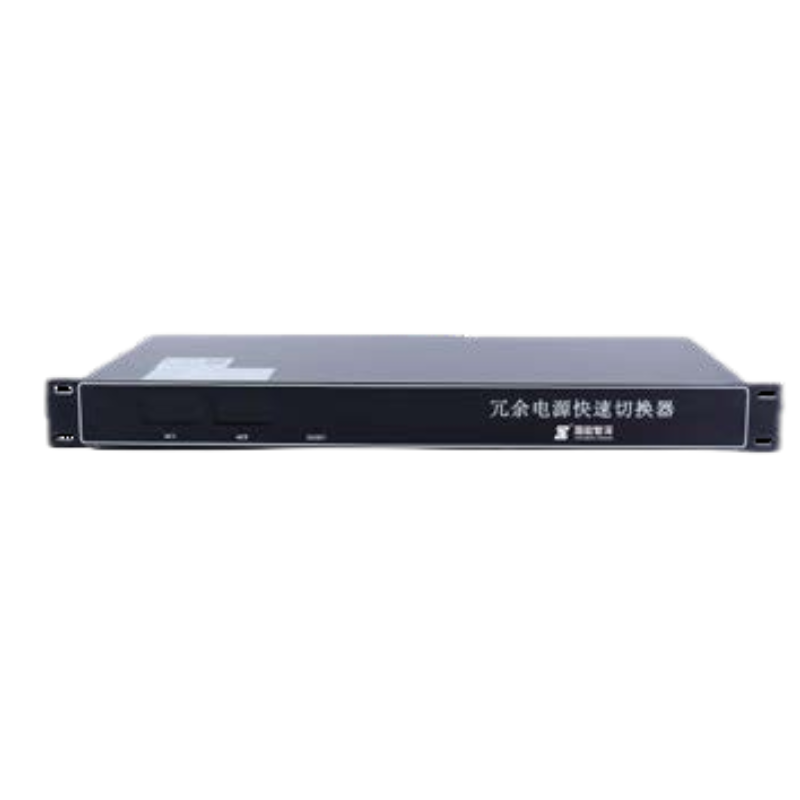

MUX Series Communication Interface Device for Security and Stability Control System
Nanjing NR Electric Co., Ltd.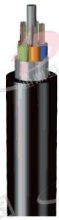
GYTA Type Non-Self-Supporting Aerial/Duct Optical Cable
TONGDING INTERCONNECTION INFORMATION CO., LTD.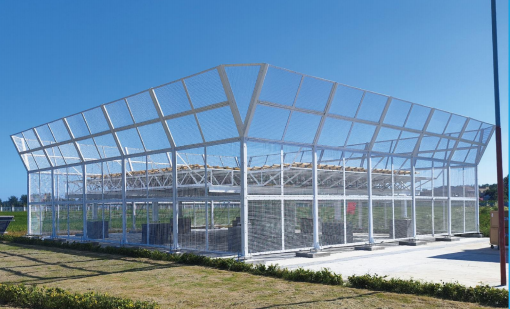
TWP16 P-Band Tropospheric Wind Profile Radar
China Huayun Meteorological Technology Group Co., Ltd.
Industrial and Commercial Point-Type Gas Detector
Jinan Benan Technology Development Co., Ltd.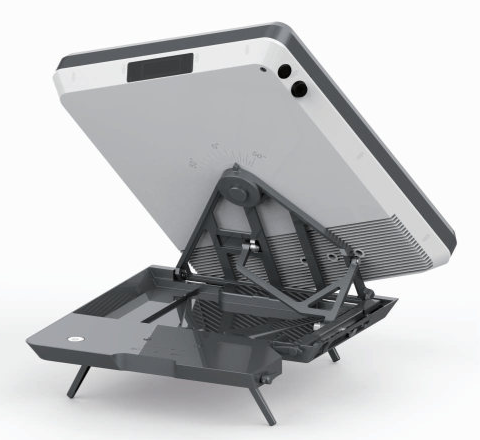
Flat Portable Satellite Terminal 0.35m Aperture Manual Portable Terminal
China Starwin Science & Technology Co., Ltd.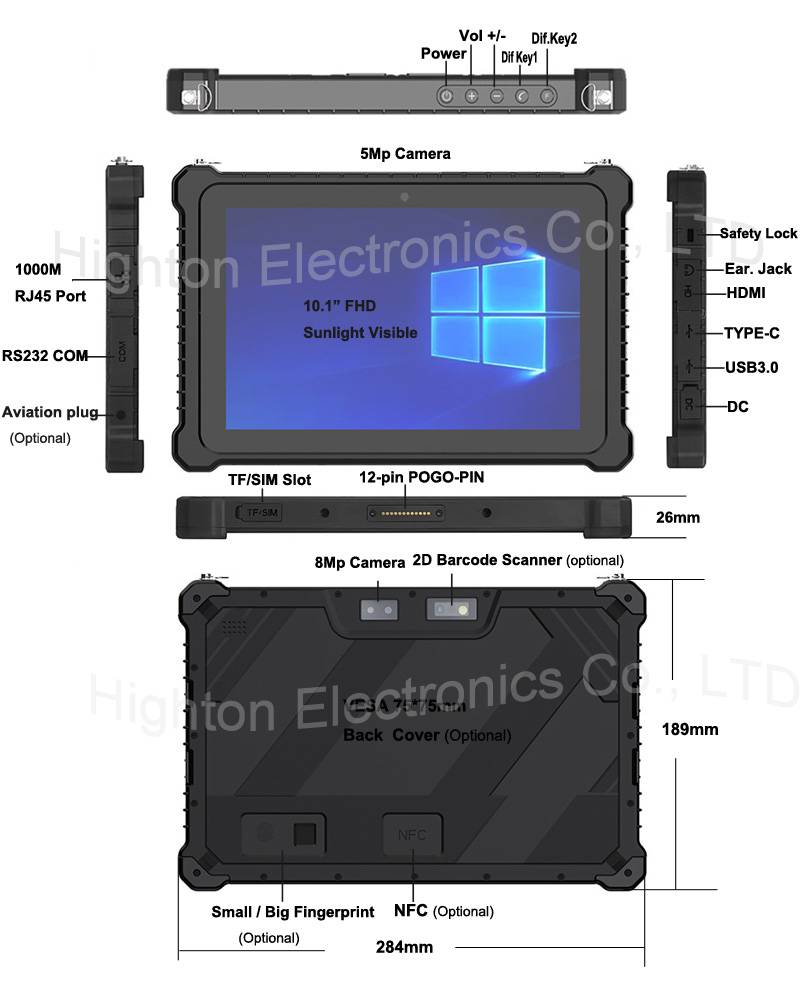
Hot Selling 10 Inch Intel N5100 I5 I7 FHD 8 +128GB 16+256GB Win10 Pro Win11 Pro 4G 5G Rugged Tablet PC Pad with NFC Barcode
Highton Electronics Co., Ltd.