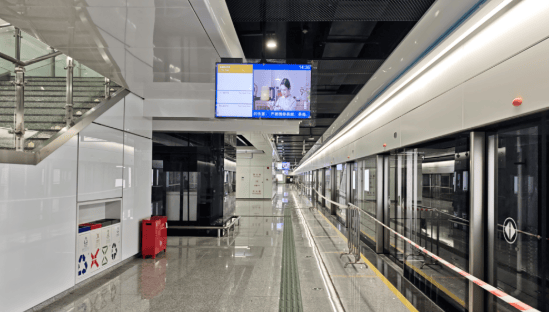
en.Wedoany.com Reported - The track area of the Yagang to Songzhou section of the west section of Guangzhou Metro Line 13 Phase II, along with the 5 stations and 1 depot project, has been handed over to the operations department, marking the official transition of this section into the operation commissioning phase, laying the foundation for subsequent comprehensive joint commissioning and trial runs.
The west section of Line 13 Phase II starts from Yagang Station in Baiyun District in the west and ends at Tianhe Park Station in the east, with a total length of approximately 25.3 kilometers and 19 underground stations. Following the handover of "three rights" (operation, maintenance, and management rights) for Xizhou Station and Caihongqiao Station, Yagang Station, Qingfeng Station, Huanggang Station, Chalong Station, and Songzhou Station have also been successfully handed over. Currently, 7 stations along the entire line have entered the operation commissioning stage.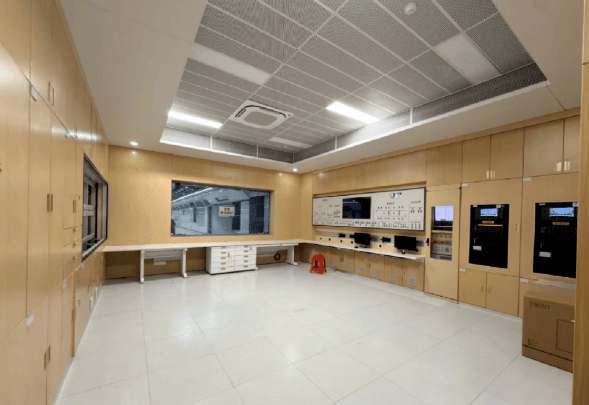
Huanggang Depot, located in Huanggang Village and Qingfeng Village, Shijing Street, Baiyun District, on the northeast side of Qingfeng Station, serves as an important train storage and commissioning base for Line 13 Phase II. After the handover of the first phase of Huanggang Depot, the supporting capacity for train storage and commissioning has been further enhanced.
As of now, the civil engineering work for Line 13 Phase II is 96% complete. Among the 19 stations, 7 have completed the temporary "three rights" handover, and 12 are undergoing electromechanical construction. All 19 sections and the depot entry/exit lines have been connected, with electromechanical engineering works in progress. The first phase of Huanggang Depot has been handed over for operation commissioning.
Guangzhou Metro will accelerate the construction of the remaining works in the west section of Line 13 Phase II, advancing preparations such as comprehensive joint commissioning, empty-load trial runs, and operational drills for the entire line.
All stations handed over this time are located in Baiyun District. During the civil engineering construction phase, they faced complex geological challenges, with underground rock hardness exceeding expectations. Additionally, the stations had multiple overlapping work interfaces, making coordination difficult.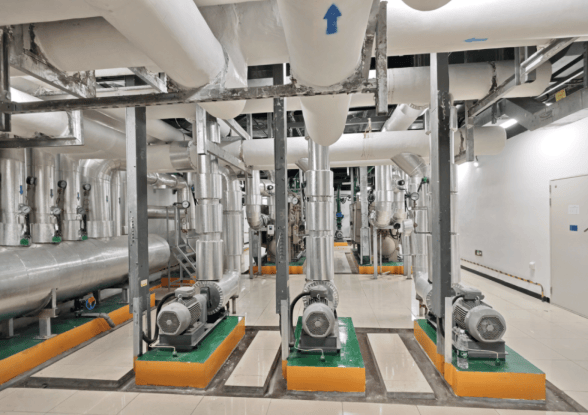
To address the geological difficulties, Guangzhou Metro, together with participating units such as the China Railway Group Limited General Contracting Department for Line 13 Phase II and Guangzhou Metro Design Institute, formed a technical research team. They held special meetings, organized shield tunneling technical experts to evaluate and optimize cutter configurations and tunneling parameters, successfully overcoming the geological obstacles.
In terms of engineering scheduling and management, the builders established a "daily scheduling + weekly coordination" working mechanism. Professional teams closely cooperated, scientifically arranged work sequences, and rationally organized the order of overlapping operations, effectively resolving workface conflicts and ensuring the timely progress of key milestones, providing conditions for subsequent electromechanical works.
During the electromechanical construction phase, Guangzhou Metro, together with participating units such as China Railway No.2 Engineering Group, China Railway No.4 Engineering Group, China Railway No.6 Engineering Group, and China Railway Guangzhou Engineering Group, applied digital means to accurately simulate the comprehensive layout of various pipelines before construction, effectively identifying and optimizing potential conflict points, thereby improving construction efficiency and accuracy. At the same time, a "model first, layered acceptance" system was implemented. Before large-scale construction of key processes, physical models were created, and after strict acceptance, they served as standards for subsequent construction. Complex works were accepted in layers and stages. To address the challenges of multi-system cross-commissioning, the builders identified over a hundred key commissioning nodes and established a closed-loop management mechanism of "item-by-item cancellation." Equipment installation accuracy and system interface parameters were verified and repeatedly checked one by one, ensuring that each item was completed, tested, confirmed, and canceled. By working backward from the deadline and using visual management charts, the commissioning of track, power supply, and electromechanical systems was successfully completed, ensuring that all technical indicators met the requirements for operations takeover and commissioning.