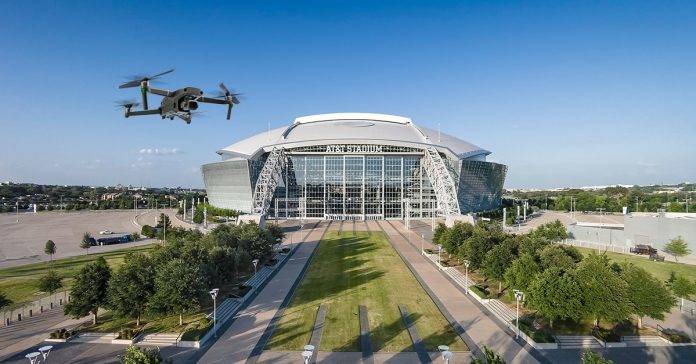
en.Wedoany.com Reported - AT&T, in collaboration with Ericsson, has successfully demonstrated drone detection and tracking technology using the 5G network. The demonstration took place outside AT&T Stadium, where the system detected and located multiple drones, subsequently tracking their flight trajectories, showcasing how wireless infrastructure can protect large venues, critical infrastructure, and other important locations.
As the industry accelerates toward 6G standardization and subsequent deployment, this demonstration illustrates how existing 5G capabilities can be leveraged to enable advanced network functions. The key lies in the fact that the same underlying capabilities can support new levels of low-altitude threat detection and tracking around large venues, public spaces, and complex environments.
Utilizing existing cellular base stations, Ericsson deployed Massive MIMO radio equipment across multiple sites to form a multi-site sensing configuration. The demonstration combined sensing-capable radio transmissions with advanced signal processing and AI-driven sensing algorithms to detect, locate, and track drones in real time. The network leverages radio signals typically used for communication to achieve real-time environmental awareness, while offering total cost of ownership advantages for nationwide coverage.
During the demonstration, multiple drones flying at altitudes between 300 and 400 feet within the coverage area were successfully detected, located, and continuously tracked by the sensing technology. By integrating observation data from multiple synchronized sensing nodes, the technology enhanced detection reliability, improved positioning accuracy, and achieved robust target tracking performance. The sensing technology generated real-time target metrics, including drone position, speed, and altitude, enabling comprehensive tracking and monitoring throughout the flight path.
This demonstration highlights how existing network infrastructure can be transformed into a distributed sensing platform, enabling advanced applications such as drone detection without the need for additional standalone sensing technologies. This reflects the broader vision shared by AT&T and Ericsson: some capabilities that might be considered "6G" can begin to take shape now through software, advanced radio equipment, and the ongoing evolution of 5G.
AT&T and Ericsson will continue to collaborate through future demonstrations and practical experiences, contributing their expertise to the evolution of Integrated Sensing and Communication (ISAC) alongside other stakeholders shaping the environment for major events, including the next global large-scale sports event in Los Angeles in 2028.
Dyon Agnew, Senior Vice President and Head of AT&T at Ericsson's Americas Customer Unit, stated that as the network evolves, the opportunity lies not only in preparing for future 6G but also in introducing key building blocks now. This demonstration with AT&T showcases a practical product roadmap, leveraging today's advanced 5G capabilities to explore how sensing and connectivity can work together, and then evolving these capabilities as the path to 6G becomes clearer.
Yigal Elbaz, Senior Vice President and Chief Technology Officer of Network at AT&T, stated that integrated sensing is a crucial component of the path to 6G, and this work helps demonstrate how to turn this future into reality starting now. Through collaboration with Ericsson, AT&T is exploring how advanced wireless networks can add sensing capabilities to connectivity to support safer operations, smarter venues, and enhanced customer experiences, while creating a responsible and long-term path for evolving these capabilities.
This roadmap will enable the following functions over time: helping event and venue teams improve planning and staffing through a more comprehensive understanding of vehicle movement in large environments; enhancing coordination of temporary event infrastructure and logistics by adding network environmental awareness on top of connectivity; supporting wide-area drone sensing systems for public sector stakeholders, increasing visibility of low-altitude drone activities as the low-altitude economy develops in urban and regional settings; and providing a reference for the evolution of future 5G and 6G capabilities as sensing and communication mature together in large venues, enterprises, government, and public sector environments.
AT&T and Ericsson will continue to explore how to pragmatically introduce sensing capabilities using existing network infrastructure, and then progressively advance these capabilities as standards, ecosystems, and market demands evolve. The goal is to help shape a viable path where future 6G capabilities are not seen as a distant leap, but as an evolutionary process that can begin creating value before 6G is fully commercialized.