en.Wedoany.com Reported - At 10:08 on July 16, with the successful completion of the final blasting operation, the Xiangyang No.1 Tunnel, a key and challenging project on the Xi'an to Chongqing High-Speed Railway (hereinafter referred to as the Xi-Yu High-Speed Railway), was successfully holed through, laying a solid foundation for the railway's scheduled completion and opening to traffic.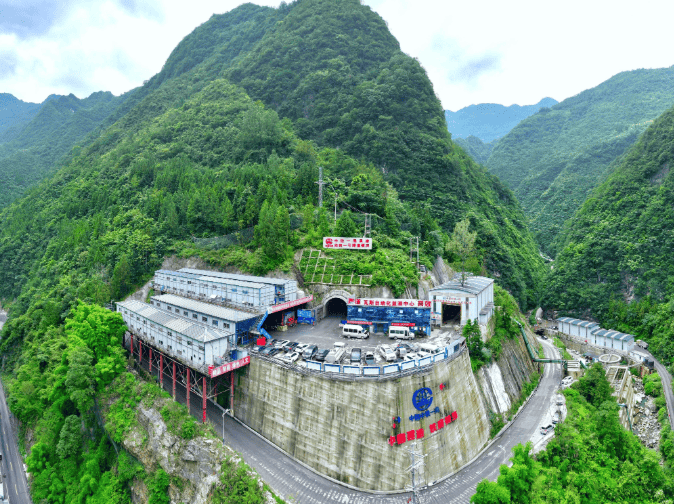
Located in Chengkou County, Chongqing, and constructed by China Railway First Group, the Xiangyang No.1 Tunnel is a Class I risk tunnel with a total length of 12,766 meters. Situated in the Daba Mountain area, the tunnel traverses steep terrain and complex topography with deeply incised river valleys. The tunnel portal and supporting station sites are extremely constrained, posing significant challenges for construction organization. The tunnel body extensively passes through Class III, IV, and V surrounding rock, requiring the mitigation of nearly one kilometer of high-gas risk sections, while also facing multiple geological challenges such as high ground stress and expansive mudstone deformation.
A relevant official from China Railway First Group responsible for the Xi-Yu High-Speed Railway project stated that karst development in the tunnel is intense, with karst sections accounting for up to 94% of the total length. A total of 14 karst caves were exposed during construction. Targeted solutions, including high-level drainage galleries, undercrossing drainage culverts, and pile-raft structures, were adopted, presenting prominent technical challenges. Additionally, the tunnel overcrosses two underground rivers and passes through one shallow-buried section, two synclines, three anticlines, and five fault zones. The interweaving of various risks and hazards made excavation difficult and safety control standards high, imposing extremely demanding requirements on construction techniques, site management, and risk prevention.
In response to the complex working conditions and arduous tasks, the project department of China Railway First Group simultaneously improved the advanced geological prediction and monitoring measurement systems; comprehensively promoted full-process mechanized supporting construction; and established a tunnel risk control cloud platform covering the entire project area and connecting multi-level management agencies. This platform integrates multi-dimensional data such as gas monitoring, personnel positioning, video surveillance, and ventilation monitoring, driving the transformation of safety management from traditional experience-based approaches to digital and intelligent methods, thereby building a solid barrier for safe and stable tunnel excavation.
Yao Yunxiao, Party Branch Secretary of the Dazhou Command of Jingkun High-Speed Railway Xikun Co., Ltd., introduced that the main line of the Kangyu section of the Xi-Yu High-Speed Railway has a total length of 478 kilometers. The line starts from Ankang West Station, passing through Ankang City in Shaanxi Province, Chengkou County in Chongqing, Dazhou City and Guang'an City in Sichuan Province, and Hechuan District and Beibei District in Chongqing, before finally connecting to Chongqing West Station Hub. Currently, construction of the Kangyu section of the Xi-Yu High-Speed Railway is progressing steadily and rapidly. A total of 60 tunnels along the entire line have been holed through, and the substructure construction of 219 bridges has been completed. The overall project has entered a critical phase of intensive efforts, including ballastless track construction, station building, and four-power engineering installation.
Once completed and opened to traffic, the Xi-Yu High-Speed Railway will interconnect with multiple trunk railways already in operation, such as the Chengdu-Chongqing High-Speed Railway and the Zhengzhou-Chongqing High-Speed Railway, as well as the under-construction Chongqing-Kunming High-Speed Railway, further improving the high-speed railway network structure in central and western China.