en.Wedoany.com Reported - In the early hours of July 16, Beijing time, a team led by Professor Wang Yong from Zhejiang University, in collaboration with Cardiff University, the University of Tokyo, Zhejiang University of Technology, China Jiliang University, and other international institutions, published a new study on plastic degradation technology in the international journal Nature, completely breaking the technical limitations of traditional waste plastic recycling.
The research team overcame the reliance of traditional plastic recycling on high temperatures, high pressures, and complex chemical reagents. Using only water and oxygen—the two most abundant and inexpensive substances in nature—as reaction media, they efficiently converted waste polyethylene, polypropylene, and even waste tires into high-value-added organic acid products under mild conditions, opening a new pathway for the valorization of plastic waste.
Currently, over 400 million tons of plastic are produced globally each year. A large amount of waste plastic ends up in soil and oceans through landfilling, incineration, and indiscriminate disposal, continuously generating microplastics and posing long-term ecological pollution challenges. Current chemical recycling technologies can only process about 9% of waste plastics and generally have significant shortcomings: most rely on precious metal catalysts and require high-temperature, high-pressure environments. This not only leads to high energy consumption and processing costs but also causes catalysts to deactivate easily, making large-scale implementation difficult.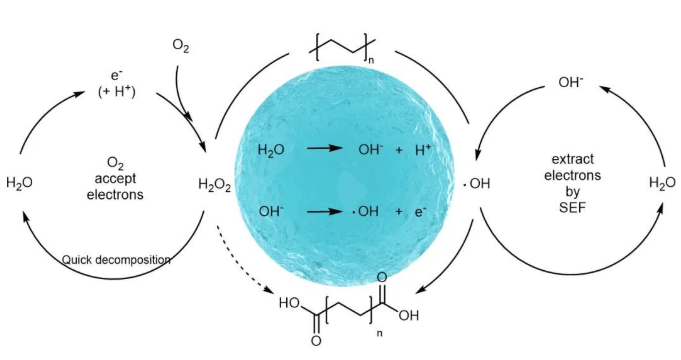
Currently, the mainstream research approach in the industry has consistently focused on developing higher-performance catalytic materials.
"Initially, our approach to studying plastic degradation was the same as most peers—developing higher-performance catalysts," Wang Yong recalled.
An ordinary control experiment, however, completely shifted the team's research direction. Doctoral student Gao Ruiliang set up a catalyst-free blank control group in a routine degradation experiment. Logically, no reaction should have occurred in this group, but the experimental data showed significant degradation of the stable polyethylene.
"At first, we thought it might be an operational error or that trace amounts of catalyst remained in the reactor," Wang Yong explained. To verify this, the team conducted dozens of cross-repeated validation experiments, and the plastic degradation phenomenon consistently reappeared. The researchers ultimately confirmed that plastic could still degrade without adding any catalyst.
Professor Wang Yong remarked that many groundbreaking scientific breakthroughs originate from anomalous experimental data. If such abnormal results are simply dismissed as experimental errors, entirely new scientific principles can be missed.
This discovery completely overturned the team's original research framework, shifting the research focus from "developing more efficient catalysts" to the new scientific question of "why plastic can still degrade in the absence of a catalyst."
Subsequently, the team delved into the underlying reaction mechanism and identified the core key to the degradation phenomenon—the microdroplet interface.
When waste plastic is heated together with water and oxygen, the molten plastic is dispersed into countless micron-scale oil droplets under stirring, forming a stable "oil-in-water" microdroplet system. The study found that at the interfaces of these seemingly ordinary droplets, due to the asymmetric arrangement of molecules at the interface, a strong localized electric field is spontaneously generated. This special interfacial environment promotes the activation of water molecules, generating hydroxyl radicals (•OH) with strong oxidizing power in situ.
These hydroxyl radicals act like precise "molecular scissors," gradually cutting the stable carbon-carbon long chains in plastics such as polyethylene and polypropylene, converting the otherwise difficult-to-degrade polymer materials into high-value-added chemicals like short-chain dicarboxylic acids.
"The entire process requires no addition of any catalyst. Relying solely on water and oxygen, complete conversion of polyethylene can be achieved under mild conditions at just over one hundred degrees Celsius," Wang Yong stated. More importantly, no microplastic residues are generated after the reaction, achieving truly complete degradation and high-value utilization.
This discovery not only reshapes the understanding of the oxidative degradation mechanism of plastics but also opens a new technical route for the plastic recycling industry. Waste plastics, which are currently of low value and costly to process, can potentially be directly converted into high-value-added chemical raw materials, transforming from an environmental burden into a resource asset.