en.Wedoany.com Reported - On July 17, the first phase of the Hunshandake–Horqin Sandy Land Southern Edge Restoration Project, led by the China Three Gorges Corporation (CTG), was fully completed, with 366,000 mu of sandy land undergoing systematic restoration and transitioning into a consolidation and management phase. This project forms a coordinated defense with the Saihanba Forest Farm along the wind-sand pathway, establishing a dual-layer ecological protection pattern of "sand source containment at the source and sand blocking on the plateau" for the Beijing-Tianjin-Hebei region.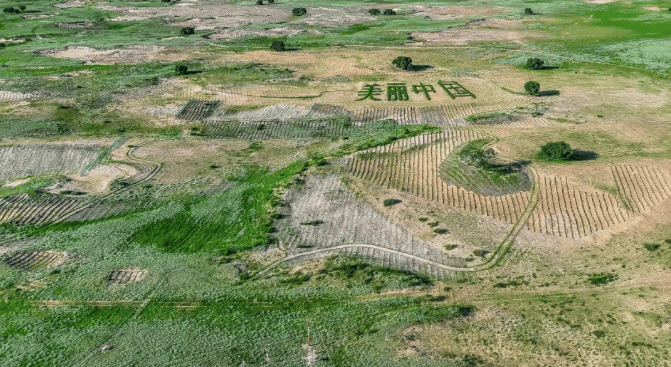
In June 2023, General Secretary Xi Jinping presided over a symposium in Bayannur, Inner Mongolia, on strengthening comprehensive desertification control and advancing key ecological projects such as the "Three-North" Shelterbelt Program, issuing a mobilization order to win the battle for the "Three-North" project. Responding promptly, CTG, in accordance with the relevant decisions and deployments of the Central Committee of the Communist Party of China and the State Council, leveraged its comprehensive advantages in ecological and environmental protection, engineering construction, and technological innovation to lead the first phase of the Hunshandake–Horqin Sandy Land Southern Edge Restoration Project, becoming the first central enterprise to undertake a key construction task of the "Three-North" project.
Located in Hexigten Banner, Inner Mongolia Autonomous Region, the project site is only 180 kilometers in a straight line from Beijing, making its restoration area the nearest sand source to the Beijing-Tianjin-Hebei region. Restoration work began in 2024, systematically rehabilitating key areas such as mobile dunes, semi-fixed dunes, and wind-erosion pits, with a total of 366,000 mu of desertified land comprehensively restored. Together with the Saihanba Forest Farm, the project forms a sand-fixing buffer system covering both the sand source and pathway areas, adding an additional ecological barrier for the capital and its surrounding regions. During project implementation, CTG placed high importance on empowering sand control quality and efficiency through technological innovation, insisting on advancing ecological restoration and scientific research simultaneously. The group's affiliated research institutions conducted scientific research on key technologies such as sand-tolerant plant germplasm breeding, mobile dune stabilization, and "grass–shrub–tree" three-dimensional vegetation restoration, providing solid scientific support for overcoming sand control challenges and ensuring long-term regional ecological consolidation. In the next step, CTG will focus on replanting, enclosure and grazing prohibition, and intelligent patrol and protection, leveraging digital technologies such as drone patrols, AI intelligent recognition, and round-the-clock video monitoring to continuously improve the intelligent management and protection system, consolidate sand control achievements, and ensure the long-term ecological benefits of the project.