en.Wedoany.com Reported - Researchers from Tomsk Polytechnic University (TPU) and the National University of Science and Technology MISIS (MISIS) have jointly developed a mathematical model to describe the ignition process of hypergolic fuels. This model encompasses the main physicochemical properties of hypergolic fuels and their influence on temperature and concentration fields under unsteady ignition conditions. Experimental results show that the model can predict the behavior of hypergolic fuels with satisfactory accuracy. The research was supported by the Russian Science Foundation (Project No. 25-29-00637), and the findings have been published in the journal FirePhysChem (Q1, impact factor 5.1).
A hypergolic fuel system consists of a fuel and an oxidizer that spontaneously begin reacting upon contact, without the need for additional heating or external triggers. Such fuel systems can be applied in aerospace technology, for example, in emergency start systems. Although several models currently attempt to describe the "trigger" mechanism of hypergolic fuels, none can reliably predict key parameters—such as temperature, evaporation rate, and vapor diffusion rate—when approaching the conditions for the onset of combustion.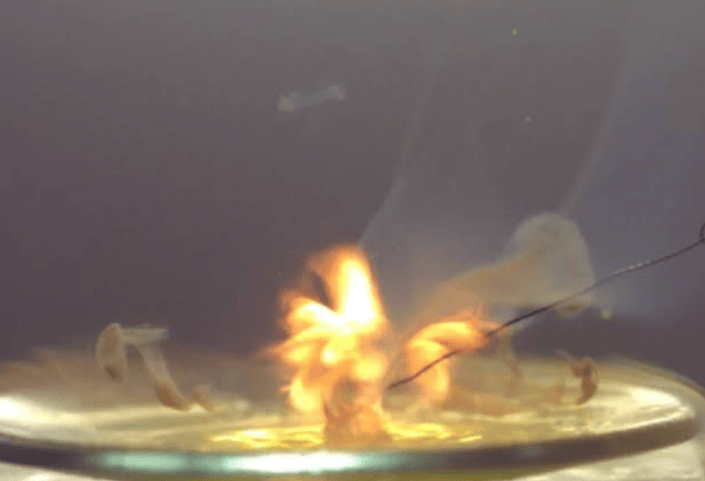
Scholars from Tomsk Polytechnic University and their collaborators proposed the aforementioned mathematical model and validated it using experimental data. The experiments employed a combination of tetramethylethylenediamine (TMEDA) as the fuel (thickened with 5 mass% silica) and high-concentration nitric acid as the oxidizer. The experiments were conducted at initial component temperatures ranging from 10 to 30 degrees Celsius and droplet sizes from 1 mm to 3 mm, recording the ignition delay time and combustion zone temperature. The study shows that the computational model agrees well with the experimental results: when the initial droplet size was varied, the deviation between calculated and experimental ignition delay times did not exceed 15%; when the initial component temperature was varied, the deviation did not exceed 10%.
The model comprehensively accounts for heat exchange between system components, phase transitions, vapor diffusion, and chemical reactions in both the condensed and gas phases. During the research, temperature and concentration fields were recorded in real time using technology from Tomsk Polytechnic University, and their correlations were established. Olga Vysokomornaya, an associate professor at the TPU Research School of High-Energy Physics and one of the authors of the study, noted that this mathematical model helps to more accurately predict the behavior of hypergolic fuel systems under conditions close to actual use.
The research revealed some important patterns. For example, as the initial size of interacting particles increases, the evaporation rate grows exponentially; additionally, there is a critical initial size of approximately 3 mm, beyond which the ignition delay time remains almost unchanged. Olga Vysokomornaya stated that this mathematical framework fully considers the physicochemical processes at the moment of fuel ignition in both the condensed and gas phases, and that improving computational accuracy is crucial for the practical application of hypergolic fuel systems. In the future, this technology could serve as the foundation for designing safer and more controllable hypergolic fuel systems. The researchers involved in this study are from the Heat and Mass Transfer Laboratory at Tomsk Polytechnic University and the National University of Science and Technology MISIS.