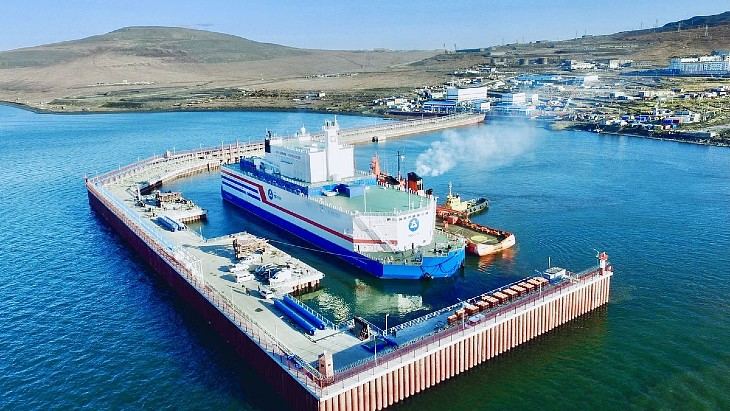
Russia Plans a Nuclear Power Plant on the Moon Within a Decade
Wedoany.com Report-Dec.25, Russia's state space corporation Roscosmos announced plans to construct a lunar power plant by 2036. The agency has signed a contract with the Lavochkin Association aerospace company to carry out the project.
The power plant will support Russia's lunar programme, providing energy for rovers, an observatory, and infrastructure related to the joint Russian-Chinese International Lunar Research Station.
Roscosmos described the initiative in a statement: "The project is an important step towards the creation of a permanently functioning scientific lunar station and the transition from one-time missions to a long-term lunar exploration programme."
While Roscosmos did not explicitly state that the plant will be nuclear, the project involves participation from the Russian state nuclear corporation Rosatom and the Kurchatov Institute, Russia's leading nuclear research institute.
Dmitry Bakanov, head of Roscosmos, said in June that one of the corporation's aims was to put a nuclear power plant on the moon and to explore Venus, known as earth's "sister" planet.
This development aligns with global efforts to advance long-term presence on the moon, Earth's natural satellite located approximately 384,400 km (238,855 miles) away. The moon plays a key role in stabilizing Earth's climate by moderating its axial wobble and generating ocean tides.
Other nations are pursuing similar energy solutions for lunar operations. NASA declared its intent in August to deploy a nuclear reactor on the moon by the first quarter of fiscal year 2030.
Sean Duffy, U.S. Transport Secretary, commented in August: "We're in a race to the moon, in a race with China to the moon. And to have a base on the moon, we need energy." He noted that reliable energy is essential for sustaining human presence on the moon and supporting future missions to Mars.
International agreements prohibit nuclear weapons in space, but nuclear energy sources are permitted for peaceful purposes as long as they follow established safety and operational rules.
The moon holds scientific and resource interest, with estimates suggesting significant quantities of Helium-3, a rare isotope on Earth, along with various rare earth metals useful in advanced technologies.
Such projects highlight the growing focus on sustainable energy solutions to enable extended lunar activities and scientific research. Roscosmos continues to advance its lunar exploration goals through these strategic partnerships and technological developments.