en.Wedoany.com Report on Mar 24th, Recently, China's Ningbo Zhirui New Energy Materials Co., Ltd. and the Ningbo Bay Area Group signed a cooperation agreement. The "GWh-Level Advanced Energy Storage Carbon Material Intelligent Manufacturing Base" project, with a total investment of 1.2 billion yuan, has officially settled in the Chuangyin Industrial Park in Yinzhou District, Ningbo. This project focuses on the manufacturing of carbon materials for advanced energy storage systems. Although its scale is relatively small compared to large-scale anode material projects, its positioning as "GWh-level energy storage material supporting" indicates that it is closer to the actual application needs of the battery system end, rather than simply expanding material production.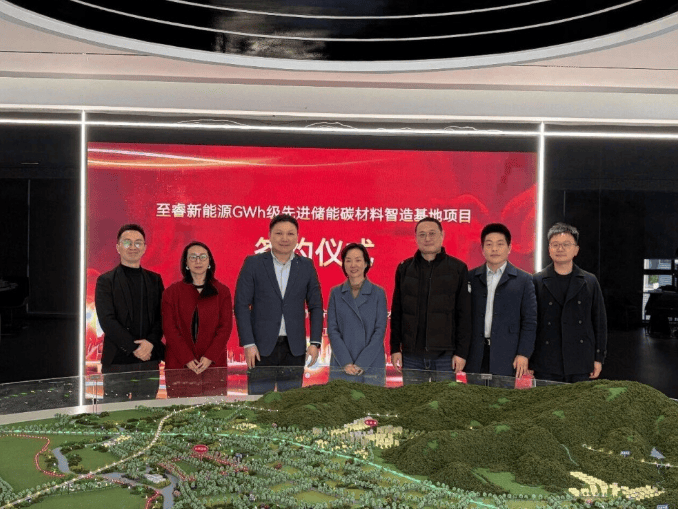
The implementation of this project, combined with the existing silicon-based anode production capacity layout in the region, enhances the industrial density of Ningbo and surrounding areas in the silicon-carbon anode direction. Currently, Ningbo is forming a material cluster centered on silicon-based anodes. Shanshan Co., Ltd., which has long been engaged in the anode material field, has planned an annual production capacity of 40,000 tons of silicon-based anodes in Ningbo, including 20,000 tons of silicon oxide and 20,000 tons of silicon carbon, and has started production in batches. The total investment of this project is about 5 billion yuan, covering an area of about 250 mu. After reaching full capacity, the annual output value is expected to be close to 10 billion yuan, reflecting that silicon-based anodes are moving from technological reserves to large-scale applications.
Echoing Ningbo's layout is that of Zhoushan. Tianmu Xian Dao, the industrialization platform for silicon-based anode materials of the Institute of Physics, Chinese Academy of Sciences, plans to build a new generation high-end silicon-carbon anode material production base in Zhoushan, with a total investment of about 4 billion yuan. The first phase investment is 1 billion yuan, corresponding to an annual production capacity target of 10,000 tons of high-end silicon-carbon anodes, leaning more towards technology orientation and high-end product positioning.
From the demand side, power batteries face dual challenges of energy density and cycle life. The current industry mainstream primarily uses silicon-carbon composite materials, achieving a balance between performance and stability by coating or embedding silicon with a carbon-based skeleton. Therefore, the industrialization of silicon-carbon anodes is a comprehensive competition involving material systems, process routes, and equipment capabilities. The projects in Ningbo and Zhoushan show that companies are diverging in their path choices.
Shanshan Co., Ltd.'s layout leans towards scale priority and gradual upgrading, simultaneously advancing both silicon oxide and silicon carbon routes to hedge against risks associated with different technological maturity levels. Silicon oxide anodes are relatively stable and already have a commercial foundation; silicon-carbon anodes represent the direction of higher energy density but require higher process and consistency standards. Tianmu Xian Dao, relying on its scientific research background, focuses on entering the high-end silicon-carbon anode field, targeting 10,000-ton level high-performance products. The challenge lies in stably transforming laboratory solutions into industrial products.
The Ningbo Zhirui New Energy project reflects the logic of material synergy close to the application end. Its positioning as a GWh-level energy storage carbon material base means its products directly serve energy storage battery systems, with clearer requirements for cost, stability, and large-scale supply, playing a role in scaling up and validating the industrial chain.
Overall, the investment boom in silicon-carbon anodes is shifting from being driven by technological expectations to being driven by orders and production capacity, with the market entering a substantial scaling-up phase. Short-term capacity construction will continue to advance, strengthening regional agglomeration effects. The mid-term industry landscape will depend on the penetration speed of products in power batteries and energy storage systems. Long-term dominance will belong to companies that achieve a stable balance between performance, cost, and scale.