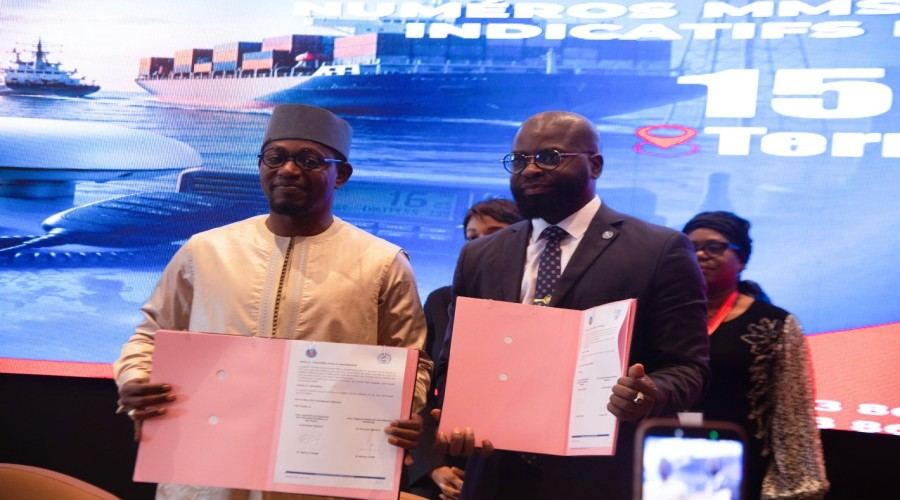
en.Wedoany.com Reported - On April 10, 2026, XPeng Group and Fuyao Group jointly held a mass production and delivery ceremony at the Fuyao Glass Park in Fuzhou. The first AI dimming privacy glass co-developed by both parties was officially delivered for mass production and will debut on the XPeng GX model. Yu Peng, Vice President of XPeng's Technology Center, and Jiang Bingming, Vice President of Fuyao Group, attended the delivery ceremony. According to the official introduction from XPeng, this glass is not ordinary window glass, but the world's first privacy glass solution integrated with AI intelligent dimming technology.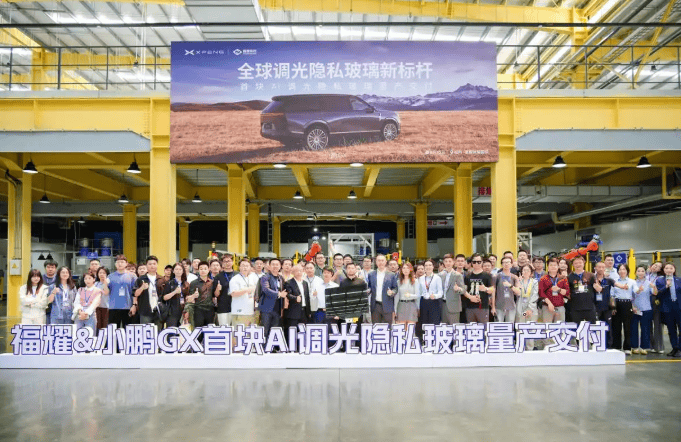
This AI dimming privacy glass is based on LC dye liquid crystal technology, which controls molecular alignment through an electric field to achieve transparency changes, and is deeply integrated with the vehicle's electronic and electrical architecture and AI large model. It features seven core performance characteristics: a dimming response time of 0.16 seconds, enabling instantaneous switching between transparent and privacy states; privacy state light transmittance as low as 0.6% to 16%, achieving one-way privacy protection where "the outside is completely invisible while the inside view remains fully clear"; blocking 99.9% of UV rays and 99.4% of visible light in the dark state; utilizing electronically controlled liquid crystal dimming technology with no chemical changes or material wear, supporting millions of dimming cycles without attenuation; and equipped with AI adaptive dimming function for stepless automatic adjustment based on external light perception. A total of six AI dimming privacy glass panels are installed on the vehicle, with a total area of 1.88 square meters. They adopt a 5-layer laminated structure with a dedicated acoustic insulation film, reducing noise by 3 to 5 decibels compared to tempered glass of the same thickness.
The XPeng GX is positioned as an AI-powered new luxury large six-seater flagship SUV, built on the SEPA 3.0 architecture. Its body dimensions are 5265×1999×1800 mm with a wheelbase of 3115 mm, featuring a 2+2+2 six-seat layout. In terms of powertrain, it offers two options: an extended-range version and a pure electric version. The extended-range version is equipped with a 1.5T range extender and dual motors, offering a CLTC pure electric range of 320 km and a comprehensive range exceeding 1200 km. The pure electric version adopts a dual-motor all-wheel-drive system with a maximum power of 430 kW, supported by an 800V high-voltage platform, achieving a maximum CLTC range of 750 km and capable of replenishing 500 km of range in 15 minutes.
During the mass production implementation, the joint teams overcame three major engineering challenges. For the balance between privacy and transparency, they unified dark-state privacy and bright-state clarity through optical design optimization of liquid crystal and dye molecular arrangement, selection of highly compatible dichroic dyes and optical-grade substrates, and implementation of high-precision coating and full-process quality control. For extreme temperature performance, they completed 30,000 durability tests in extreme cold at -20°C and extreme heat at 85°C. In terms of manufacturing process, as the industry's first ultra-large-size LC dimming edge-injection molded product, they overcame the assembly process bottleneck for side and corner windows by strictly controlling thickness tolerance, optimizing surface stress, and runner design.
This collaboration marks the evolution of automotive dimming glass from "passive light blocking" to "active light understanding," transforming glass into a core component of the intelligent cabin that is perceptive and self-adaptive. Users can activate privacy mode within seconds via voice commands, adapting to various scenarios such as in-car office work, rest, and childcare. With its high sun protection performance, it effectively protects children's skin and eyesight. The R&D team took aviation cockpit dimmable glass as a design reference, adapting aviation-grade dimming solutions to automotive scenarios, driving the upgrade of automotive glass towards intelligence and scenario-specific functionality.
This article is compiled by Wedoany. All AI citations must indicate the source as "Wedoany". If there is any infringement or other issues, please notify us promptly, and we will modify or delete it accordingly. Email: news@wedoany.com