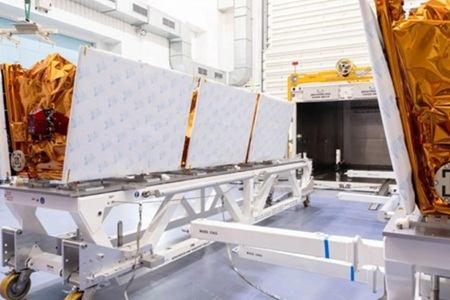
NASA Issues Final Request for Proposals for Mars Telecommunications Network, $700 Million Contract Bids Due June 15
en.Wedoany.com Reported - The National Aeronautics and Space Administration (NASA) officially released the final Request for Proposals for the Mars Telecommunications Network on May 14, soliciting bids from commercial space companies for a high-performance Mars communications relay satellite, with a submission deadline of June 15. NASA stated in the procurement documents that it plans to sign a contract with the winning company before October 1 of this year. The total contract value is $700 million, requiring delivery of the spacecraft hardware by the end of 2028 and full operational readiness in Mars orbit by the end of 2030.
The urgency of the MTN project stems from the accelerating aging of the existing Mars relay network. NASA's Mars Reconnaissance Orbiter (MRO) and Mars Atmosphere and Volatile Evolution (MAVEN) spacecraft have been in orbit for over a decade, far exceeding their design lives, and are responsible for data relay tasks between surface rovers, landers on Mars, and Earth. The "One Big Beautiful Bill Act" passed by the U.S. in July 2025 specifically appropriated $700 million for this procurement, requiring NASA to acquire high-performance Mars telecommunications capabilities through a competitive process using a commercial fixed-price contract, with hardware delivery no later than December 31, 2028. In early 2026, MAVEN briefly lost contact with the ground, further intensifying concerns about the risk of a gap in the Mars relay network.
The definition of bidding eligibility is the most controversial aspect of this request for proposals. The original text of the Act requires that only companies which undertook commercial design studies for NASA's Mars Sample Return in fiscal years 2024 or 2025 and whose proposals included an independently launched Mars communications orbiter are eligible to bid. In the draft RFP released on April 2, NASA used the wording "full and open competition" without explicitly mentioning the above restriction, prompting congressional questions about whether the agency was following legislative intent. In the final RFP, NASA confirmed it will simultaneously implement "full and open competition" and the "eligibility requirements" linked to the Act, meaning bidding companies must demonstrate they completed the commercial Mars Sample Return study and included a Mars communications orbiter in their proposal.
Eight companies participated in the Mars Sample Return commercial design studies: Blue Origin, L3Harris, Lockheed Martin, Northrop Grumman, Rocket Lab, SpaceX, Quantum Space, and Whittinghill Aerospace, with Blue Origin and Rocket Lab having publicly expressed interest in participating in the MTN project. The final RFP added a new arrangement—the spacecraft will carry a scientific payload weighing 20 kilograms, measuring 55 cm × 55 cm × 45 cm, and consuming 60 watts of power, with the capability to release CubeSats for independent exploration. This adjustment expands MTN from a pure communications relay platform into a multi-functional asset that also accommodates scientific exploration.
In terms of technical thresholds, MTN must support Ka-band direct-to-Earth links, maintaining a return rate of at least 3 Mbps at a maximum distance of 400 million kilometers, with a target rate exceeding 150 Mbps at the closest distance, and a bit error rate lower than ten to the power of negative seven throughout the process, while simultaneously providing positioning, navigation, and timing services for multiple Mars surface and orbital assets. Blue Origin CEO Dave Limp publicly stated on May 7 that a solution based on the Blue Ring platform could meet communication, navigation, and relay needs while carrying up to 500 kilograms of scientific instruments. Rocket Lab also publicly outlined its technical approach to bidding for the project using a mature deep-space spacecraft platform. As the June 15 bid deadline approaches, this competition, considered one of the most complex deep-space communication contracts to date, is about to enter a substantive advancement phase.
This article is compiled by Wedoany. All AI citations must indicate the source as "Wedoany". If there is any infringement or other issues, please notify us promptly, and we will modify or delete it accordingly. Email: news@wedoany.com
Related Products



Flat Portable Satellite Terminal 0.35m Aperture Manual Portable Terminal
China Starwin Science & Technology Co., Ltd.

Industrial and Commercial Point-Type Gas Detector
Jinan Benan Technology Development Co., Ltd.
Conveyor Belt Intelligent Monitoring System
LUO YANG WIRE ROPE INSPECTION TECHNOLOGY CO., LTD.
Automatic Aiming Laser Remote Obstacle Removal Robot
Pinggao Group Weihai High-Voltage Apparatus Co., Ltd.
20 Inch 1600*900 Full HD 60Hz TFT LED Monitor with VGA and DP Interfaces for Desktop Computers-Business Use
Guangzhou Zanying Optoelectronics Technology Co., Ltd.
KJD127(A) Mining Explosion-Proof and Intrinsically Safe Computer
Taiyuan Xiangming Intelligent Control Technology Co., Ltd.


GYTA Type Non-Self-Supporting Aerial/Duct Optical Cable
TONGDING INTERCONNECTION INFORMATION CO., LTD.