Beijing Advances AI Content Labeling Compliance and Rectification, Over 150 Enterprises Convene for Special Action Deployment
en.Wedoany.com Reported - The Cyberspace Administration of Beijing Municipality organized a special work promotion meeting on May 18 for the "Qinglang · Rectification of AI Application Chaos" campaign. The meeting reported on typical issues identified in recent compliance inspections regarding AI content labeling within the jurisdiction and simultaneously deployed the 2026 "Qinglang · Rectification of AI Application Chaos" special action. Representatives from over 150 enterprises attended, including locally registered operators of generative artificial intelligence large models and key content dissemination platforms.
The meeting reported on typical problems discovered during recent compliance inspections of AI content labeling within the jurisdiction, requiring all platform enterprises to deeply learn from these lessons, draw inferences, conduct self-checks, comprehensively investigate and rectify weak links in labeling management, and ensure that all compliance requirements are implemented thoroughly and executed effectively. The inspections reported this time were based on the "Measures for the Labeling of AI-Generated Synthetic Content," which came into effect on September 1, 2025. These measures explicitly require that all AI-generated synthetic content must include both explicit and implicit labels, and strictly limit the dissemination scenarios for unlabeled content.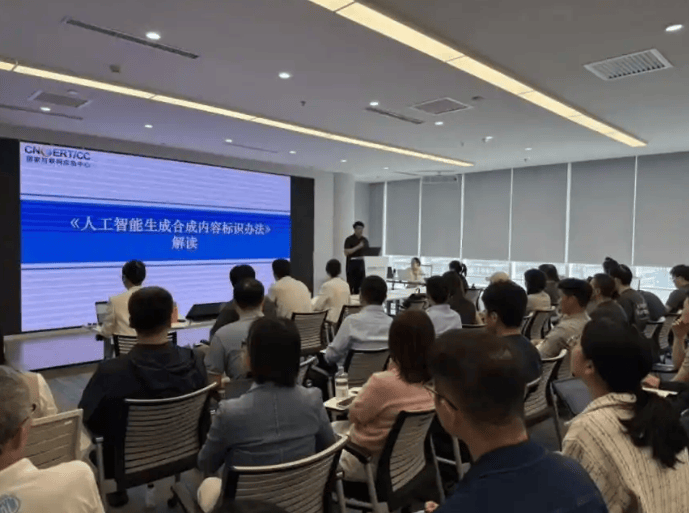
The 2026 "Qinglang · Rectification of AI Application Chaos" special action, deployed concurrently at the meeting, targets four key categories for governance: first, using AI to generate fake news, forge policy documents, and tamper with official data, disrupting economic and social order; second, producing and disseminating infringing and vulgar content such as AI face-swapping and voice mimicry, violating the legitimate rights and interests of others; third, using AI to create online rumors and false information, inciting social confrontation; fourth, using AI to generate illegal and harmful content such as obscenity, pornography, violence, and terrorism, damaging the online ecosystem. The meeting also required platforms to establish AI content security management systems, clarify technical labeling specifications, improve review processes, strengthen technical detection capabilities, and establish robust user complaint and reporting mechanisms to open up channels for public oversight.
At the specific implementation level, platform enterprises were required to carry out five core measures: comprehensively upgrade AI content labeling technical means to ensure labels are tamper-proof and traceable; establish and improve AI content review mechanisms to achieve mandatory label verification before the release of AI-generated content; improve user agreements and platform rules to clarify AI content publishing standards; strengthen employee training to enhance AI content management capabilities; and establish emergency response mechanisms for the rapid handling of non-compliant content.
Previously, after the implementation of the "Measures for the Labeling of AI-Generated Synthetic Content," regulatory authorities had already summoned and penalized multiple platforms that failed to fulfill their labeling obligations. In April this year, the Cyberspace Administration of China released the overall deployment for the 2026 "Qinglang" series of special actions, listing the "Rectification of AI Application Chaos" as one of the ten key tasks. As a city with a high concentration of the AI large model industry, Beijing took the lead in convening this local promotion meeting and launching the special action, which holds demonstrative significance nationwide.
The meeting also sent a clear signal: the regulatory governance of AI application chaos is shifting from a model of "post-event punishment" to a full-chain control model combining "pre-event prevention" and "in-process monitoring." The attendance of over 150 enterprises, covering the main generative AI large model operators and key content dissemination platforms in the Beijing area, reflects that both the breadth and depth of regulatory coverage are being strengthened.
This article is compiled by Wedoany. All AI citations must indicate the source as "Wedoany". If there is any infringement or other issues, please notify us promptly, and we will modify or delete it accordingly. Email: news@wedoany.com
Related Products



Comprehensive Mining Automation Control System
Beijing Tianma Intelligent Control Technology Co., Ltd.

Flat Portable Satellite Terminal 0.35m Aperture Manual Portable Terminal
China Starwin Science & Technology Co., Ltd.
GYTA Type Non-Self-Supporting Aerial/Duct Optical Cable
TONGDING INTERCONNECTION INFORMATION CO., LTD.
Hot Selling 10 Inch Intel N5100 I5 I7 FHD 8 +128GB 16+256GB Win10 Pro Win11 Pro 4G 5G Rugged Tablet PC Pad with NFC Barcode
Highton Electronics Co., Ltd.

Conveyor Belt Intelligent Monitoring System
LUO YANG WIRE ROPE INSPECTION TECHNOLOGY CO., LTD.


MUX Series Communication Interface Device for Security and Stability Control System
Nanjing NR Electric Co., Ltd.