en.Wedoany.com Reported - On June 3, local time, Tang Yandi, Economic and Commercial Counselor of the Chinese Embassy in Sri Lanka, led a delegation to inspect the Kirula-Narahapita Sewage Pumping Station and Pipeline Network Project and the Ambatale Water Treatment Plant Efficiency Improvement Project, both undertaken by PowerChina. The inspection was accompanied by representatives from PowerChina's Sri Lanka office and relevant project personnel. Both projects are part of the Colombo water infrastructure construction and efficiency improvement chain.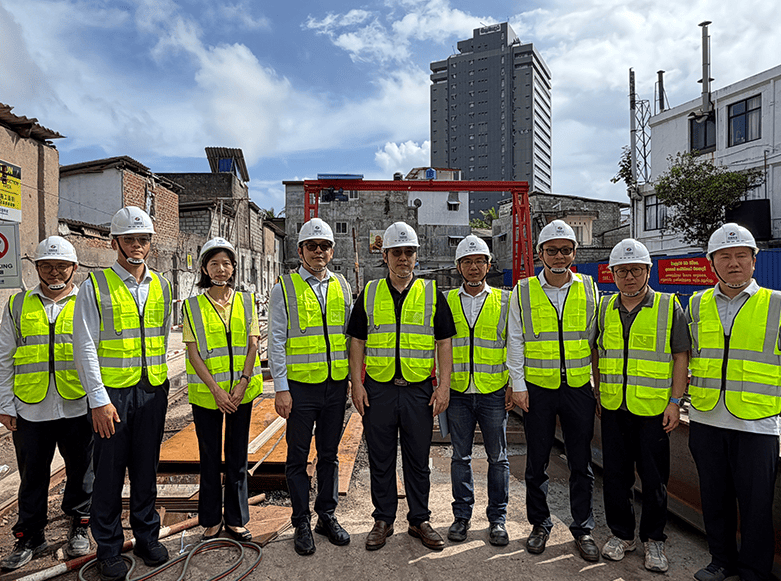
This inspection covered two different types of projects—sewage collection and transportation, and urban water supply efficiency improvement—reflecting that PowerChina's performance focus in Sri Lanka's water infrastructure sector has shifted from single-point project construction to improving urban public service capacity. The Kirula-Narahapita Sewage Pumping Station and Pipeline Network Project primarily involves sewage collection, transportation, pumping station operation, and pipeline network improvement. The quality of project progress directly affects the efficiency of sewage treatment, drainage organization, and urban environmental management in the surrounding areas. During the on-site inspection, the team focused on understanding project progress, construction organization, safety and quality management, and risk prevention and control. This indicates that the project currently involves not only construction milestones but also organizational coordination in complex urban environments, underground pipeline construction, community impact control, schedule management, and safety management. Sewage pumping station and pipeline network projects are typically characterized by high concealment, multiple construction interfaces, and significant impacts on surrounding traffic and residents' lives. Project management must balance engineering progress, quality control, safety production, and community communication. For PowerChina, the performance capability of overseas water projects is reflected not only in civil engineering and installation but also in local legal compliance, community relations, supply chain organization, on-site safety, and operational adaptability after project handover. The inspection team's attention to the challenges and issues encountered during project progress also underscores the requirements of such livelihood projects for timely delivery and long-term stable operation.
The Ambatale Water Treatment Plant Efficiency Improvement Project focuses more on upgrading existing water supply facilities.
The inspection team visited various production stages of the water treatment plant and learned about the project's process flow, core technical parameters, and its role in improving local water supply and water quality. Compared to new water treatment plants, efficiency improvement projects often test the contractor's ability to organize construction under conditions of minimal or no production shutdown, and rely more on accurate assessments of existing facilities, original processes, pipeline network loads, and water quality targets. The value of water treatment plant efficiency improvement lies not only in increasing capacity or replacing equipment but also in optimizing treatment processes, enhancing effluent stability, reducing operational energy consumption, strengthening system resilience to fluctuations, and extending the service life of existing assets. Some urban water supply facilities in Sri Lanka have long faced issues of aging, insufficient efficiency, and pressure on water quality assurance. Efficiency improvement of water treatment plants can enhance the service capacity of existing systems without complete demolition and reconstruction, directly benefiting residents' lives and supporting urban development. PowerChina's role in this project includes not only engineering construction and equipment system integration but also comprehensive control over water treatment processes, on-site construction organization, commissioning and operation, and post-delivery standards. The recognition of the project's livelihood benefits during the inspection indicates that local water supply, water quality improvement, and infrastructure resilience have become important dimensions for evaluating Chinese enterprises' overseas water projects. As overseas infrastructure cooperation enters a more refined stage, whether projects can withstand scrutiny in terms of quality, safety, compliance, and livelihood outcomes will directly affect Chinese enterprises' ability to sustain operations in local markets.
Such water projects are also among the types of engineering that are more easily perceived by local residents in the practical cooperation between China and Sri Lanka. While large-scale projects such as roads, ports, and energy often demonstrate national-level infrastructure capabilities, sewage pumping stations, drainage networks, and water treatment plant upgrades directly enter the daily operation of cities, affecting residents' water use, drainage safety, environmental hygiene, and public health. Project leaders stated that they will further strengthen project management, coordinate engineering construction, safety production, and compliant operations, and ensure high-quality and timely project completion. For PowerChina, the key to the Colombo water projects moving forward lies in translating on-site inspection feedback into optimized construction plans, closed-loop risk management, and improved delivery quality. For the local city, the completion of these projects will further enhance sewage collection, treatment, and water supply assurance capabilities, providing support for the upgrading of urban infrastructure.
The competition for Chinese enterprises in the overseas water market is shifting from "whether they can build" to "whether they can deliver high-quality performance, compliant handover, and stable operation." The simultaneous inspection of the Kirula-Narahapita Sewage Pumping Station and Pipeline Network Project and the Ambatale Water Treatment Plant Efficiency Improvement Project indicates that there is still sustained demand for urban water environment management and water supply facility upgrades in Sri Lanka. As the projects progress, industrial chain segments such as water treatment equipment, pumping station systems, pipeline network construction, automation control, energy-saving renovation, operation and maintenance, and environmental management services may continue to create cooperation opportunities centered on local livelihood infrastructure construction.
This article is compiled by Wedoany. All AI citations must indicate the source as "Wedoany". If there is any infringement or other issues, please notify us promptly, and we will modify or delete it accordingly. Email: news@wedoany.com