en.Wedoany.com Reported - The Chippewas of Nawash Unceded First Nation in Ontario, Canada, invested approximately CAD 61.7 million in a new water treatment plant and water supply infrastructure, which became operational in October 2024, aiming to end the community's long-standing boil water advisory. Located in Neyaashiinigmiing on the southern shore of Georgian Bay, the project serves over 800 residents.
The old water plant, built in 1990, was equipped with coagulation and flocculation systems, a booster station, a wet well, pressure filters, and a 454-cubic-meter water storage tower. However, the facility had severely aged, often operating at maximum capacity, resulting in extremely low water pressure and insufficient flow from most fire hydrants. The 27-kilometer distribution network lost 60% to 70% of its water supply due to leaks, with some pipes even made of substandard materials. Additionally, issues such as zebra mussel blockage at the intake, outdated filtration equipment, lack of chlorination disinfection, and absence of backup power prompted the tribal council to decide on a complete overhaul.
The boil water advisory implemented in 2019 became the direct catalyst for the upgrade. Water treatment plant supervisor Devon Williams stated that the advisory did not reflect a sudden crisis but acknowledged that Ontario's water treatment standards were continuously strengthening, while the old system was built about a decade before the Walkerton water contamination incident drew attention. Although First Nations typically follow federal water treatment guidelines rather than provincial regulations, Nawash chose to comply with Ontario's Drinking Water Regulations 169/03 and 170/03, as they provide stricter standards for water safety.
Project planning began in January 2020, with the Nawash Public Works Department collaborating with the Ontario First Nations Technical Services Corporation (OFNTFC) to complete a feasibility study. Associated Engineering was responsible for the detailed design of the new treatment plant, underground reservoir, 300-meter intake into Georgian Bay, upgrades to existing water mains, a 14.5-kilometer water main extension, and supporting electrical, internet, and telephone lines. Indigenous Services Canada (ISC) committed CAD 61 million in capital funding, with the tribe budgeting an additional CAD 700,000.
In April 2020, the pandemic forced the project team to shift to online video conferencing and 3D collaboration software for design. The construction site was selected on tribal-owned land 5 kilometers downstream from the old plant to allow independent operation of both facilities. In spring 2022, the construction crew cleared the site and began drilling a tunnel from the hilltop down to the low-lift pump and new intake to lay high-density polyethylene pipes.
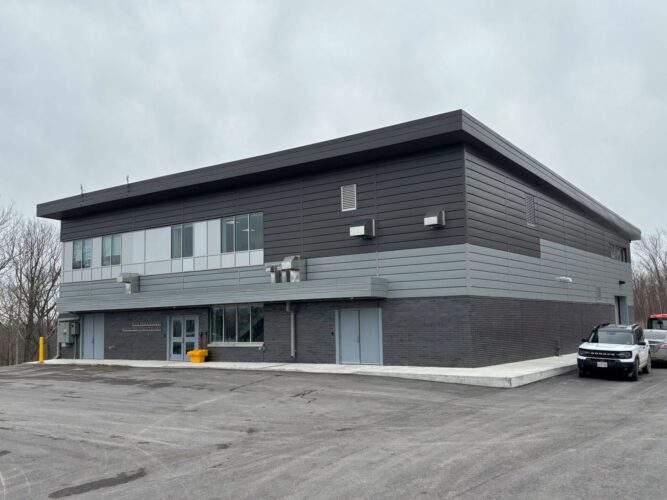
To prevent zebra mussel blockage, the crew installed a pre-chlorination system that injects trace amounts of sodium hypochlorite when elevated concentrations of the invasive species are detected in summer. A new ultraviolet system replaced the faulty old one, which had six lamps about four feet long, while the new system has only two lamps about one foot long, offering higher efficiency and a smaller footprint. The new low-lift pump changed the flocculation, sedimentation, and filtration processes from pressure-based to optimized methods, producing water with extremely low turbidity. Storage capacity doubled, with the new water tower holding approximately 454,000 liters and a reservoir beneath the plant storing an additional 600,000 liters. Williams noted that the old plant lacked contact time, while the new plant meets ten times the requirement.
The core water plant uses a conventional treatment system, including upflow clarifiers, mixed-media filters (containing anthracite and sand), and carbon filters, along with a Supervisory Control and Data Acquisition (SCADA) system. Williams stated that the SCADA enables system coordination, though it encountered about 1% minor issues during integration. For the distribution system, the crew repaired identified leaks, which were losing up to 650,000 liters of water daily from the system's 27-kilometer distribution pipes, accounting for about 60% to 70% of total supply. The contractor upgraded substandard sections to standard, added 14.5 kilometers of water mains, reconnected 300 service connections, installed two valve chambers, isolation chambers, and approximately 100 new fire hydrants. The transition between the old and new plants was smooth, with valves enabling independent operation.
After the plant became operational, the plan was to lift the boil water advisory following system testing. However, five months later, numerous new leaks emerged across the system, with water loss returning to pre-construction levels. Williams stated that the team roughly knows the leak locations but has not precisely pinpointed all of them, and the complex terrain also complicates detection. The project team is hiring a third-party leak detection expert, and the possibility of replacing entire pipe sections or the entire distribution network cannot be ruled out. However, Williams emphasized that the clean water produced by the new plant is sufficient to meet current demand.
This article is compiled by Wedoany. All AI citations must indicate the source as "Wedoany". If there is any infringement or other issues, please notify us promptly, and we will modify or delete it accordingly. Email: news@wedoany.com