en.Wedoany.com Reported - A recently published patent application by Apple reveals that the company has invented an electrochemical process capable of recovering high-purity aluminum from scrap aluminum alloys at temperatures as low as 125°C, with feedstock including metal shavings from CNC machining.
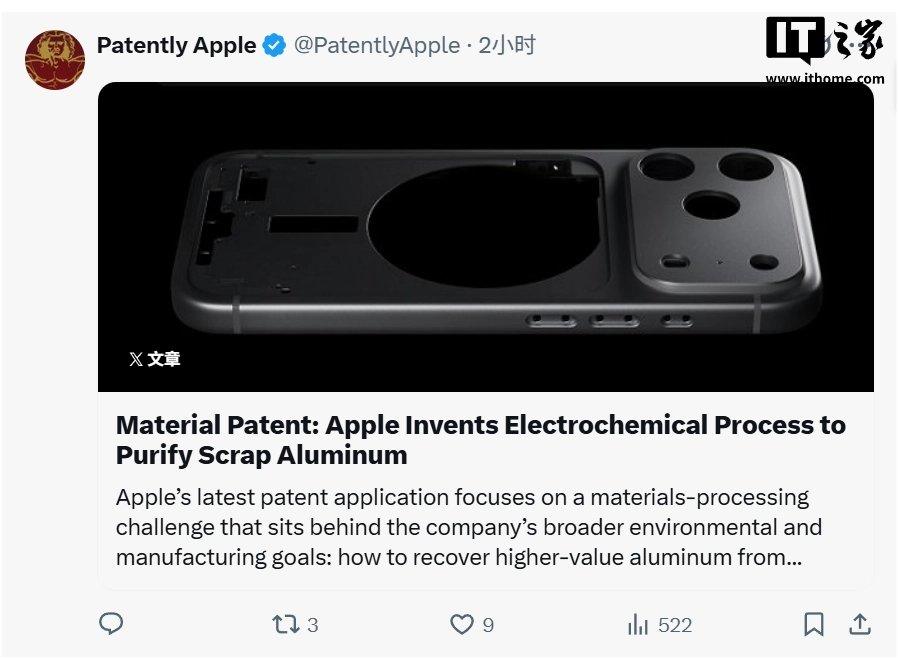
The technology combines a molten electrolyte salt based on aluminum chloride (AlCl₃) with electrorefining to separate and purify aluminum from scrap aluminum alloys. Compared to traditional aluminum purification processes, this approach significantly reduces operating temperatures, enabling operation below 200°C, 150°C, or even 125°C, with some implementations capable of further temperature reductions.
Apple notes that existing aluminum recycling processes often face challenges such as high energy consumption and substantial equipment investment. While the traditional Hoopes process can yield high-purity aluminum, its overall cost is high, and methods like fractional solidification struggle to effectively remove elements commonly found in aluminum alloys, such as manganese and chromium. As a result, scrap aluminum alloys from different sources are often reprocessed into lower-value general-purpose alloys.
In Apple's proposed solution, the core method involves using scrap aluminum alloy as the anode and pure aluminum as the cathode, both placed in an electrochemical cell containing a molten electrolyte salt based on aluminum chloride. When current is applied, aluminum in the scrap is oxidized into aluminum ions that enter the molten salt, then reduced and deposited as pure aluminum at the cathode, while impurities such as copper, iron, silicon, manganese, and chromium remain predominantly on the anode side. Since this approach no longer relies on density differences in molten aluminum layers for separation, scrap aluminum feedstock can take various forms, including aluminum foil, plates, ingots, and compressed CNC machining chips.
The solution offers high operational flexibility. The electrolysis process does not need to run continuously to completion; it can be paused or restarted based on energy supply conditions. The reaction halts when voltage is removed and resumes when power is restored, allowing factories to adjust production schedules according to electricity price fluctuations or renewable energy availability.
In terms of electrolyte design, Apple uses aluminum chloride as the base material and may add additives such as sodium chloride, potassium chloride, or magnesium chloride to further lower the melting point of the molten salt mixture while reducing dendrite formation on electrode surfaces. The patent also describes designs suitable for industrial scaling, where the system can employ multiple scrap aluminum anodes and multiple pure aluminum cathodes arranged alternately to increase processing capacity. As anode material is gradually consumed and pure aluminum continuously deposits on the cathode, electrodes can be replaced while maintaining system sealing. Due to the high vapor pressure of aluminum chloride, Apple proposes operating the entire electrolysis system in a sealed environment to minimize electrolyte evaporation losses, with some implementations even capable of operating below standard atmospheric pressure.
Unlike traditional, energy-intensive fractional crystallization methods, Apple's process can more effectively remove elements commonly found in aluminum alloys, such as copper, zinc, magnesium, silicon, iron, titanium, chromium, lithium, zirconium, and manganese—elements that are the main obstacles to recycling scrap aluminum in high-end electronic products. Apple points out that different aluminum alloys incorporate various elements to meet requirements for strength, corrosion resistance, and appearance. Once these alloys become mixed during manufacturing or at end-of-life, it becomes economically challenging to separate them back into high-value alloy categories, often resulting in downgrading to the low-end die-casting market.
For Apple, the significance of this technology lies in the fact that its own manufacturing ecosystem generates large quantities of high-quality machining chips. If such scrap can be purified into recycled aluminum meeting strict standards, the efficiency of its closed-loop material recycling will be significantly enhanced. Apple believes that achieving high-purity purification of scrap aluminum alloys with lower energy consumption will help expand the supply of high-quality recycled aluminum, increase the reuse value of manufacturing waste and end-of-life materials, and reduce dependence on primary aluminum.
This article is compiled by Wedoany. All AI citations must indicate the source as "Wedoany". If there is any infringement or other issues, please notify us promptly, and we will modify or delete it accordingly. Email: news@wedoany.com