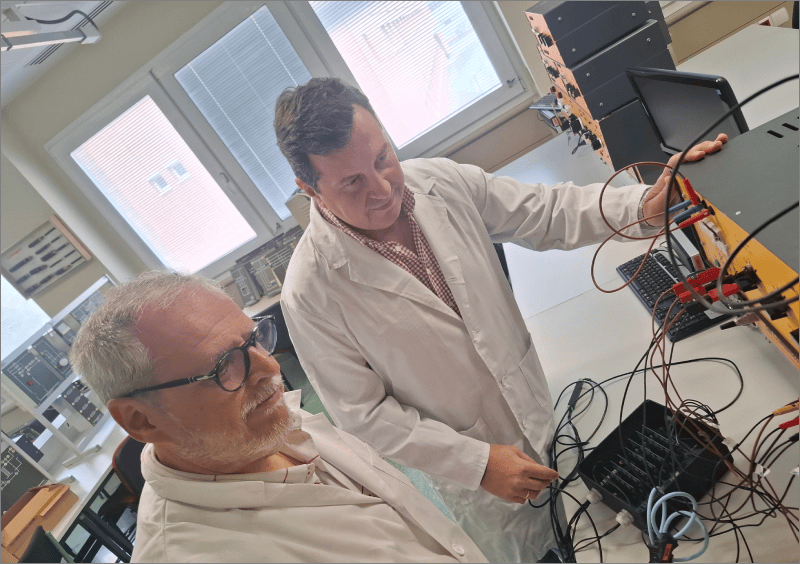
en.Wedoany.com Reported - Researchers at the University of Jaén (Universidad de Jaén, UJA), under a project funded by the Andalusian Regional Ministry of University, Research and Innovation (Consejería de Universidad, Investigación e Innovación de la Junta de Andalucía), have developed a low-cost device for real-time detection of faults and anomalies in power grids. The system combines electronic equipment installed in distribution boxes with open-source computer programs, enabling monitoring of residential and industrial facilities and automatically sending data to the cloud.
This solution is aimed at industrial enterprises, electrical facility managers, and energy companies that require continuous access to power quality information. Compared to commercial devices that are more expensive and have delayed data access, this development from the University of Jaén can record anomalies instantly as they occur, and even operate in environments without Wi-Fi coverage.
The main technical contribution of the device lies in combining real-time measurements with Internet of Things (IoT) connectivity. Data transmission uses LoRaWAN technology, a low-power, long-range wireless technology that can continuously send data without relying on nearby Wi-Fi networks, facilitating deployment in industrial environments or areas with limited connectivity. The device is manufactured using standard electronic components, reducing production costs, and LoRaWAN technology offers lower energy consumption during data transmission and higher security against unauthorized access. The system is also designed for smart grid management, aiding the integration of renewable energy sources into the grid, as these sources typically introduce more distortion into electrical signals.
This research addresses a growing issue in modern power systems: devices such as electric vehicle chargers, LED lighting, and electronic equipment introduce signal distortions that, if not detected early, can lead to faults, overheating, or energy losses. The system's working principle is published in the article "Design and implementation of a low-cost, open-source power quality analyser for smart grids" in the journal Internet of Things. The device analyzes power quality in residential or industrial facilities, detecting both the main signal and minor distortions (i.e., harmonics) that affect stability. To this end, the researchers designed a compact device integrating voltage and current measurement modules, capturing thousands of samples per second, and applying mathematical techniques to extract additional frequencies that contaminate the electrical signal, identifying possible distortions through software processing. Information is automatically sent to an internet server and can be queried in real time via computer or mobile device. University of Jaén researcher Francisco Sánchez Sutil emphasized that power grids require immediate information to optimize operation and prevent accidents.
The research team validated the device in a real facility at the University of Jaén with 36 electric vehicle charging points. During a one-month test, scientists analyzed grid behavior and confirmed that the system could detect changes in voltage, current, and harmonics with high precision. The tests also revealed that electric vehicle chargers themselves can cause grid imbalances and signal distortions, demonstrating the need for monitoring tools capable of assessing their impact in real time. In the next phase, the team is working to expand the system's capabilities to detect higher-frequency harmonics (known as supraharmonics) associated with new electronic devices, aiming to improve measurement quality and anticipate emerging issues in power grids. This research was funded by the Andalusian Regional Ministry of University, Research and Innovation through the project "Intelligent Hybrid Transformers for the Provision of Grid Services" (Transformadores híbridos inteligentes para la provisión de servicios de red).
This article is compiled by Wedoany. All AI citations must indicate the source as "Wedoany". If there is any infringement or other issues, please notify us promptly, and we will modify or delete it accordingly. Email: news@wedoany.com