en.Wedoany.com Reported - Researchers at the Korea Institute of Energy Research (KIER) have developed a shingled photovoltaic module that can be integrated with a thermoelectric generator (TEG), aiming for efficient PV-TEG waste heat energy recovery. The module architecture utilizes a unique series strip design to increase operating voltage while reducing output current, thereby minimizing current-related resistive losses and Joule heating in the TEG, enhancing fill factor stability, and ultimately improving the power extraction efficiency of the hybrid system.
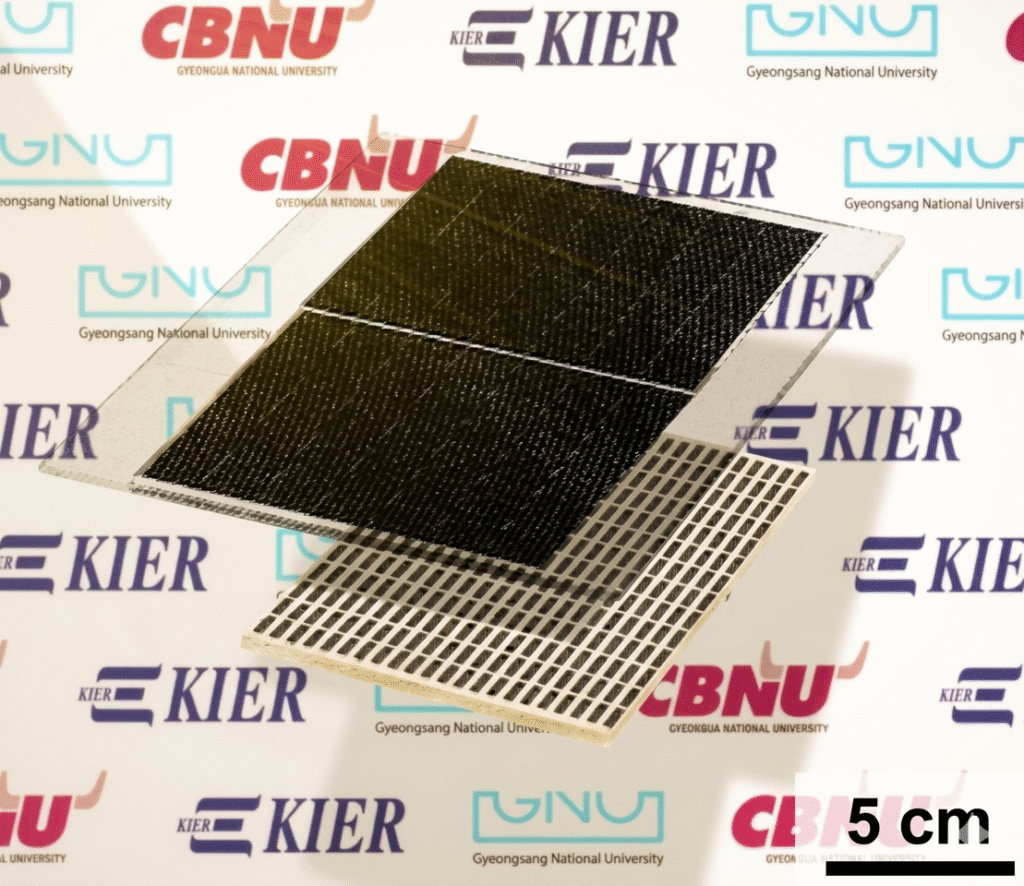
TEGs convert thermal energy into electrical energy by leveraging the Seebeck effect, where a temperature difference between two different semiconductors generates a voltage difference. These devices are commonly used in industrial settings to convert waste heat into electricity, but their high cost and limited performance restrict broader applications. Shingled cell technology replaces traditional ribbon interconnections by directly connecting solar cell strips in series, which not only increases the effective area for light absorption but also reduces thermal and mechanical stress within the module, offering advantages in efficiency and long-term reliability over standard interconnection methods.
In the module manufacturing process, the KIER team used PERC solar cells supplied by Shinsung Engineering as the starting material. The cells were first scribed with a 1064 nm infrared laser into narrow strips and then mechanically cleaved. Shingled modules consisting of three, five, or seven cell strips were fabricated with an effective area of 100 cm²; while the fourteen-strip configuration increased the module area to 170 cm². The cell strip dimensions varied with configuration: 100×38.83 mm for three strips, 100×21.70 mm for five strips, 100×16.07 mm for seven strips, and 85×16.07 mm for fourteen strips. Adjacent cell strips were assembled in series using CA 3556HF conductive adhesive, followed by hot pressing at 180°C for 1 minute to ensure a strong bond. Welding of photovoltaic ribbons at both ends of the module provided external electrical contacts, and the module was finally encapsulated with a front glass layer, ethylene-vinyl acetate (EVA) encapsulant, and a polyethylene terephthalate (PET) backsheet.
The commercial thermoelectric (TE) elements used for testing were supplied by Xinrong, a Chinese company. Researchers fabricated a 100 cm² TEG array using 308 substrate-free elements, with polymer filling between them to ensure mechanical stability and heat transfer. The array was completed by screen-printing solder on a polyimide substrate, reflow soldering, and removing the substrate to expose the electrodes. The hybrid PV-TEG system was tested in two configurations: a two-terminal (2T) setup where the PV and TEG were directly connected in series with only one external contact pair, and a four-terminal (4T) setup where both operated independently, used for analyzing and comparing series resistance losses.
A custom experimental platform applied a controlled temperature gradient using a top transparent copper mesh heater and a bottom cooler, while transmitting standard solar radiation, enabling precise I-V characterization of the PV, TEG, and combined devices. Hall effect and time-varying resistance measurements were used to evaluate the transport and stability behavior of the TE elements. The PV module was modeled using a double-diode formula combined with thermoelectric generator equations, solved via a Lambert W function-based transformation. By fitting the model to experimental data, researchers extracted key parameters such as effective TEG resistance and quantified power losses in 2T operation.
Measurement results showed that minimizing PV current and increasing voltage significantly reduced the impact of TEG resistance on performance, with the shingled PV module excelling in this regard. Thermal analysis indicated that PV-driven current induced Peltier cooling or heating and Joule heating in the TEG, increasing its effective resistance over time. Meanwhile, the linear correlation between current and temperature gradient confirmed the coupling of electrical transport and thermoelectric heat exchange. A validated numerical model predicted that a low-current, high-voltage design could reduce power losses to near zero. This prediction was experimentally confirmed in a large-area 170 cm² device, achieving ultra-low losses and high power output under controlled conditions.
The researchers concluded that using a 14-strip shingled module to split the current and increase voltage across multiple cell strips resulted in a load-robust shingled PV module. The scale and performance of this PV-TEG system represent a significant advancement over the largest (68 cm²) and best-performing (1.15 W) devices reported in the literature to date. The researchers noted that, unlike tandem solar cells requiring complex monolithic integration and fine spectral splitting, their PV-TEG involves only direct connection of commercially available PV and TEG components without any front-end process manufacturing. The research paper, "Load-resilient shingled photovoltaic module for field-scale thermoelectric coupling," was published in Scientific Reports.
This article is compiled by Wedoany. All AI citations must indicate the source as "Wedoany". If there is any infringement or other issues, please notify us promptly, and we will modify or delete it accordingly. Email: news@wedoany.com