SOOP's Q1 R&D spending hits record high of 6.6 billion won
en.Wedoany.com Reported - SOOP has launched AI subtitles, an upgraded version of its AI management assistant SARSA 2.0, and a personalized assistant SOOPi, transforming generative AI technology into practical services. This achievement stems from the unified R&D operations driven by the AI Lab (AI랩), a dedicated organization established by SOOP last year, and a record quarterly R&D investment of 6.6 billion won (consolidated basis).
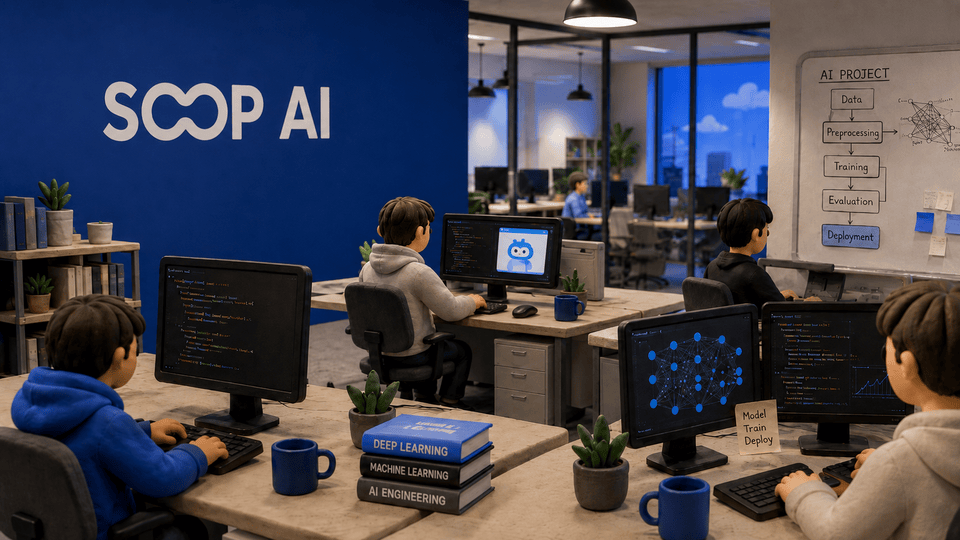
SOOP has launched several AI-related technologies this year. The AI subtitle feature enhances the live streaming viewing experience. The AI management assistant service SARSA for streamers has been upgraded to version 2.0, adding a live stream takeover feature where an AI avatar continues the broadcast on behalf of the streamer. The user-centric AI assistant SOOPi is evolving from a simple Q&A tool into a personalized AI assistant capable of learning user preferences and work styles to provide assistance.
To achieve the SOOPi upgrade, SOOP has integrated various technologies including live and VOD content understanding, summarization, recommendation, and conversational interfaces. Technologies for understanding and summarizing live content improve viewing convenience, while recommendations and conversational interfaces are linked to users' personalized content discovery experiences. For streamers, SOOPi can also be used to enhance live streaming operational efficiency.
A SOOP official stated that the newly added technologies are not intended to treat generative AI as an independent technology, but rather to integrate it with service upgrades that streamers and users can actually perceive. SOOP is concretizing various technologies towards improving content production, viewing experience, and operational efficiency within the live streaming ecosystem.
SOOP's first-quarter financial report shows a significant expansion of AI-based generative technologies among its R&D outcomes. The number of AI-based generative technologies, which was just one in the first quarter of 2025, increased to six in the first quarter of 2026. SOOP first included this technology in its report starting from the first quarter of last year.
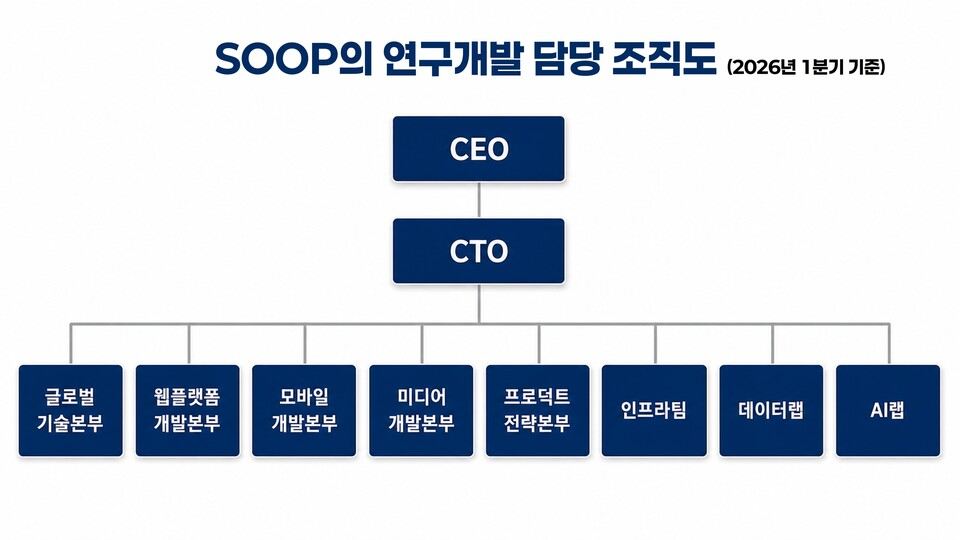
The core of the transformation lies in the AI Lab (AI랩), established last June. To promote AI project development and modularization, SOOP formed the AI Lab (AI랩) under the leadership of the Chief Technology Officer (CTO). Previously, technologies were reviewed and developed on a per-project basis; after the establishment of the AI Lab (AI랩), the focus shifted to building a structure capable of accumulating and reusing general-purpose AI technologies.
A SOOP official explained that the biggest change after the establishment of the AI Lab (AI랩) is that AI R&D, previously dispersed across various projects, can now be managed uniformly within a single organizational system. By building a structure to accumulate and reuse general-purpose AI technologies, SOOP has improved R&D efficiency and can stably manage the AI capabilities required for its services at the organizational level.
AI research is often a mid-to-long-term undertaking, making it difficult to see short-term results. Through the AI Lab (AI랩), SOOP systematically manages the entire process from technology validation to service application. The company believes this has laid the foundation for clearly managing AI researchers and technology assets, and for more quickly advancing AI project reviews and service implementation.
AI-centric investment continues to increase. SOOP's R&D expenses for the first quarter of this year were 6.6 billion won, setting a new quarterly record. R&D spending as a percentage of revenue reached 6.23%, the second-highest level since 6.89% in 2023.

SOOP's R&D expenses for the first quarter of each year are as follows: 3.7 billion won in 2021 (6.07% of revenue), 4.6 billion won in 2022 (6.16%), 5.0 billion won in 2023 (6.89%), 5.8 billion won in 2024 (6.15%), 5.1 billion won in 2025 (4.76%), and 6.6 billion won in 2026 (6.23%). Compared to the first quarter of last year, R&D expenses increased by 1.5 billion won, expanding the capacity for investment in AI technology application and platform upgrades.
A SOOP official stated that the increase in AI-based generative technologies in the first quarter of this year is because large-scale technologies developed since last year have shown potential for practical service application, leading to concretization in multiple directions. The initial focus was on verifying the potential of generative AI technology, while this year the focus is on connecting it with SOOP's services and business.
The SOOP official noted that, centered around the AI Lab (AI랩), SOOP simultaneously manages the technology validation and service application processes, improving R&D efficiency, and will gradually expand AI features that streamers and users can actually experience.
This article is compiled by Wedoany. All AI citations must indicate the source as "Wedoany". If there is any infringement or other issues, please notify us promptly, and we will modify or delete it accordingly. Email: news@wedoany.com
Related Products

Flat Portable Satellite Terminal 0.35m Aperture Manual Portable Terminal
China Starwin Science & Technology Co., Ltd.
KJD127(A) Mining Explosion-Proof and Intrinsically Safe Computer
Taiyuan Xiangming Intelligent Control Technology Co., Ltd.
20 Inch 1600*900 Full HD 60Hz TFT LED Monitor with VGA and DP Interfaces for Desktop Computers-Business Use
Guangzhou Zanying Optoelectronics Technology Co., Ltd.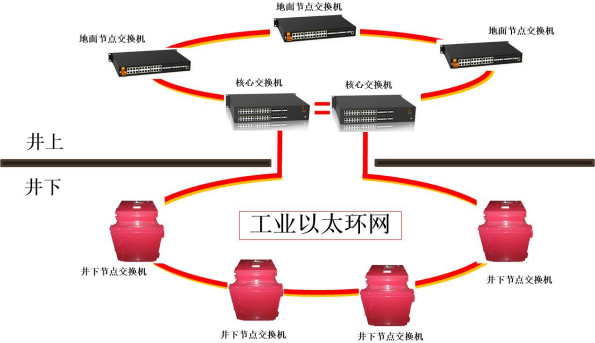
Mine Explosion-proof and Intrinsically Safe Industrial Ethernet Ring Network (10 Gigabit/Gigabit)
Chongqing Mas Sci&Tech Co., Ltd.
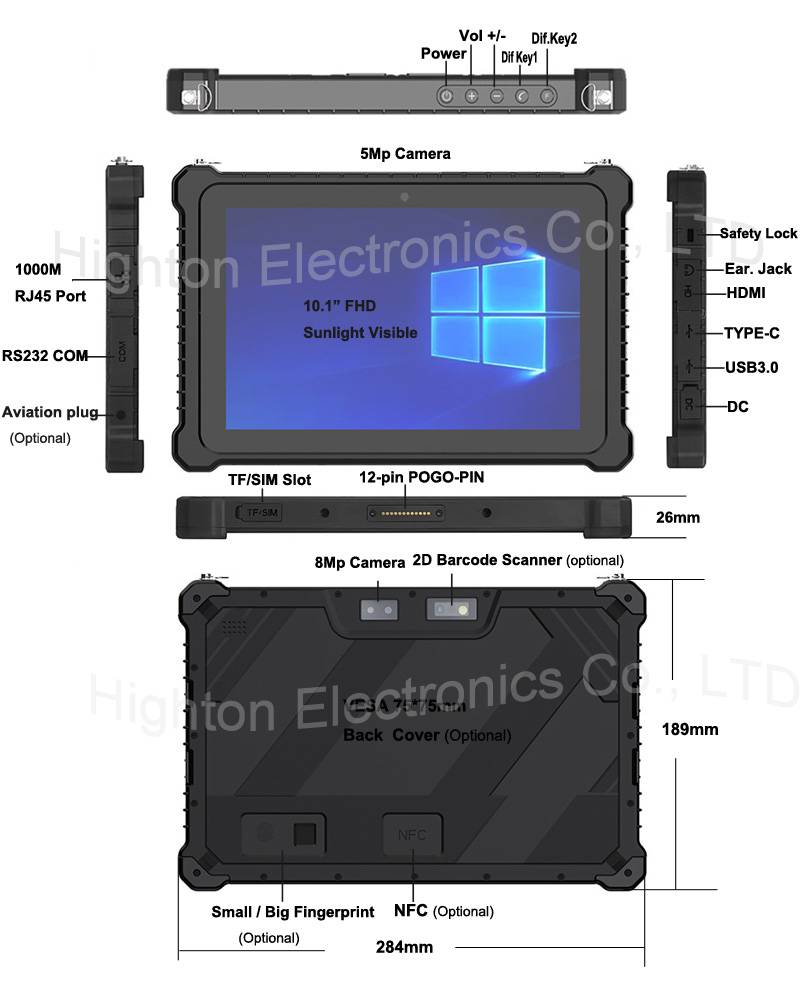
Hot Selling 10 Inch Intel N5100 I5 I7 FHD 8 +128GB 16+256GB Win10 Pro Win11 Pro 4G 5G Rugged Tablet PC Pad with NFC Barcode
Highton Electronics Co., Ltd.

Industrial and Commercial Point-Type Gas Detector
Jinan Benan Technology Development Co., Ltd.