en.Wedoany.com Reported - Huawei's theme at this year's exhibition is "Co-building the Industrial Intelligent Entity, Enabling New Industrialization," and it introduced its strategic positioning and practices in this direction on-site. Huawei is not only a supplier of ICT infrastructure and intelligent terminals, but also a provider of industrial internet solutions. At the same time, it owns factories and produces products through the entire process of R&D, design, production, and manufacturing, making it a user and active practitioner of the industrial internet.
Several years ago, Huawei proposed the concept of the Industrial Intelligent Entity and introduced a reference architecture, likening it to the human body: industrial equipment as the limbs, industrial networks as the nervous system, industrial data as the blood flowing throughout the body, industrial platforms and AI as the brain, and converged edge computing and computing power as the heart. These components work together to support the full-process optimization of a company's product lifecycle flow, production and manufacturing flow, and value creation flow. Huawei also outlined the "New Six Modernizations" trend in industrial development, namely the digitalization of industrial equipment, full connectivity of industrial networks, cloudification of industrial software, valorization of industrial data, openness of industrial control systems, and universalization of industrial intelligence.
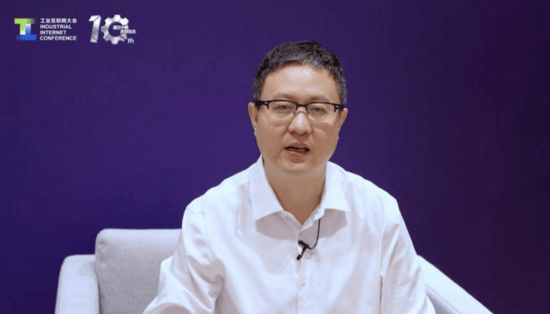
In his presentation, Guo Xiaolong emphasized the importance of openness and decoupling at the current stage, pointing out that making the industry no longer a coupled and closed system is key to solving "bottleneck" issues. Huawei also stressed full-stack intelligence, hoping that more intelligent equipment, intelligent edges, and intelligent networks will assist in the universal development of the industrial internet. In this process, Huawei can provide core capabilities such as chips, operating systems, networks, computing power, and platforms, and collaborate with partners to build the Industrial Intelligent Entity.
When discussing the impact of artificial intelligence on industry, Guo Xiaolong stated that AI will significantly affect various sectors. He agreed with Siemens CEO Roland Busch's analogy comparing AI to the "electric power revolution," believing that AI is currently only in the stage of point-based applications and has not yet fully transformed processes and factories. However, future factories are likely to be driven by AI. The impact of AI on industry will be a gradual process of "point, line, surface, and body": points refer to single-point optimization, lines refer to intelligent optimization of processes, surfaces refer to intelligent optimization of factory systems, and bodies refer to the impact on the ecosystem.
Currently, AI has evolved to the stages of Agentic AI and Physical AI, significantly impacting traditional fields. For example, the software industry may be disassembled by AI, moving towards fragmentation, functionalization, and servitization under AI-driven development. In the future, new business models such as Model as a Service and Agent as a Service will emerge in industries like manufacturing, forming new divisions of knowledge.
In the era of artificial intelligence, industry knowledge will be further deconstructed from data, ultimately settling into new knowledge carriers such as models, agents, workflows, and skills. Industrial knowledge will become modular, functional, and skill-based, giving rise to entirely new business models like Data as a Service, Model as a Service, Agent as a Service, and Result as a Service. This transformation will spawn a large number of new service providers and individual service professionals, focusing on producing knowledge at a finer granularity and serving the entire industry.
Guo Xiaolong's judgment on the future trend of industrial intelligence is "the universalization of industrial intelligence." He believes that the development of AI in various industries follows a sequential order, first being applied in large industries, large enterprises, and large scenarios with high digitalization levels and good commercial returns, such as the internet, finance, and semiconductor industries, as well as high-value scenarios like code generation, product quality inspection, and knowledge management. As AI capabilities improve and costs decrease, it will gradually spill over and become universally available to more industries, enterprises, and scenarios.
Guo Xiaolong pointed out that digitalization, especially data standardization, is the foundation of intelligence. If an industry or enterprise has a low level of digitalization and lacks high-quality data, it is too early to promote intelligence. Huawei believes that industrial intelligence is a process of universalization that needs to develop gradually from points to lines, surfaces, and bodies, starting with digitalization before intelligence, beginning with large industries, large enterprises, and large scenarios with high digitalization levels and good commercial returns, and ultimately becoming universally available to more industries, enterprises, and scenarios.
At the end of last year, Huawei, together with the China Academy of Information and Communications Technology, the Institute for Artificial Intelligence of Tsinghua University, and Roland Berger Management Consulting, jointly compiled the "Guide for the Integration of Industry and AI Applications." This guide provides a macro-level analysis of the current status and future of AI-industry integration, specifically outlines AI application scenarios in seven major industries, and proposes a "Three Layers, Five Stages, Eight Steps" method for enterprises to implement AI, offering a systematic path for intelligent upgrading from strategic planning to execution.