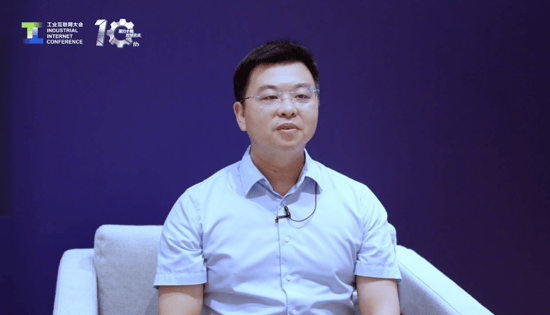
en.Wedoany.com Reported - WPG has transformed from a traditional equipment manufacturer into a technology enterprise specializing in "Industrial Internet + Smart Water," building a full-scenario digital and intelligent water supply solution centered on the Industrial Internet concept. On the occasion of the 10th anniversary of the Alliance of Industrial Internet (AII), WPG executive Xue Hao introduced the company's decade-long digital transformation journey: starting from secondary water supply hardware equipment, it gradually established a five-layer architecture for a smart water industrial internet platform, ranging from physical perception to full-stack independent controllability.
WPG's digital foundation, the WaterOS dedicated operating system for water utilities, has accumulated 38 business models, supports 403 protocol integrations, and opens over 70,000 APIs. This platform has obtained 41 information technology application innovation (ITAI) certifications, been selected as an excellent ITAI case by the Ministry of Industry and Information Technology system, holds 186 patents, and has led or participated in the formulation of 5 national standards. Xue Hao stated that the platform not only provides water utility digital foundation capabilities but also achieves highly reliable security, ITAI compliance, and independent controllability.
For core scenarios in the water utility industry, WPG developed the Hetu AI platform. Xue Hao explained that the water utility industry demands extremely high safety and precision, making traditional general-purpose large models difficult to apply directly. Leveraging PB-level time-series, spatial, and business data, the platform builds its own multimodal classification dataset, integrates large models with knowledge graphs, and incorporates over 50 sets of water utility-specific mechanistic models. In more than 20 core business scenarios, such as burst pipe warning, intelligent dosing, and water quality prediction, the platform's model inference accuracy has reached 95%. Taking intelligent dosing as an example, the platform monitors water quality indicators in real time, combines them with specialized equipment, and uses a fusion of large and small models for precise prediction and control, ensuring both effluent water quality and energy savings.
WPG also showcased a water utility-specific inspection robot dog. Xue Hao pointed out that traditional water plant inspections involve high risks such as high temperatures, harmful gases, and electric shocks, while manual inspections suffer from missed detections, false detections, and difficulty in data retention. This robot, serving as a mobile sensing terminal connected to the industrial internet platform, integrates modules such as a dual-light PTZ camera, depth camera, gas detector, and robotic arm. In electrical instrument scenarios, the robot can automatically read pressure gauges and flow meters and identify knob positions; in equipment inspection scenarios, it can detect floating debris in pools, alum floc conditions, pipeline crystallization, and leaks; in security scenarios, it provides 7×24 hour smoke, fire, and high-temperature anomaly warnings. Collected data can be transmitted in real time to the central control platform, where intelligent analysis automatically generates inspection reports. Xue Hao stated that through this integration, the traditional "human patrol, human observation, human judgment" model has been upgraded to an industrial internet intelligent closed loop of "machine patrol, platform management, AI judgment, and closed-loop handling."
Regarding why the water utility industry needs an industrial internet platform, Xue Hao explained that the industry is characterized by "many points, long lines, wide coverage, and complex scenarios." Traditional information systems built by business department or single scenario often create data silos. The value of an industrial internet platform lies in the unified access, unified modeling, and unified management of dispersed devices, protocols, data, and business processes. WPG's WII (WPG Industrial Internet) platform already supports 403 protocol integrations, adapting to complex and diverse device types; it has accumulated 38 business models for digital representation of objects such as pump houses, water plants, pipe networks, and meters; and it opens over 70,000 APIs to support rapid integration and application development across different business systems. Xue Hao emphasized that an industrial internet platform is not a simple data dashboard but a key infrastructure supporting water utilities in their journey toward digital and intelligent transformation.
Looking ahead, Xue Hao stated that WPG will, under the guidance of the Ministry of Industry and Information Technology and the Alliance of Industrial Internet (AII), deeply explore "Industrial Internet + Smart Water." The company plans to continuously integrate the complete chain of hardware equipment, IoT sensing, platform foundation, data assets, and business scenario applications; deepen the implementation of AI technology to enhance the inference accuracy and decision-making capabilities of the Hetu AI platform in more complex scenarios; and promote industry standardization by transforming innovative achievements into industry standards, empowering more water utilities to achieve digital transformation.