en.Wedoany.com Reported - Wood Mackenzie, in its latest report "Powering Johor's Data Centre Boom: Supply, Demand, and Grid Constraints," points out that electricity demand from data centers in Malaysia's Johor state is expected to account for 40% of the state's total electricity consumption by 2035, with transmission and distribution infrastructure gaps becoming a core bottleneck hindering industry development.
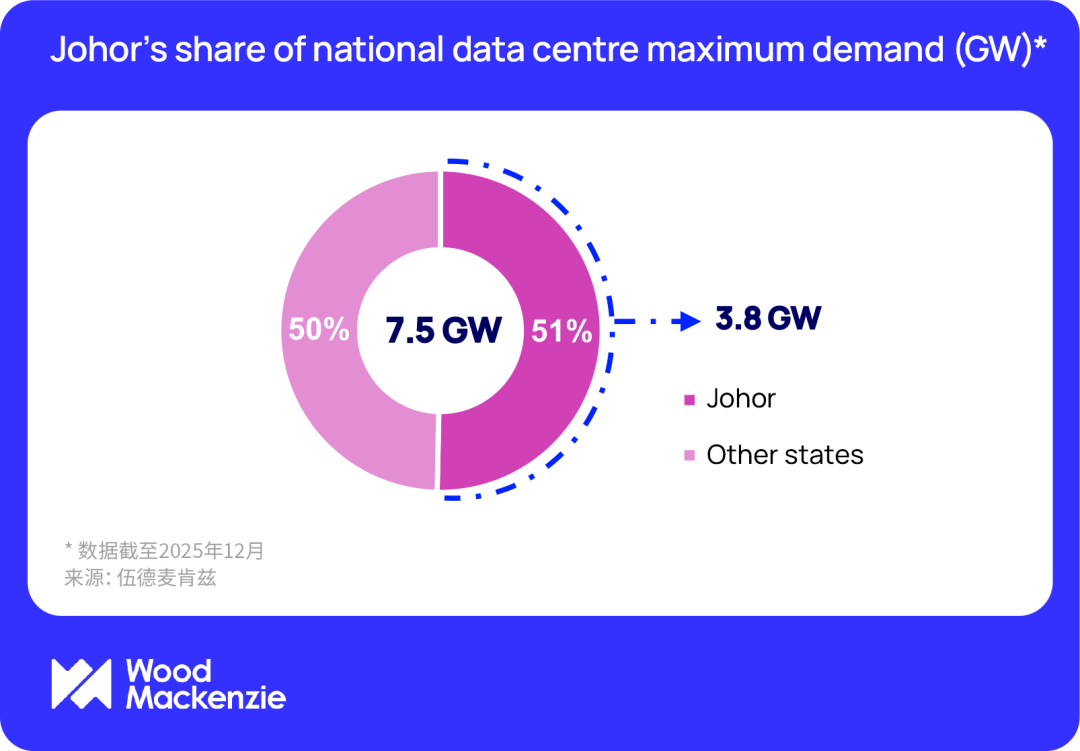
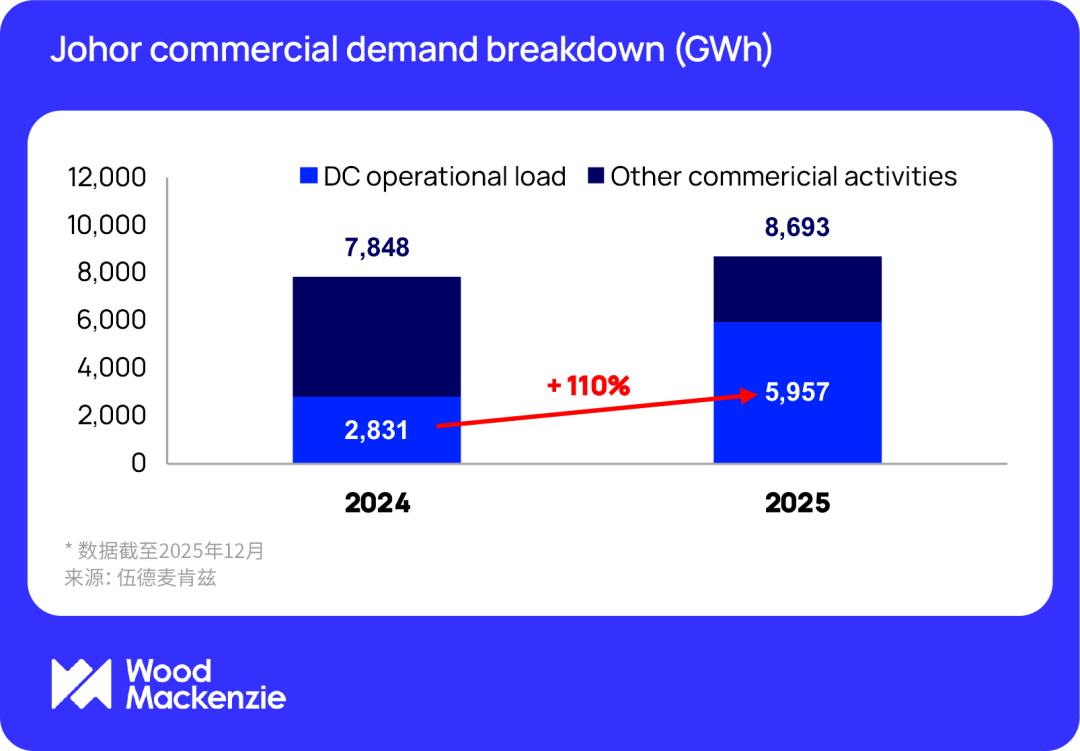
Johor is one of the fastest-growing data center hubs in Southeast Asia. Leveraging its proximity to Singapore, lower operating costs, and favorable policies, the state has attracted investments of 165 billion Malaysian ringgit (approximately USD 42 billion) from hyperscale cloud computing and technology companies. Between 2024 and 2025, the local data center electricity load doubled. Currently, the peak electricity demand from Johor's data centers accounts for approximately 51% of the total scale of Peninsular Malaysia.
Wood Mackenzie estimates that the peak electricity demand from Johor's data centers has reached approximately 3,800 MW, nearly 1.5 times the state's current total societal electricity demand. Data centers currently account for about 24% of Johor's end-use electricity consumption, a figure expected to rise to around 40% by 2035.
Alvin Tan, Power and Renewable Energy Research Analyst at Wood Mackenzie, stated that electricity supply issues have shown significant regional disparities. The core bottleneck is no longer whether the local area can provide sufficient electricity, but whether the electricity can be transmitted to regions with concentrated demand. The areas with the highest concentration of data center investments are precisely those where the grid infrastructure is under the most pressure, making transmission and distribution capabilities a key factor determining future development.
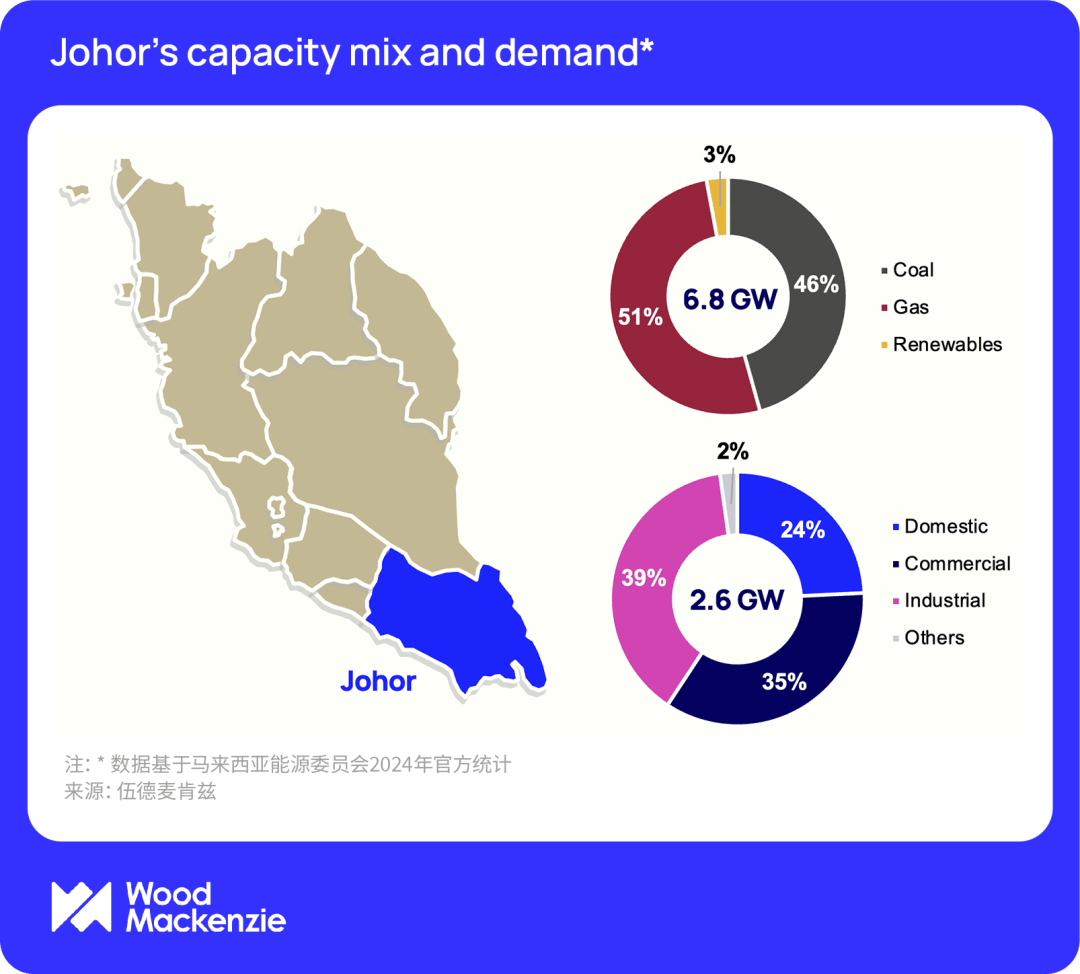
Johor has an installed power generation capacity of approximately 6,800 MW, primarily from natural gas and coal-fired power plants, and is interconnected with the main grid of Peninsular Malaysia. Current electricity demand is about 2,600 MW, indicating ample overall power supply margins. However, the report notes that the overall utilization rate of the state's transmission and distribution facilities is only about 30%, and electricity demand is rapidly concentrating in data center clusters such as the Sedenak Tech Park and Nusajaya Tech Park, leading to prominent local power supply bottlenecks.
Insufficient capacity of 132 kV main incoming line substations and a scarcity of suitable grid connection points are the most prominent infrastructure shortcomings, particularly evident in the integration of renewable energy. Feasible solutions include adopting 275 kV high-voltage transmission schemes with dedicated substations; increasing the deployment of distributed photovoltaic systems for on-site self-consumption; and, in the long term, planning dedicated renewable energy supporting facilities for data center clusters.
The report also highlights long-term power supply risks. It is expected that around the mid-2030s, approximately 2,100 MW of coal-fired units in Johor will be retired. Due to growing electricity demand and the expiration of power purchase agreements for several natural gas power plants, the overall power reserve margin in Peninsular Malaysia may tighten in the short term. Malaysia has launched the NewGen26 plan, aiming to add 6,000 to 8,000 MW of new natural gas-fired power generation capacity through open tenders, while the NewGen25 plan seeks to alleviate short-term supply gaps by extending the operating periods of some natural gas power plants.
The construction of the Southern Johor Renewable Energy Corridor (SJREC) will play a crucial role in the energy structure transition. Planned renewable energy projects in Mersing and Kota Tinggi are expected to add up to 4,000 MW of installed capacity for photovoltaic power plants, along with supporting energy storage facilities, potentially offsetting the power gap caused by the retirement of coal-fired units. These new projects are expected to gradually alleviate pressure starting from 2031, but Wood Mackenzie believes that sustained increased investment is needed in both power generation and grid infrastructure.
With comprehensive incentive policies and regulatory reforms, Johor remains one of the most attractive data center investment destinations in Asia. Key policies include providing tax incentives through the Johor-Singapore Special Economic Zone (JS-SEZ), streamlining approval processes via the Malaysia National Data Center Framework, and establishing a green approval channel by Tenaga Nasional Berhad to shorten grid connection processing times. Regulators are progressively raising sustainable development requirements, including researching carbon pricing mechanisms, reviewing water tariff adjustment plans for data centers, and strengthening project approval oversight.
The pace of renewable energy electricity procurement continues to accelerate. As of June 2025, the total contracted capacity under the Corporate Renewable Energy Supply Scheme (CRESS) in Peninsular Malaysia reached 1,300 MW, all supplied to data center projects in Johor. Alvin stated that the real test for Johor lies in whether infrastructure planning can keep pace with the industry's expansion. Any delays in substation construction, transmission line upgrades, or new power plant projects could become key factors constraining further industry development.