ORNL and IBM Jointly Use Quantum Computing for the First Time to Simulate Tritium Behavior in Fusion Materials
en.Wedoany.com Reported - The U.S. Oak Ridge National Laboratory (ORNL), in collaboration with IBM Quantum and the Cleveland Clinic, has published a paper that, for the first time, applies quantum computing to the electronic structure calculation of tritium chemical behavior in FLiBe, a key material for fusion blankets. This demonstrates the capability of a quantum-classical hybrid computing framework for high-precision simulation of such complex systems.
Current mainstream magnetic confinement fusion routes primarily rely on the deuterium-tritium (D-T) reaction. The paper notes that a 1 GW-class fusion substation would consume approximately 0.5 kg of tritium per day, while the global tritium inventory is about 25 kg. Future commercial fusion will depend on lithium in the blanket to breed tritium through neutron reactions and efficiently recover it for reinjection into the plasma. Therefore, understanding the generation, migration, and binding behavior of tritium in blanket materials is a core issue that fusion engineering cannot circumvent.
FLiBe (LiF-BeF₂) molten salt is considered an important candidate material for advanced fusion reactors. It contains lithium, which can produce tritium via neutron reactions, and its liquid state allows it to simultaneously serve heat transfer and fuel breeding functions. However, in high-temperature molten salt environments, tritium may exist in different forms, such as tritium ions (T⁺), tritium molecules (T₂), or complex structures with fluorine (F-T-F). These forms directly affect tritium residence time, extraction efficiency, and recycling costs.

Modeling the behavior of tritium in FLiBe is a computational challenge. Traditional methods such as density functional theory (DFT), molecular dynamics (MD) simulations, and machine learning force fields (MLFF) face accuracy bottlenecks when dealing with strongly electron-correlated systems like complex molten salt molecules and charged ion clusters containing tritium. Higher-precision methods like full configuration interaction (FCI) or coupled cluster approaches incur computational costs that increase exponentially with system size, making them impractical for realistic fusion material environments.
This research was published on the arXiv preprint platform, with the paper titled "Quantum Computations on Fusion Blanket Molten Salts." The researchers focused on the binding mechanism of tritium with blanket materials, utilizing a quantum-classical embedded wavefunction computational framework to calculate nine different FLiBe molecular configurations. Instead of directly simulating the macroscopic blanket, they employed the "extended sample-based quantum diagonalization" (ext-SQD) algorithm, delegating complex fragments to the IBM Heron quantum processor for solution, and ultimately compared the results with classical high-precision FCI outcomes.
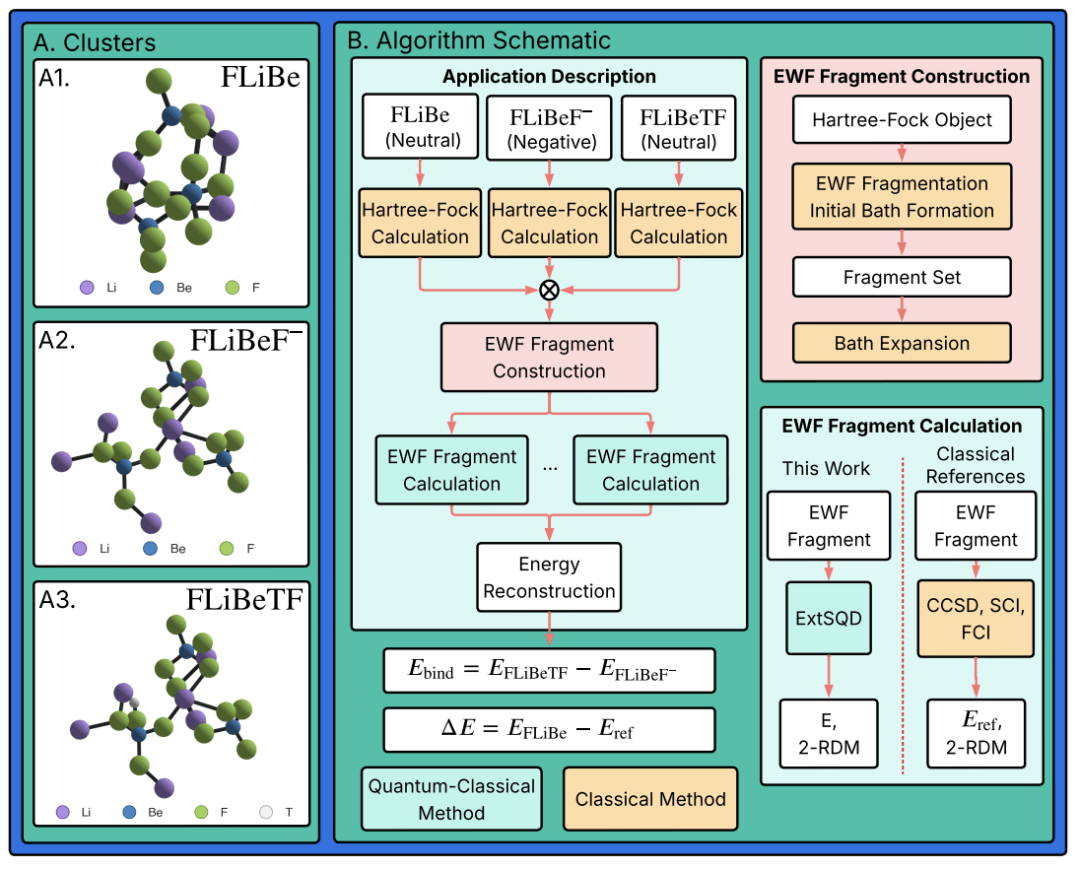
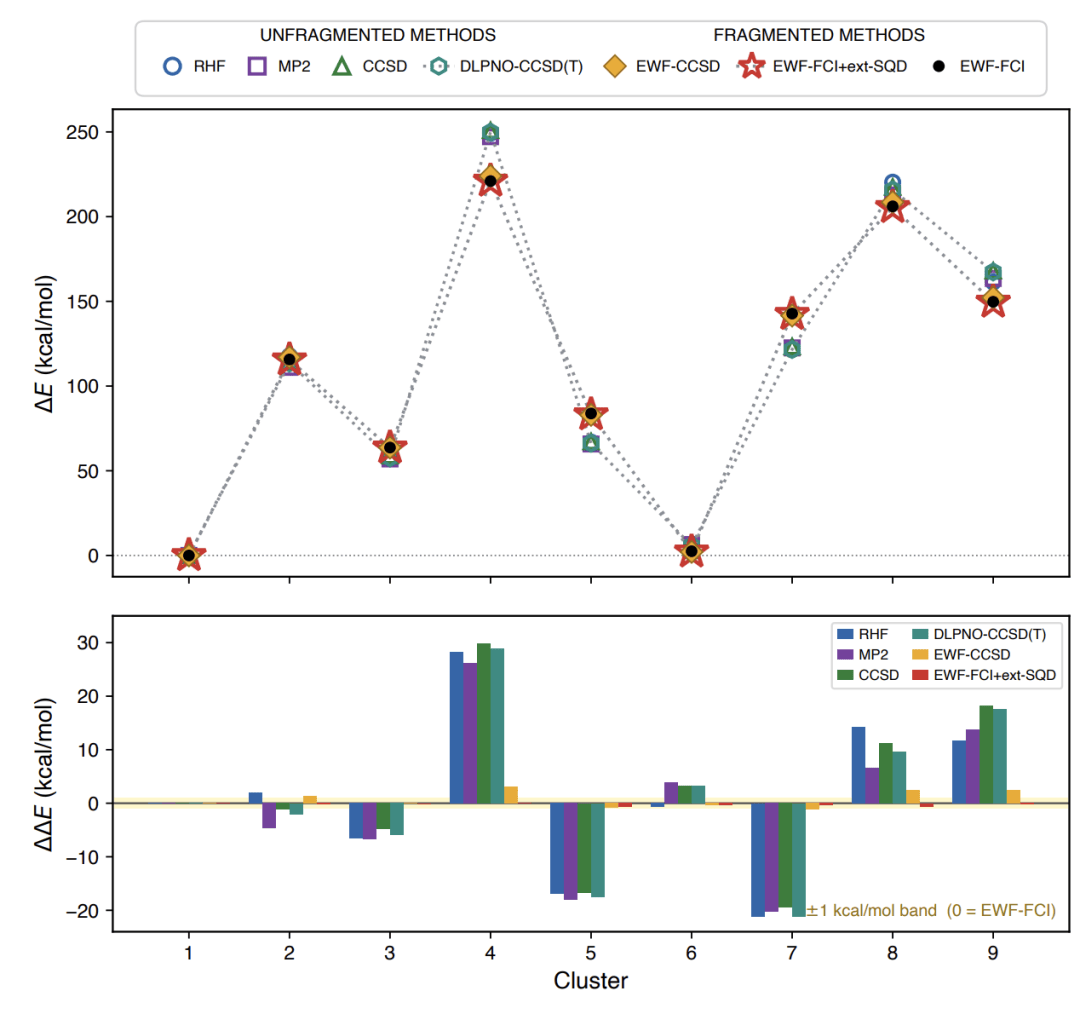
The results show that the deviation between the ext-SQD quantum method and the FCI results is approximately 0.7 kcal/mol, with a mean absolute deviation of about 0.3 kcal/mol. This marks the first successful verification of quantum-classical computation in charged ion systems, particularly inorganic molten salt systems, within the industry.
This research signifies that the development of fusion materials may transition from the traditional model reliant on experimental trial and error into a materials genome computational design phase based on high-performance computing, AI models, and quantum computing. In the past, blanket material development depended on lengthy cycles of "experimental trial and error—neutron irradiation testing—macroscopic performance evaluation." In the future, leveraging the integration of high-performance computing, AI, and quantum computing, researchers may be able to accurately predict the suitability of molten salt combinations for tritium release from the atomic or even quantum level. At the same time, this study reveals that the tritium fuel cycle is evolving from a macroscopic systems engineering problem into a fundamental materials science issue.
This paper opens a technical pathway for applying quantum computing to fusion materials research. However, the study also points out that the current scale of quantum computing is insufficient to cover macroscopic engineering scenarios, and future breakthroughs in larger-scale quantum computing systems and underlying algorithms are needed. This cross-disciplinary collaboration between ORNL, IBM Quantum, and the Cleveland Clinic offers a noteworthy direction for technological integration.
Related Products


Post-type AC Pollution-resistant Disc Suspension Porcelain Insulator (Triple Umbrella Type)
Shandong High Voltage Insulator Co., Ltd.


Smart Photovoltaic Prefabricated Substation
Shanghai Jinyou Jinhong Intelligent Electric Co., Ltd.


0.66kV Power Supply Instrument Transformer
Guangdong Sihui Instrument Transformer Works Co., Ltd.

H-40.5/0.4~1.14kV New Energy Power Generation Dedicated High Voltage/Low Voltage Prefabricated Substation
XJ (Xiamen) Intelligent Power Equipment Co., Ltd.
TAI Slew-drive Single-axis Independent 1P Tracking Bracket System
ANTAI TECHNOLOGY CO., LTD.
Ultrasonic Wind Speed and Direction Instrument
Kingmach Measurement & Monitoring Technology Co., Ltd.