Chinese scientists use Chang'e-6 lunar soil to reveal for first time differences in solar wind injection on the Moon's far side
en.Wedoany.com Reported - Researchers from the Institute of Geology and Geophysics of the Chinese Academy of Sciences and other institutions have, for the first time, used lunar soil samples from the far side of the Moon collected by the Chang'e-6 mission to reveal significant differences in how the Moon's near side and far side receive solar wind particles: particles on the far side have higher energy and penetrate deeper into the lunar soil. The study attributes this difference to Earth's magnetosphere. The findings have been published in the journal Nature Geoscience.
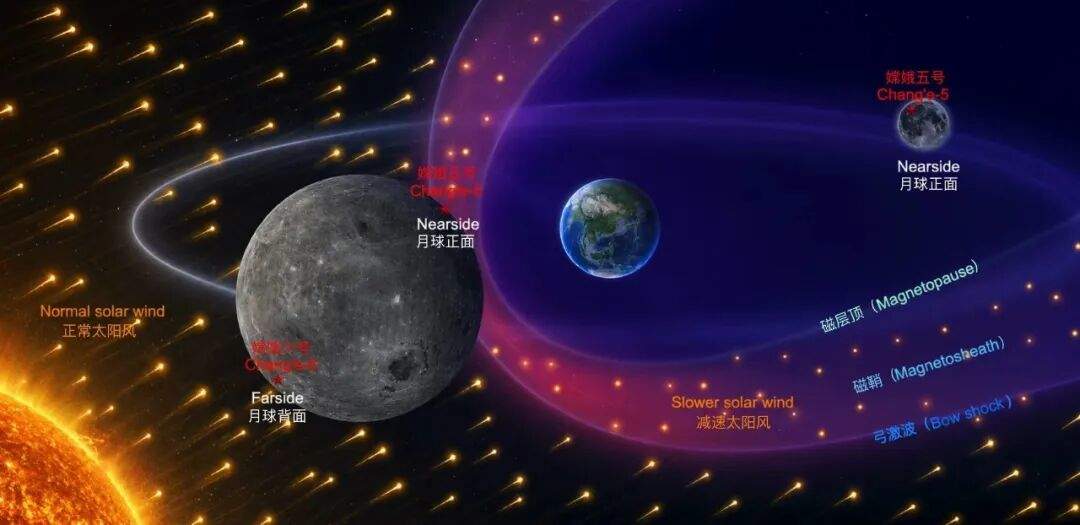
The researchers conducted a more detailed analysis of noble gases in the Chang'e-6 lunar soil and compared them with samples from the Moon's near side brought back by the Chang'e-5 mission. The results show that the neon isotope composition values in the Chang'e-6 samples are significantly lower than all known near-side samples. This phenomenon indicates that the Moon's far side has undergone a more extreme isotopic fractionation process, in which lighter neon isotopes are more prone to escape.
The differences in solar wind injection between the near side and far side are also evident in heavier noble gases such as krypton and xenon. In heating experiments, solar wind-derived noble gases in the Chang'e-5 near-side samples were released at both low and high temperatures, exhibiting a bimodal pattern; in contrast, the Chang'e-6 far-side samples showed only a single peak at high temperatures. Dr. Zhang Xuhang, first author of the paper and a researcher at the Institute of Geology and Geophysics, Chinese Academy of Sciences, stated that this indicates that some solar wind particles in the near-side lunar soil are injected at shallower depths, while the overall injection depth of particles on the far side is greater.
The study further explains the cause of this difference: when the Moon passes through Earth's magnetosphere, the normal solar wind speed significantly decreases from approximately 400 kilometers per second to about 200 kilometers per second. This decelerated "slow solar wind" only affects the Moon's near side, with lower energy and shallower injection; meanwhile, the far side is continuously exposed to undecelerated solar wind, which has higher energy and thus penetrates deeper.
Dr. Zhang Xuhang pointed out that this study provides the first physical evidence that Earth's magnetic field plays a substantial role in regulating the speed of solar wind reaching the Moon. Heavy noble gases in lunar soil may serve as a "fossil record" to reconstruct the boundaries of the ancient Earth's magnetosphere, offering new clues for tracing the evolutionary path of the geomagnetic field.
Related Products

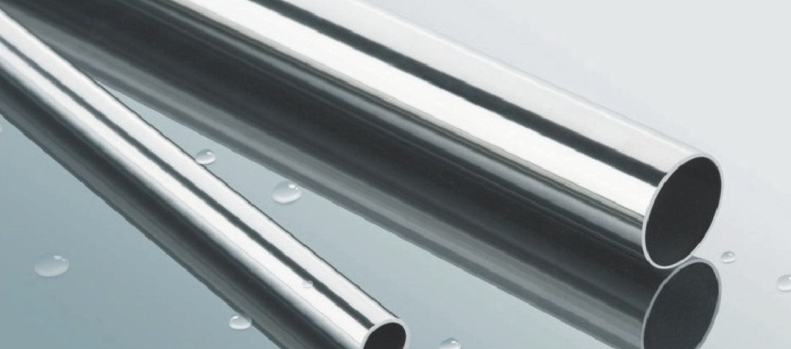
ERW Welded Pipe (Black Pipe and Hot-dip Galvanized Steel Pipe)
Handan Zhengda Steel Pipe Co., Ltd.


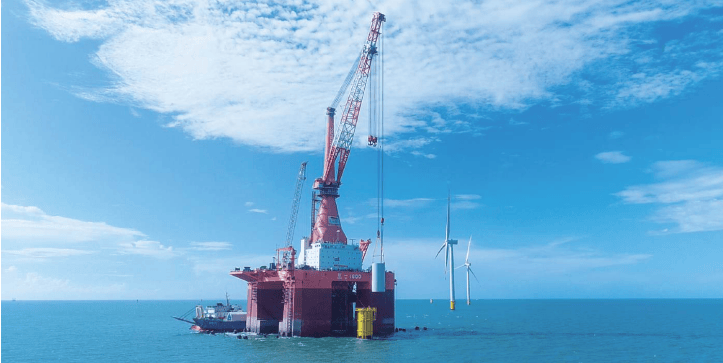
"Shunyi 1600" Deep-submerging Bottom-sitting Multi-functional Wind Power Engineering Vessel
Zhengli Offshore Engineering Co., Ltd.
3m intelligent buoy combining navigation safety and real-time marine monitoring integrated navigation and marine monitoring system for real-time maritime data
Chengdu Dixin Technology Co., Ltd.