Ghana's CBI Invests $110 Million to Build World's Largest Calcined Clay Plant, Operational by March 2026
en.Wedoany.com Reported - Ghana's cement industry has long relied on imported clinker, a supply chain bottleneck that ultimately gave rise to the world's largest calcined clay plant. CBI Ghana Ltd., driven not solely by environmental goals but by a decades-old raw material challenge in Ghana, opted for the limestone calcined clay cement (LC3) route.
Ghana is one of Africa's largest importers of clinker, the energy-intensive base material for traditional Portland cement. Industry estimates suggest the country's annual clinker import bill approaches $500 million. This external dependence ties cement prices closely to international energy costs, freight rates, and the depreciation of the cedi. Between 2022 and 2024, sharp cedi depreciation pushed retail cement prices in Accra and Kumasi to between 110 and 135 Ghanaian cedis per 50 kg bag, causing construction costs to exceed budgets for many builders.
Founded in 2017 in the Tema Free Zone, CBI Ghana Ltd. viewed this predicament as a solvable engineering problem. Its solution was LC3 technology—replacing a significant portion of clinker with calcined clay and limestone, reducing CO2 emissions by up to 40% compared to traditional Portland cement, while sourcing raw materials from Ghana's abundant domestic deposits.
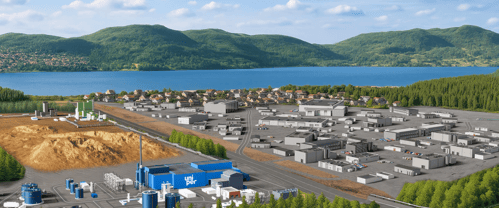
From the outset, the project targeted industrial scale, not a small pilot. With a total investment of $110 million, the plant was officially inaugurated by Ghanaian President John Dramani Mahama in March 2026 and is recognized by the industry as the world's largest calcined clay facility of its kind.
The core principle of LC3 is straightforward: kaolin clay, when calcined under controlled temperatures, becomes reactive and can replace a portion of clinker in cement. Combined with limestone, the resulting cement achieves strength comparable to traditional grades but with significantly lower carbon emissions.
The challenge lies in product consistency. In a tropical, humid climate, clay raw materials vary in quality. Achieving stable, industrial-grade production of reactive calcined clay requires precise and reliable process equipment. CBI Ghana Ltd. awarded the calcination technology contract to Fuller Technologies, whose system could maintain consistent quality at the required production capacity—a capability key to winning the bid.
At the Tema plant, calcined clay is blended with clinker and limestone from licensed quarries in the Eastern Region. The mixture is graded and verified through daily testing at the company's on-site laboratory. Supa Power 42.5R achieves a clinker substitution rate of 35% to 45%, while Supa Fast 32.5R keeps clinker content at no more than 45%—the lowest level globally for 32.5R grade cement.
The plant's impact extends beyond CBI Ghana Ltd.'s own products. It also supplies calcined clay to other cement producers in Ghana, thereby extending the carbon reduction benefits of LC3 technology to a larger share of the country's cement output, beyond CBI Ghana Ltd.'s own production.
From decision to commissioning, the project faced three major challenges.
First, the clay raw material primarily comes from Torgome in the Volta Region. Ghana had never mined this material on an industrial scale before. Establishing a reliable, high-volume supply system required investment in logistics and quality control. The chemical composition of clay varies between deposits and must be strictly managed before entering the calciner.
Second, when CBI Ghana Ltd. began scaling up LC3 production, Ghana had no national standard for this type of cement. Existing Portland cement standards could not accommodate the clinker substitution ratios required for LC3, which would have rendered the product unusable in public and private projects requiring compliance. CBI Ghana Ltd., together with the Ghana Standards Authority and research partners, worked to establish GS PAS 5:2024, Ghana's first national standard for LC3 cement, paving the way for commercialization.
Third, the $110 million investment required a robust network of partners. CBI Ghana Ltd. integrated strategic investment and development finance support. However, standard approval did not guarantee automatic customer acceptance. The company invested in technical exchanges with engineers, contractors, and developers to promote the use of LC3 in demanding applications.
Related Products

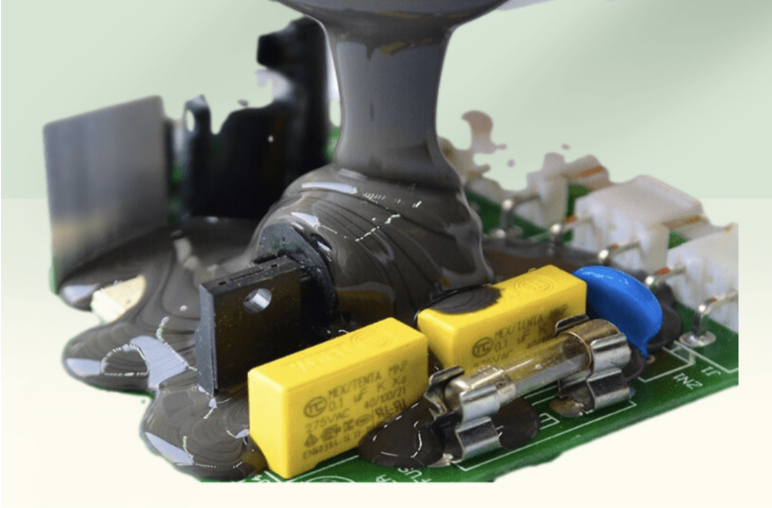
High Thermal Conductivity Encapsulating Resin
Nantong BESALL Sealing Technology Company.,Limited
New Environmentally Friendly Green Potassium Salt Collector
Chonfar Engineering and Technology Co., Ltd.
Steel Plates for Chemical Pressure Equipment
Gansu JISCO Group Hongxing Iron and Steel Co., Ltd.