en.Wedoany.com Reported - On July 17, the team led by Zhou Peng and Liu Chunsen from Fudan University published their latest findings in the journal Science, inventing the "quantum flash memory" technology. They developed a device with the world's largest non-volatile quantum storage window and pioneered the theoretical system of single-electron quantum storage. This achievement fills a critical theoretical gap for the engineering application of quantum storage.
As the fundamental building block of computing power, storage chips face data interaction latency and power consumption issues that are the fundamental bottlenecks hindering computing power improvement. Electrons are indivisible elementary particles; theoretically, "one electron, one bit" represents the physical limit of storage density. However, single-electron quantum effects are extremely difficult to capture stably and have long been considered merely theoretical. At the end of the last century, scientists attempted to observe single-electron storage, but results showed that a single electron contributed only tens of millivolts of voltage change, and the state disappeared within less than 5 seconds. Current mainstream dynamic random-access memory requires approximately 200,000 electrons to store 1 bit of information.
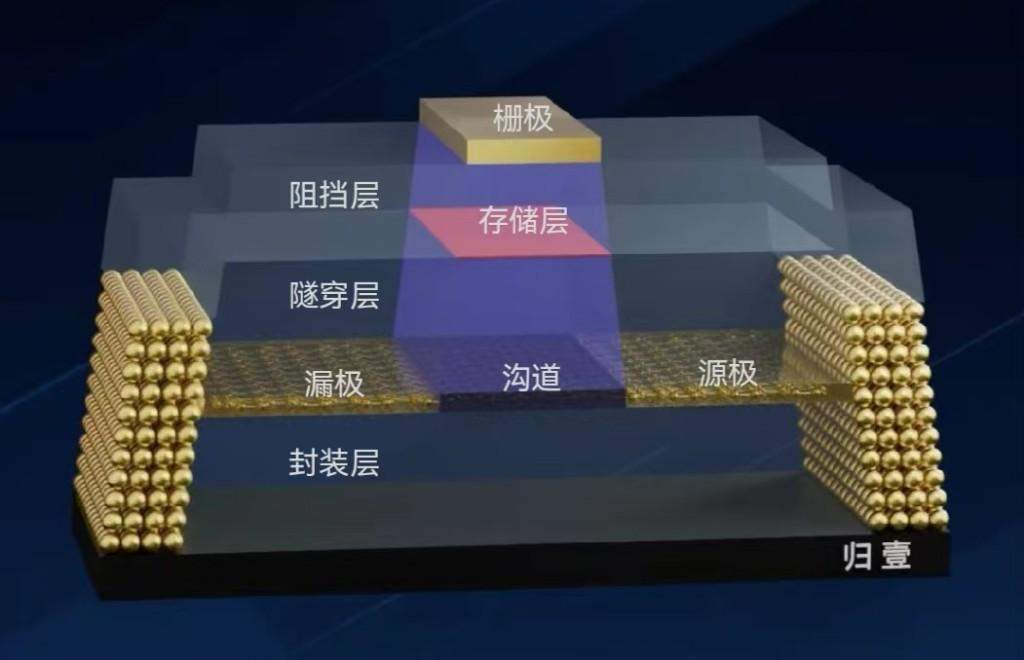
Previously, the team had developed a 400-picosecond ultrafast "Dawn" device and a "Long Ying" hybrid architecture flash memory chip, with related achievements selected among China's Top 10 Scientific Advances in 2025. This time, based on the fundamental principles of quantum mechanics and leveraging the electron confinement advantages of two-dimensional semiconductors at atomic thickness, the team designed a coplanar drain-channel-source "Guiyi" structure. For the first time, they observed stable single-electron storage behavior at room temperature of 27°C, overcoming the technical bottlenecks where single-electron states in similar experiments could not be stably maintained at room temperature and quantum behavior could not be clearly observed. This quantum flash memory device, named "Guiyi," requires only a single electron injection to form a 0.5-volt storage window, meeting commercial implementation standards and reaching the theoretical peak of "one electron, one bit" charge storage. The device can fundamentally reduce computing power consumption, making it a new-generation storage core suitable for the development of artificial general intelligence.
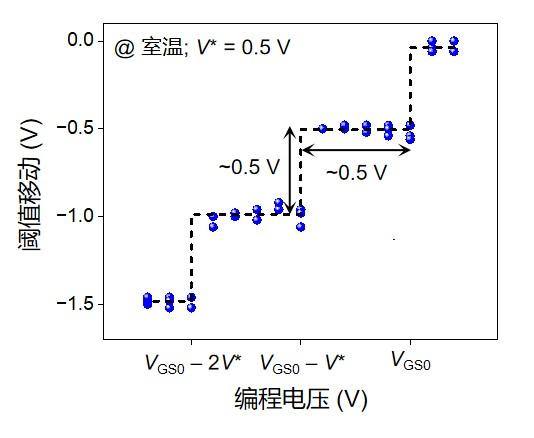
Building on this foundation, the team innovatively proposed the "density-of-states scissors" theory, revealing for the first time an unprecedented anomalous quantum storage behavior: precisely "cutting" specific quantum states in energy space, causing them to vanish into thin air. The journal Science commented that this achievement introduces a completely new theoretical mechanism, making engineered manipulation of quantum states a reality, and holds broad prospects and significant impact in the fields of storage physics and nanodevices.