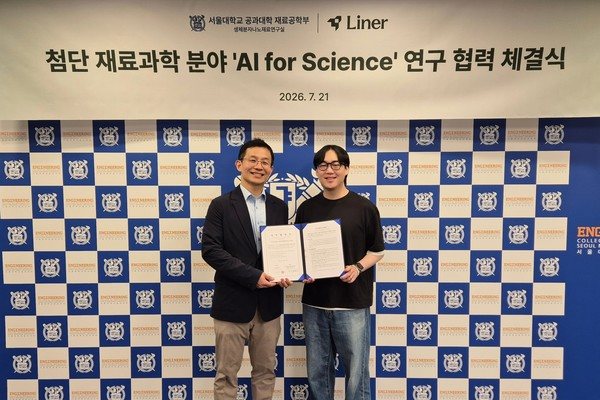
en.Wedoany.com Reported - Liner announced on the 22nd that it has signed a business agreement with the "Biomolecular Nanomaterials Research Laboratory (BMNL)" led by Professor Nam Ki Tae of the Department of Materials Science and Engineering at Seoul National University to collaborate in the field of "Scientific Research AI." The partnership aims to alleviate the repetitive workload of university researchers through AI tools, fostering an environment conducive to creative research.
Professor Nam Ki Tae is a materials scientist specializing in biomimetic materials engineering, artificial photosynthesis, and chiral nanomaterials. His team published a study on the precise synthesis of three-dimensional chiral nanoparticles in Nature in 2018, which has accumulated over 24,000 citations on Google Scholar.
The purpose of this collaboration is to empirically measure the contribution of AI to productivity in cutting-edge natural science research. To this end, both parties will utilize Liner's AI research tool, "Liner Scholar," and a materials science-specific AI research agent. The core research topics include three areas: an empirical study of research workflows based on Liner Scholar; joint development of a materials science-specific AI research agent; and quantitative analysis of AI's contribution to research. Liner is responsible for developing the AI pipeline and models, while BMNL provides domain expertise, research, and data validation.
In the empirical study for the first topic, researchers affiliated with BMNL will use Liner Scholar throughout the entire research process, from hypothesis formulation and literature review to paper writing. The data obtained will serve as the foundation for jointly developing a materials science-specific AI agent. Ultimately, the two parties plan to quantitatively analyze AI's contribution to research, thereby academically elucidating the extent to which AI can enhance the speed and outcomes of scientific research.