Finnish VTT independent testing shows Donut Battery energy density of 409 Wh/kg
en.Wedoany.com Reported - Donut Lab has released the latest test results for its battery product, the Donut Battery. A report issued by the Technical Research Centre of Finland (VTT) shows that the battery achieves a gravimetric energy density of 409 Wh/kg and a volumetric energy density of 805 Wh/L.
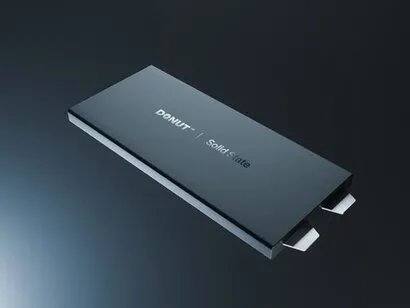
During testing, the cell was first weighed and measured, then subjected to one complete charge and discharge cycle across its full voltage range at an ambient temperature of 25 degrees Celsius to determine the watt-hours of energy the cell could deliver. The measured energy was divided by the cell mass to obtain the gravimetric energy density, and by the cell volume to obtain the volumetric energy density.
Ville Pippo, Chief Technology Officer of Donut Lab, stated that this test is relatively straightforward, as energy density is determined by two factors: how much energy the cell stores, and how heavy it is or how much space it occupies. He also noted that the battery used in this test shares the same cell chemistry as those previously tested by VTT, but was optimized for energy performance within the company's broader development efforts.
Donut Lab has also partnered with Intertek, an international testing and certification company, to conduct third-party research on cells of its next-generation battery technology. After examining the internal structure of the cell, Intertek confirmed that it employs a bipolar architecture.
The structural inspection revealed multiple electrochemically active layers connected in series within a single cell, with separated metal foils serving as electrodes on both sides of the electrochemical layers. The higher voltage achieved by the cell arises from the internally series-connected electrochemical layers, rather than from externally connecting multiple individual cells in series—this is the defining characteristic of a bipolar cell structure.
Intertek also performed a nail penetration test on Donut Lab's next-generation battery cell to evaluate its behavior under severe mechanical damage. During the test, a steel nail was driven through a fully charged cell and left in place for one hour to simulate a permanent internal short circuit.
For a typical lithium-ion battery with liquid electrolyte, this represents a worst-case scenario: the short circuit causes energy to be released locally in a concentrated manner, temperatures rise accordingly, and the flammable liquid electrolyte may trigger thermal runaway, leading to smoke, fire, or even explosion. In Intertek's testing, the Donut Lab cell remained completely stable throughout the entire one-hour monitoring period.
Marko Lehtimäki, Chief Executive Officer of Donut Lab, added that bipolar cells can enhance energy density at the battery pack level while reducing structural complexity and cost. From a manufacturing perspective, the significance of this cell architecture can be compared to the transition from standard lithium-ion batteries to solid-state batteries.