Wedoany.com Report-Dec.9, Uzbekistan's President Shavkat Mirziyoyev has officially launched construction of 21 new energy and infrastructure projects and commissioned 42 renewable power generation, storage and grid facilities worth US$11 billion during the 'Powering the Future' forum held in Tashkent.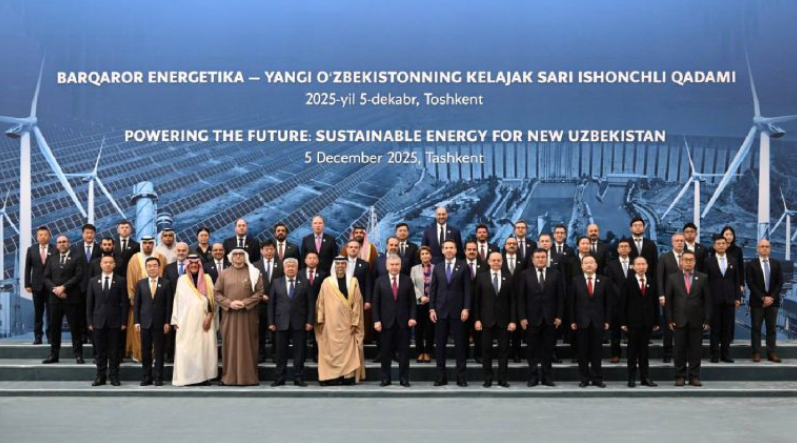
President Shavkat Mirziyoyev and foreign delegates at the energy forum in Tashkent.
The newly commissioned assets include 16 solar, wind, thermal and hydropower plants with a combined capacity of 3,500 MW located in the regions of Karakalpakstan, Bukhara, Kashkadarya and Tashkent. Once fully operational, these plants are expected to produce up to 15 billion kilowatt-hours annually, raising Uzbekistan’s total renewable electricity output to 23 billion kilowatt-hours in 2026.
Ten energy storage systems totalling 1,245 MW have also been brought online, capable of supplying an additional 1.5 billion kilowatt-hours during peak demand periods. The package further comprises 11 major substations and 420 km of high-voltage transmission lines to strengthen grid reliability.
The forum was attended by energy ministers from the United Arab Emirates, Turkey, Azerbaijan and Kyrgyzstan, together with senior representatives from ACWA Power, Masdar, EDF, Voltalia, TotalEnergies and Siemens Energy.
President Mirziyoyev stated: "Given the rapid growth of the economy and the increasing needs of the population, we are implementing large-scale reforms in the energy sector. In this area, we have defined two key goals. The first is to ensure reliable and uninterrupted energy supply to all industries and regions. The second is to achieve this primarily through modern, environmentally friendly, and renewable energy sources. All the projects we are launching today will become a source of sustainable economic growth and open new opportunities for future generations. Thanks to such purposeful steps, we will undoubtedly build a modern energy system of a new type."
Officials noted that the expanded use of renewables will reduce natural gas consumption by nearly seven billion cubic metres per year and avoid approximately 11 million tonnes of carbon emissions annually. New domestic manufacturing enterprises such as Angren Energo (transformers) and Uzhydropower (hydro units) will support the ongoing modernisation.
Since 2017, Uzbekistan has attracted US$35 billion in foreign direct investment into its energy sector and added 9,000 MW of new generation capacity. Over the next five years, the country plans to mobilise more than US$150 billion for industrial and infrastructure development, including supercomputer clusters and data centres to support growing IT and AI industries, with electricity demand forecast to rise by at least 50%.