en.Wedoany.com Reported - The global steel market is facing a more severe landscape than the period that drove its expansion over the past two decades. Global crude steel production has largely stagnated at around 1.83 to 1.84 billion tonnes, but weak demand, oversupply, trade barriers, and decarbonization costs continue to squeeze industry profits, intensifying competition. For many steelmakers, simply increasing output no longer guarantees higher profitability.
The Indian market presents a starkly different picture. The country's steel demand grew from 91 million tonnes in FY2017-18 to 164 million tonnes in FY2025-26, nearly 1.8 times growth in eight years. Steel consumption growth has consistently outpaced GDP growth by about 1 to 1.5 times, but per capita steel usage is only 100 kg, less than half the global average of 215 kg. This means India remains one of the few major steel markets globally where long-term demand growth has structural, rather than cyclical, support.
This evolving landscape is central to the transformation of Tata Steel. The company is increasingly exhibiting a dual-speed development: India drives growth, profits, and cash flow, while Europe tests the economic viability of the green steel transition.
Tata Steel's operational performance reveals a deep structural shift within the company. Although consolidated crude steel output only increased marginally from 30.92 million tonnes in FY2025 to 31.67 million tonnes in FY2026, the truly striking change is the accelerated rise of India as the group's core growth and profit engine. India is not only Tata Steel's largest market but has become the cornerstone of the company's long-term strategy. Domestic crude steel production in India rose from 21.67 million tonnes in FY2025 to a record 23.48 million tonnes in FY2026, while overseas output declined from 9.3 million tonnes to 8.2 million tonnes during the same period. This contrast clearly indicates that Tata Steel's operational focus is shifting away from Europe and increasingly concentrating on India, where infrastructure spending, manufacturing growth, and urbanization continue to support stronger steel demand.
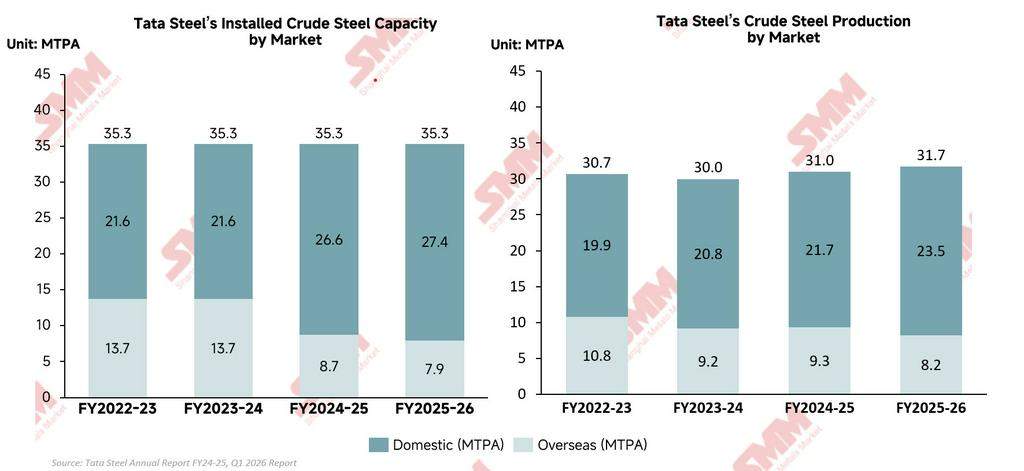
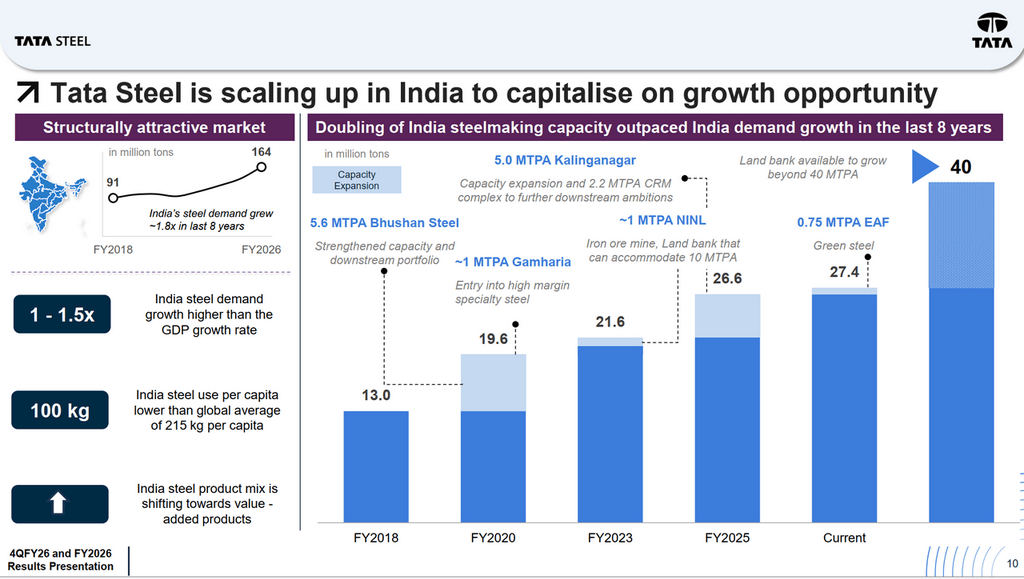
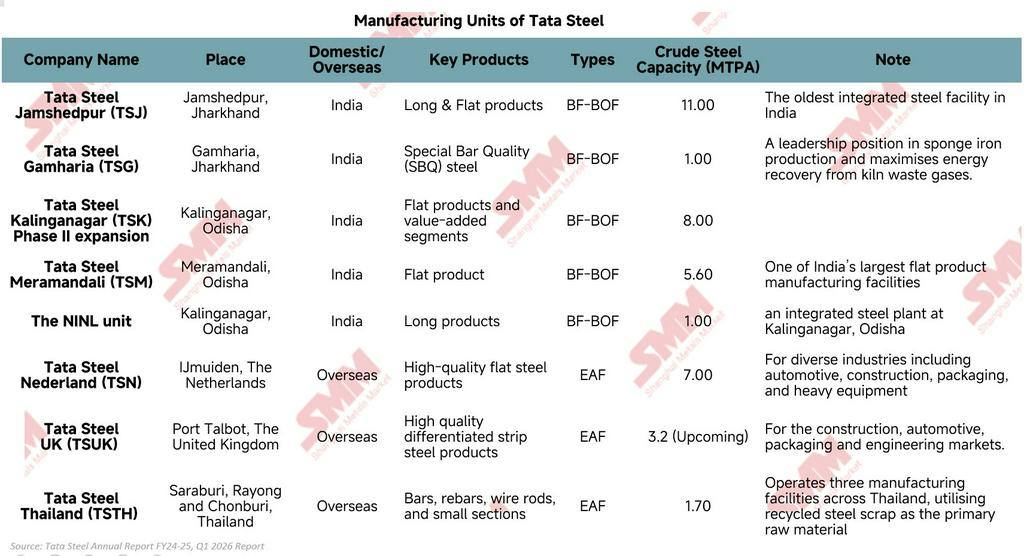
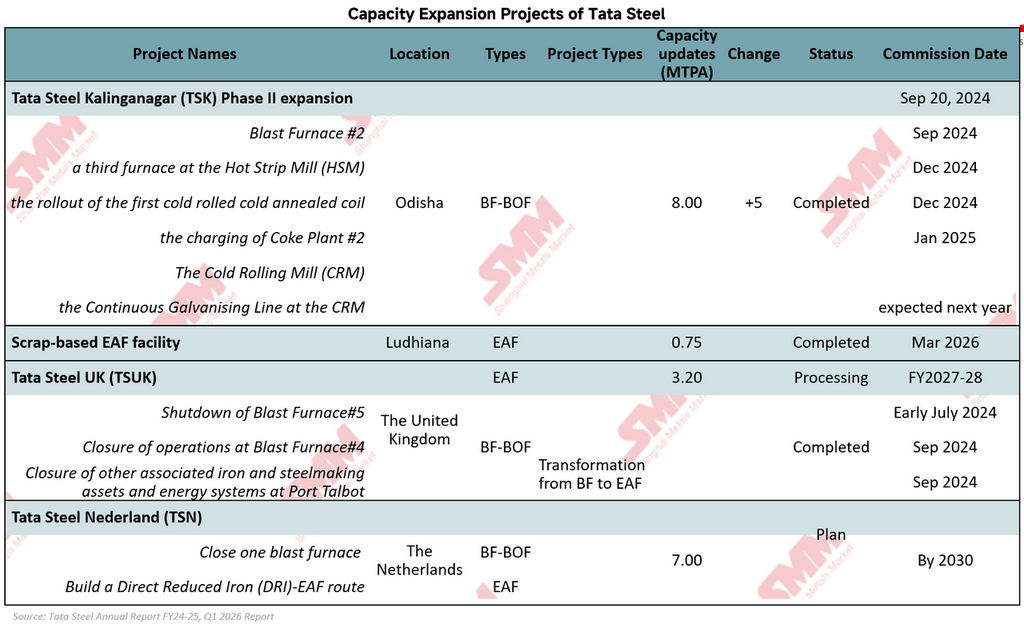
To capitalize on robust steel demand growth in India, Tata Steel has actively expanded its domestic steelmaking capacity over the past decade. Indian crude steel capacity has more than doubled, from 13 million tonnes per annum (MTPA) in FY2018 to approximately 27.4 MTPA currently, with a long-term target of 40 MTPA. Kalinganagar remains central to this strategy, with its Phase II expansion boosting capacity from 3 MTPA to 8 MTPA and strengthening Tata Steel's capabilities in downstream and automotive-grade steels.
In contrast, the European business remains essentially a restructuring story. Tata Steel UK continues its transition to Electric Arc Furnace (EAF) steelmaking, while Tata Steel Netherlands still faces high operating costs and environmental regulatory pressures. Consequently, Tata Steel's business structure is increasingly bifurcated: India drives growth and profitability, while Europe focuses on decarbonization and operational transformation.
Tata Steel's financial performance not only reflects a cyclical rebound after weak steel markets but also shows early signs that its earnings structure is improving after several difficult years of weak spreads, European losses, and high transition costs.
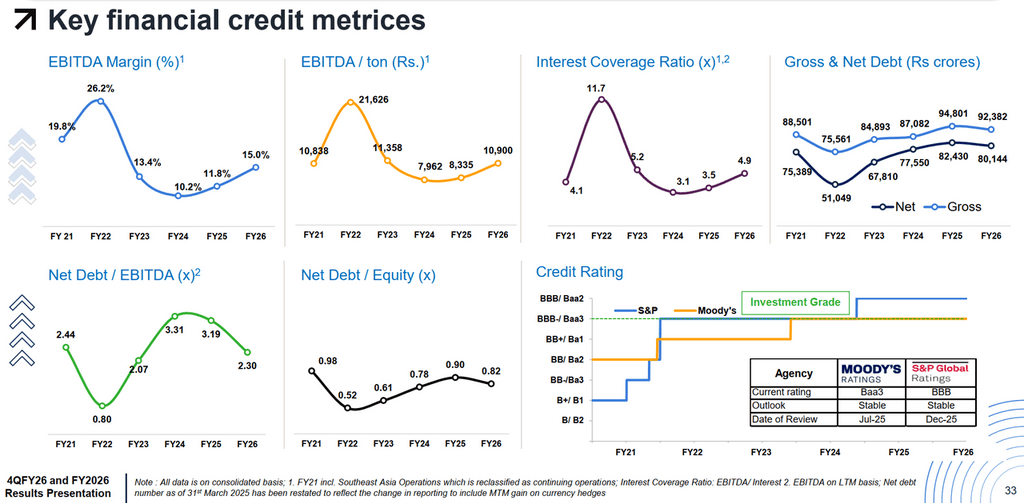
On the surface, revenue growth was relatively modest. Consolidated revenue increased by approximately 6% year-on-year to INR 2,321.4 billion. However, profitability improved much faster than sales growth. Earnings Before Interest, Taxes, Depreciation, and Amortization (EBITDA) surged 35% year-on-year to INR 348.48 billion, while reported net profit (PAT) jumped from INR 31.74 billion to INR 108.86 billion. The gap between revenue growth and profit growth is crucial; it indicates that Tata Steel not only sold more steel but also operated more efficiently and achieved stronger profitability. The most direct evidence comes from EBITDA per tonne, which rose sharply from approximately INR 8,335 per tonne in FY2025 to INR 10,900 per tonne in FY2026. This means that despite pressures from steel price volatility and weak global demand, Tata Steel significantly increased its profit per tonne of steel sold. The company's recovery is increasingly driven by internal improvements, rather than relying solely on the external steel cycle.

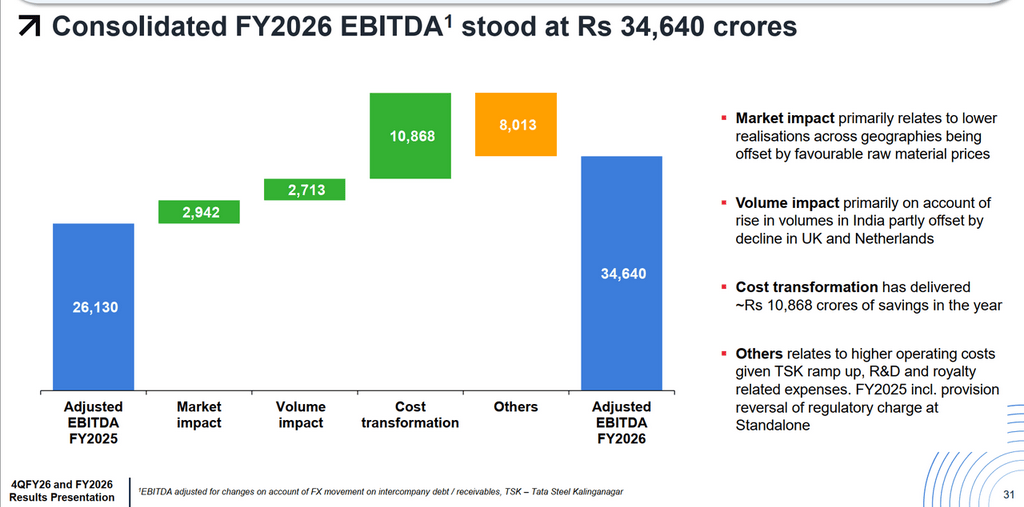
Behind this shift is Tata Steel's aggressive cost transformation program. The company disclosed that cost transformation contributed approximately INR 108.68 billion to EBITDA improvement in FY2026, far exceeding gains from increased production volume. Cost savings have become one of the largest drivers of the group's earnings recovery. This reflects management's increasing prioritization of operational discipline, profit protection, and cash generation over mere scale expansion.
India once again serves as the group's financial backbone. Tata Steel India generated EBITDA of INR 342.72 billion, with an EBITDA margin of approximately 24%, significantly higher than the group's consolidated margin of 15%. This contrast is becoming increasingly pronounced: India generates strong cash flow and healthy profitability, while Europe continues to consume capital amid restructuring and decarbonization.
Meanwhile, Tata Steel's balance sheet has also begun to stabilize. Net debt/EBITDA improved from 3.19 times to 2.30 times, and the interest coverage ratio increased to 4.9 times. Despite maintaining high capital expenditure of over INR 140 billion for Indian expansion and downstream projects, the company generated free cash flow of approximately INR 107.38 billion. Moody's and S&P both maintained investment-grade credit ratings, further bolstering market confidence.
However, compared to many global steelmakers, Tata Steel's financial story remains exceptionally complex. The company is attempting to fund two transformations simultaneously: large-scale growth expansion in India and an expensive green transition in Europe. This creates a delicate balance between growth, decarbonization, leverage, and shareholder returns. Therefore, while FY2026 was a year of financial recovery, the greater challenge lies in whether Tata Steel can sustainably maintain this stronger profitability in the coming years while continuing to absorb European transition costs.
Tata Steel's recent business moves indicate that the company is preparing for something far beyond the next steel cycle. Beneath the surface of capacity additions and restructuring, the group is steadily reshaping itself for an industry that is more demanding, greener, and more margin-sensitive than ever before.
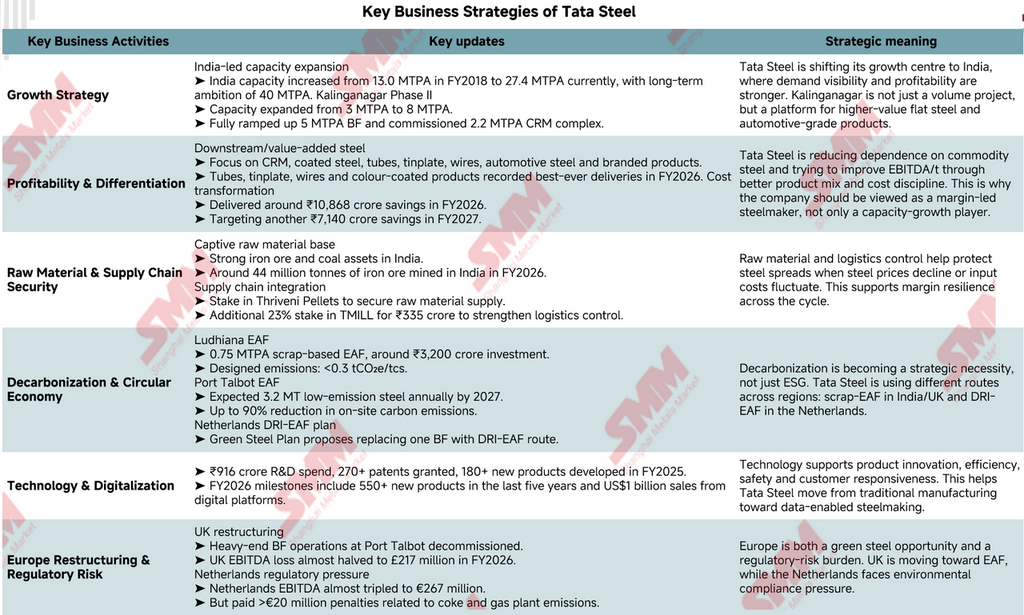
The most obvious shift is in product strategy. Tata Steel is moving deeper into automotive steel, coated products, tubes, tinplate, branded steel, and downstream processing, rather than relying heavily on commodity-grade output. Projects like the Kalinganagar CRM complex are part of this effort. The logic is that commodity steel is vulnerable to oversupply and sharp price fluctuations, while specialty steel products typically offer more stable customer relationships and stronger pricing power. Tata Steel is trying to get closer to end-users, moving away from pure volume competition.
The company is also strengthening its control over the industrial ecosystem. Its captive iron ore and coal assets in India already provide a major advantage over many steelmakers exposed to volatile seaborne raw material markets. But Tata Steel goes further, with investments in Thriveni Pellets and TM International Logistics Limited (TMILL) enhancing control over pellet supply, transportation, and logistics infrastructure. In an industry where margins can disappear quickly, this integration reduces the entire supply chain's exposure to external shocks.
However, the biggest change is occurring in decarbonization. Tata Steel no longer views green steel as a distant goal and has begun redesigning major parts of its production network around low-emission technologies. In India, Tata Steel commissioned a 0.75 MTPA scrap-based EAF facility in Ludhiana in March 2026, with an investment of approximately INR 32 billion, aiming for emissions below 0.3 tonnes of CO2 equivalent per tonne of crude steel. In the UK, Tata Steel is transitioning Port Talbot from blast furnace operations to EAF steelmaking, expecting the facility to produce approximately 3.2 million tonnes of low-emission steel annually by FY2027-28, while reducing on-site carbon emissions by up to 90%. Meanwhile, Tata Steel Netherlands has proposed a green steel plan based on closing one blast furnace and developing a Direct Reduced Iron-EAF (DRI-EAF) route by 2030. These projects demonstrate that decarbonization is no longer seen as a standalone ESG initiative but is increasingly becoming a strategic requirement for long-term competitiveness and regulatory survival. Notably, Tata Steel is not betting everything on a single decarbonization model but is adopting differentiated technologies based on regional geography, regulatory environment, energy economics, and raw material availability. This gives it more flexibility than many competitors still struggling to define viable transition pathways.
Technology is emerging as another important dimension of the company's evolution. Tata Steel continues to invest heavily in R&D, digital platforms, and product innovation, not only to enhance efficiency but also to improve responsiveness to customer needs and market changes. Over time, this may gradually shift Tata Steel's image from a traditional steel producer closer to that of a more advanced industrial materials company.
In summary, Tata Steel is no longer competing solely on how much steel it can produce. The company is preparing for an industry where competitive advantage will increasingly depend on product quality, supply chain control, carbon intensity, technological capability, and the ability to protect profits through market cycles.
Tata Steel is no longer just expanding steel capacity. It is reshaping itself for a more competitive, carbon-constrained, and margin-sensitive steel industry. India has become the primary engine for the company's growth, profitability, and cash generation, while downstream expansion, supply chain integration, and cost transformation are enhancing its earnings resilience across cycles. At the same time, Tata Steel is accelerating its transition to low-carbon steelmaking by investing in EAF and DRI-EAF projects in India, the UK, and the Netherlands. However, this transformation also constitutes a difficult balancing act: the company must simultaneously fund large-scale expansion in India, absorb restructuring and decarbonization costs in Europe, and maintain financial discipline in an increasingly volatile global steel market. Ultimately, Tata Steel's future will hinge on a key question: can the strength of its Indian operations generate sufficient profitability and cash flow to successfully transform it into a higher-value, lower-carbon steel producer over the next decade?
This article is compiled by Wedoany. All AI citations must indicate the source as "Wedoany". If there is any infringement or other issues, please notify us promptly, and we will modify or delete it accordingly. Email: news@wedoany.com