EU Proposes Reallocation of 2GHz Mobile Satellite Licenses, Integrating D2D Direct-to-Phone and Government Secure Communications into a Unified Authorization Framework
en.Wedoany.com Reported - The European Commission has recently proposed a new authorization scheme for mobile satellite services, planning to reselect operators for the 2GHz harmonized frequency band after the current licenses expire in 2027. The proposal integrates direct-to-device communications, IoT connectivity, internet access for remote areas, and government secure communications into a unified spectrum arrangement, aiming to enhance the resilience of EU satellite communications and the consistency of cross-border services.
The core impact of reallocating the 2GHz mobile satellite frequency band lies in pushing satellite communications beyond traditional dedicated terminals and industry-grade connectivity, further into ordinary mobile devices, cross-border IoT, and critical public service scenarios. According to the European Commission's vision, future authorizations will no longer be merely spectrum licensing issues handled individually by member states. Instead, through an EU-level selection procedure, a more consistent regulatory basis will be established for operators to provide services across multiple member states. For the mobile satellite industry, this means applications such as D2D direct-to-phone, emergency communications, broadband gap-filling in remote areas, and IoT for cross-border logistics and energy facilities will gain clearer spectrum usage boundaries. Previously, the European mobile satellite market was long constrained by license durations, differentiated regulations among member states, and business model uncertainties. If the new scheme enters the implementation phase, it will help reduce operators' cross-border deployment costs and enable handset manufacturers, chip companies, satellite operators, and terrestrial network service providers to form more stable technical interfaces around the unified frequency band.
The spectrum allocation in the proposal exhibits a distinct dual-track characteristic. The European Commission proposes that one-third of the 2GHz mobile satellite band be used for government purposes, including critical communications, security, and military-related services, provided by EU operators and aligned with the existing and future capabilities of the IRIS² secure connectivity program. The remaining two-thirds will be open to commercial applications, covering direct-to-device services, IoT, and other mobile satellite connectivity needs.
This arrangement reflects a shift in Europe's policy focus on satellite communications from "supplementary coverage" towards "strategic infrastructure." Direct-to-device communication is becoming a new competitive gateway for the global telecom and space industries. Phones, cars, wearable devices, industrial sensors, and maritime and aviation terminals may all gain gap-filling connectivity through non-terrestrial networks. If the EU organizes the 2GHz band through a unified authorization method, European operators will gain a clearer institutional fulcrum when competing with US low-earth orbit satellite networks, the global mobile phone ecosystem, and multinational telecom groups. For industry chain enterprises, the stability of spectrum rules will impact terminal RF design, baseband chip adaptation, satellite payload planning, ground gateway construction, and operator collaboration pace. For governments and the public sector, reserving spectrum and linking it with IRIS² can differentiate commercial satellite capabilities from sovereign secure communications, reducing the risk of critical communications relying entirely on external commercial networks.
Europe still needs to complete institutional procedures, operator selection, and member state coordination. If the authorization framework proceeds as planned, the European mobile satellite services market post-2027 will be re-stratified around unified spectrum, cross-border operations, and secure communication capabilities. The commercial side will focus more on the large-scale deployment of D2D mobile communications and IoT, while the government side will bind spectrum resources with secure connectivity plans, forming a satellite communication system that balances market openness and strategic autonomy.
This article is compiled by Wedoany. All AI citations must indicate the source as "Wedoany". If there is any infringement or other issues, please notify us promptly, and we will modify or delete it accordingly. Email: news@wedoany.com
Related Products


MUX Series Communication Interface Device for Security and Stability Control System
Nanjing NR Electric Co., Ltd.
Comprehensive Mining Automation Control System
Beijing Tianma Intelligent Control Technology Co., Ltd.
Industrial and Commercial Point-Type Gas Detector
Jinan Benan Technology Development Co., Ltd.
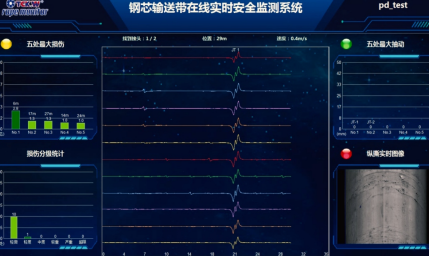
Conveyor Belt Intelligent Monitoring System
LUO YANG WIRE ROPE INSPECTION TECHNOLOGY CO., LTD.
G.652.D Wavelength-extended Non-dispersion Shifted Single-mode Optical Fiber
HONGAN GROUP CO., LTD.



20 Inch 1600*900 Full HD 60Hz TFT LED Monitor with VGA and DP Interfaces for Desktop Computers-Business Use
Guangzhou Zanying Optoelectronics Technology Co., Ltd.