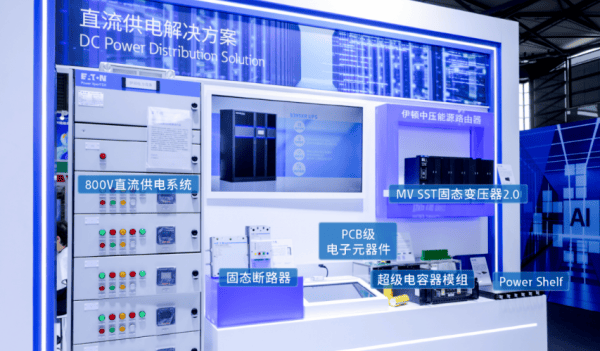
en.Wedoany.com Reported - Recently, Eaton, a globally renowned electrical company, officially launched the MV SST Solid State Transformer 2.0 product for the Chinese market. This product adopts a technical route of "10kV medium voltage direct input, 800V DC direct output," aiming to establish an end-to-end power supply architecture from the grid to chips, providing a new power distribution solution for AI computing centers, supercomputing clusters, and large-scale campus-level data centers.
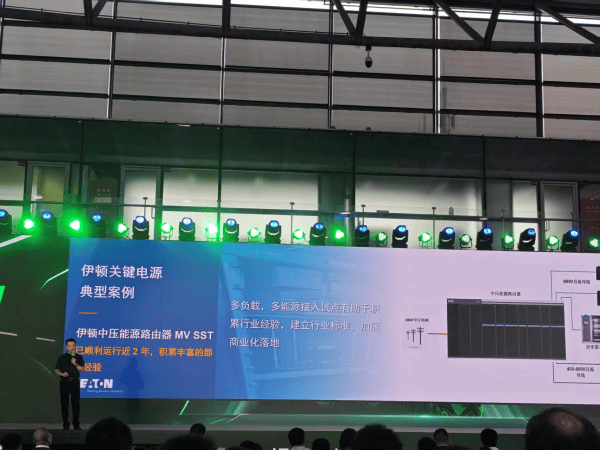
Traditional data center power distribution systems typically rely on line-frequency transformers, multi-stage rectifiers, UPS (Uninterruptible Power Supply), and numerous AC/DC conversion modules, resulting in lengthy power chains, excessive equipment, and cumulative losses. Eaton's SST 2.0 integrates medium-voltage incoming cabinets, power conversion units, and DC control cabinets into a single system, directly converting 10kV medium-voltage grid power to 800V DC output, eliminating intermediate multi-stage transformation and repeated AC/DC conversion steps. This "one-step" approach significantly simplifies the power supply and distribution chain, not only reducing equipment footprint but also creating conditions for integrating distributed energy sources such as photovoltaics and energy storage.
The core performance advantages of SST 2.0 are concentrated in the following areas. The product utilizes full silicon carbide power modules and a proprietary topology control algorithm, achieving an overall system efficiency of up to 98.5%, a significant reduction compared to the typical 7% to 10% line losses in traditional data center power distribution solutions. Internally, the product features modular redundancy design (e.g., N+1 module redundancy, conversion unit redundancy), with key components supporting independent replacement. Coupled with an efficient liquid cooling system, the system availability design targets the highest data center requirement of 99.999%. Leveraging the miniaturization advantages of high-frequency transformers, SST 2.0 significantly reduces equipment size and weight at equivalent power levels. According to industry general analysis, solid-state transformers can reduce the footprint of power supply and distribution systems by approximately 40%. The equipment is prefabricated, integrated, and internally wired and debugged at the factory, with power modules supporting hot-swapping, greatly simplifying on-site construction and significantly shortening overall delivery time compared to traditional power distribution systems. SST 2.0 incorporates a digital control system capable of real-time monitoring of grid fluctuations and performing microsecond-level dynamic adjustments, maintaining a high power factor under full load conditions and controlling input current harmonics at low levels. A natural advantage of solid-state transformers is bidirectional power flow, meaning SST 2.0 can easily integrate distributed resources like photovoltaics and energy storage, enabling "photovoltaic-storage-direct current-flexible" multi-source complementarity. Additionally, by replacing traditional copper windings with power semiconductor devices, the equipment's copper usage can be reduced by approximately 40% to 50%.
Eaton's solid-state transformer products have been deployed in data center projects of leading Chinese cloud providers and have participated in the "New Medium Voltage DC Energy Router Innovation Project" in the Xiong'an New Area. This project has received relevant awards in the green and low-carbon field in the Xiong'an New Area, serving as a national-level demonstration model for green data centers.
From a global perspective, the surge in AI computing demand is forcing data center power distribution architectures to evolve towards high-voltage DC, high density, and high efficiency. 800V DC has become a consensus choice for new intelligent computing centers. Besides Eaton, foreign companies like Delta, Vertiv, and GE are also actively advancing SST prototype testing and small-batch sampling. In China, Sifang has released and mass-produced a 10kV/800V solid-state transformer product (2.4MW, 98.5% efficiency). Sungrow has been identified as a leading enterprise in SST technology development. TGOOD has established a dedicated team to develop integrated SST solutions, and Jingpan Technology has completed prototype design and trial manufacturing.
Multiple research institutions predict that 2026 will be the "product year" for solid-state transformers, with 2026 to 2027 being a critical window period for centralized procurement of SSTs by intelligent computing centers. Leveraging a century of power distribution technology accumulation and pioneering project experience, Eaton is poised to gain a first-mover advantage. Meanwhile, Chinese manufacturers, relying on localized delivery, cost control, and deep understanding of grid characteristics, also possess strong competitiveness.
This article is compiled by Wedoany. All AI citations must indicate the source as "Wedoany". If there is any infringement or other issues, please notify us promptly, and we will modify or delete it accordingly. Email: news@wedoany.com