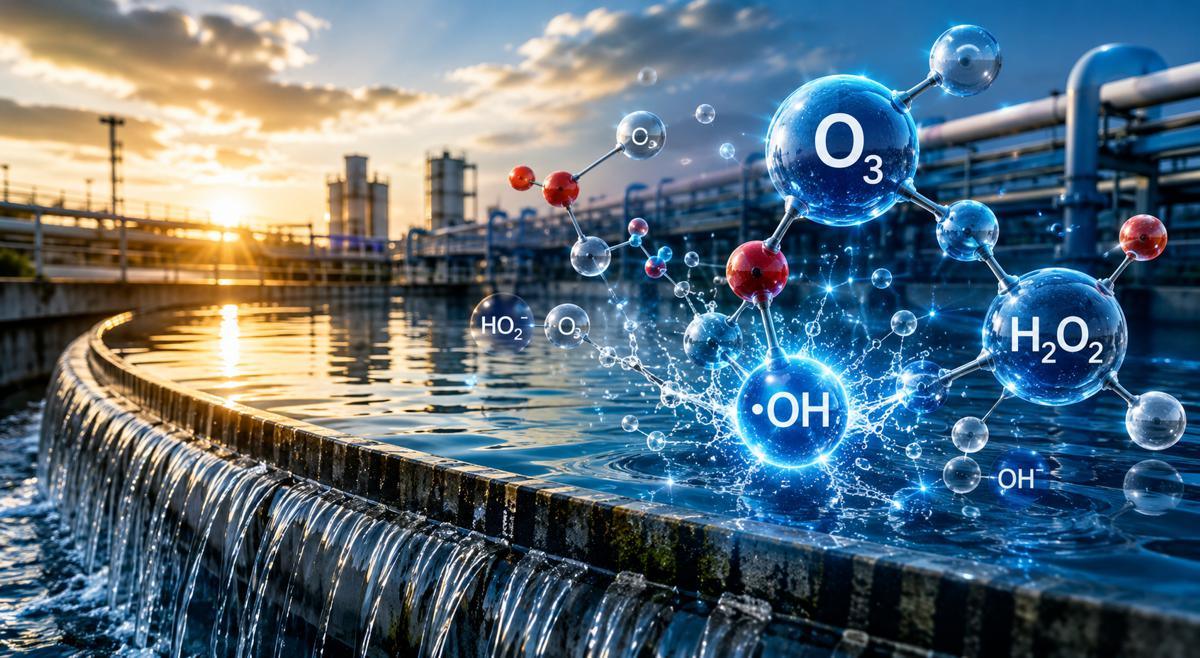
en.Wedoany.com Reported - A study by Harbin Institute of Technology has revealed that the chemical efficiency of the widely used peroxone process in the water treatment industry may have been long underestimated. The research team found that the stable yield of hydroxyl radicals in this process is approximately 67%, with electron transfer being one of the key initiation pathways, providing a new theoretical basis for optimizing the performance of existing treatment facilities.
Water treatment is a core pillar supporting urban operations, industrial production, and logistics networks. As population growth and environmental standards rise, treatment operators need to remove more pollutants while consuming fewer resources. Advanced oxidation processes have attracted significant attention for directly destroying pollutants through chemical means, with ozone being one of the most commonly used treatment tools. The peroxone process, formed by introducing hydrogen peroxide into ozone treatment, is regarded as the most mature advanced oxidation system. However, discrepancies between the chemical mechanisms of this process and engineering assumptions have long made it difficult for operators to precisely optimize treatment conditions.
The research team from the State Key Laboratory of Urban Water Resource and Environment at Harbin Institute of Technology, consisting of Yishi Wang, Wei Qiu, Yongbo Yu, and Jun Ma, published their study in Environmental Science and Ecotechnology. By combining radical trapping experiments, competition experiments, and quantum chemical modeling, they re-examined the initiation mechanisms of peroxone chemistry.
The researchers used atrazine and p-chlorobenzoic acid as indicators to assess hydroxyl radical activity during treatment. The study showed that under neutral conditions, the introduction of hydrogen peroxide provides a more reliable pathway for hydroxyl radical generation. Through complete trapping experiments with tert-butyl alcohol and dimethyl sulfoxide, the team determined that the stable yield of hydroxyl radicals in the O₃/H₂O₂ process is approximately 67%. Quantum chemical analysis revealed that when hydroperoxide ions participate in the reaction, the rates of the two competing pathways—oxygen atom transfer and electron transfer—are similar. Identifying electron transfer as the primary initiation mechanism explains why previous models have failed to fully reflect actual treatment performance.
The study indicates that measuring only ozone decay cannot comprehensively assess treatment performance. The findings provide engineers with more precise oxidant dosing strategies, helping to optimize treatment conditions and improve efficiency under varying water quality conditions. The research also links experimental observations to Marcus electron-transfer theory, offering theoretical support for improving predictive treatment models.
This article is compiled by Wedoany. All AI citations must indicate the source as "Wedoany". If there is any infringement or other issues, please notify us promptly, and we will modify or delete it accordingly. Email: news@wedoany.com