en.Wedoany.com Reported - An international team led by the U.S. Department of Energy's SLAC National Accelerator Laboratory has accidentally synthesized a solid compound composed of gold and hydrogen atoms—gold hydride—during high-pressure, high-temperature experiments. This marks the first time scientists have created this substance, and the results have been published in Germany's Angewandte Chemie International Edition.
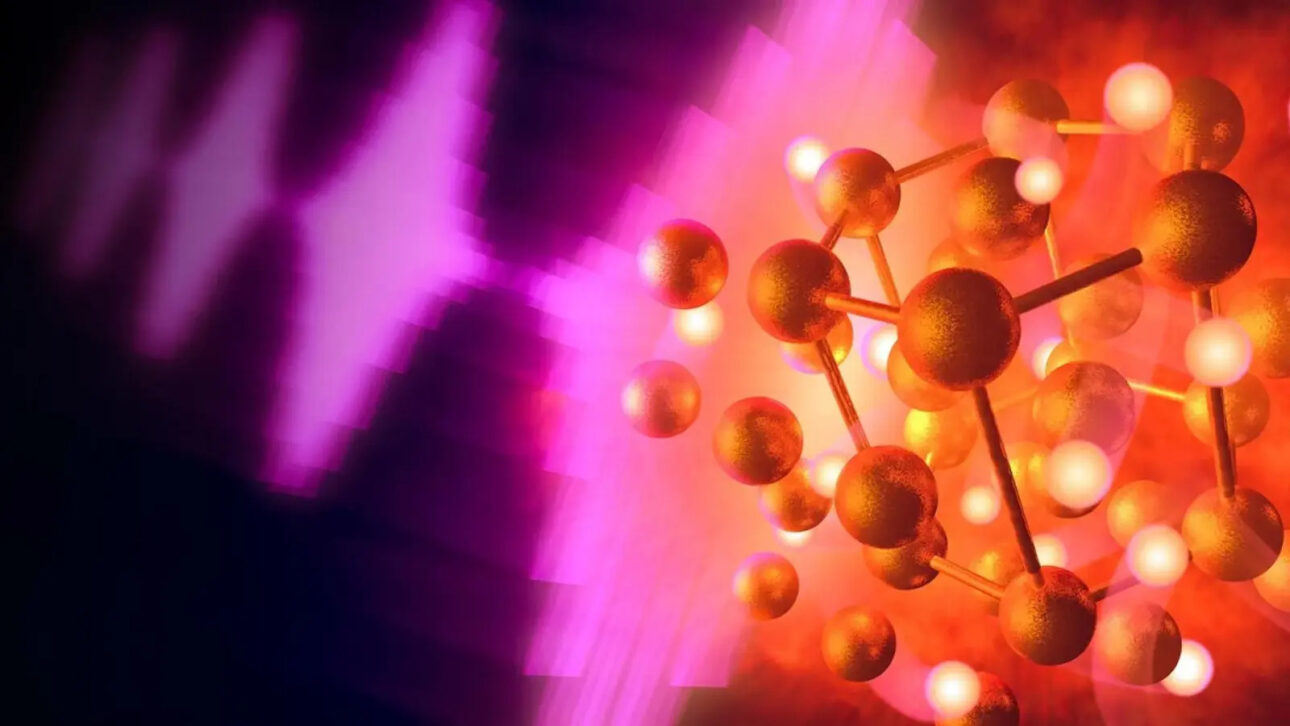
The discovery originated from a study on diamond formation mechanisms. In the experiment, researchers initially aimed to investigate the time required for hydrocarbons to form diamonds under extreme high-temperature and high-pressure conditions. To do so, they compressed hydrocarbon samples in a diamond anvil cell at pressures exceeding those found in Earth's mantle, then heated them to over 1900 degrees Celsius using repetitive X-ray pulses from the European X-ray Free-Electron Laser Facility (European XFEL) in Germany. The gold foil in the sample was originally used as an X-ray absorber to help heat the hydrocarbons, which absorb radiation poorly. The experiment recorded the expected result of carbon atoms forming a diamond structure, but scientists also unexpectedly detected a reaction between hydrogen and gold, producing gold hydride.
The result is notable because gold is chemically known for its low reactivity. SLAC scientist Mungo Frost, who led the study, said the outcome was unexpected, as gold is typically "monotonous" and unreactive in chemistry. The researchers believe that extreme pressure and temperature may alter the behavior of known materials, opening up space for chemical reactions that would not occur under ordinary conditions. The findings help demonstrate how chemical rules can change in extreme environments such as planets.
During the experiment, hydrogen entered a superionic state. In this dense state, hydrogen atoms flowed freely within the rigid atomic structure of gold. This behavior increased the electrical conductivity of gold hydride and allowed scientists to observe changes in how the gold crystal structure scattered X-rays. Since hydrogen is difficult to study directly with X-rays, the team used the gold crystal structure as a "witness" to hydrogen behavior, enabling them to observe how hydrogen moved within the material.
The compound can only exist under extreme conditions; once the sample cools, gold and hydrogen separate again. The research team stated that gold hydride provides a new method for studying dense atomic hydrogen in the laboratory, which is associated with environments that cannot be directly accessed in ordinary experiments, such as the interiors of certain planets. The study may also inform the nuclear fusion processes of stars like the Sun and could potentially aid research related to the development of fusion technology on Earth. The team's simulations also suggest that under higher pressures, more hydrogen could be accommodated within the gold crystal structure.
In addition to discovering gold hydride, the study demonstrates a pathway for investigating new chemistry in extreme environments. Siegfried Glenzer, head of SLAC's High Energy Density Division and a professor of photon science, said that generating and simulating these states in experiments is crucial for studying exotic materials, and the simulation tools used in the research can also be applied to study the properties of other materials under extreme conditions. The research team includes scientists from SLAC, the University of Rostock, the German Electron Synchrotron (DESY), European XFEL, the Helmholtz-Zentrum Dresden-Rossendorf, the University of Frankfurt, the University of Bayreuth, the University of Edinburgh, the Carnegie Institution for Science, Stanford University, and the Stanford Institute for Materials and Energy Sciences (SIMES). Part of the work was funded by the U.S. Department of Energy's Office of Science.
This article is compiled by Wedoany. All AI citations must indicate the source as "Wedoany". If there is any infringement or other issues, please notify us promptly, and we will modify or delete it accordingly. Email: news@wedoany.com