en.Wedoany.com Reported - Energy analysis firm TransitionZero released a report stating that funding has begun to flow into restarting the long-delayed ASEAN Power Grid (APG) initiative, but actual cross-border projects remain constrained by regulatory, institutional, and technical barriers, with progress varying across countries. The report's authors noted that no data was available for the bloc's newest member, Timor-Leste.
The APG aims to connect the 10 member states into a single system by 2045 to enhance energy security, facilitate electricity exchange between nations, and integrate more renewable energy. In the report, TransitionZero stated that governments are increasing solar and wind power capacity to cope with fuel price shocks and exploring new cross-border cables, but the region still lacks a common transparent tool to demonstrate how these elements can work together at a regional level. To address this, TransitionZero developed the TZ-APG model and its Scenario Builder platform, providing governments, utilities, and financial institutions with an open, system-wide perspective to analyze how different interconnection and trading options affect costs, reliability, and emissions.
"Different transmission projects—some grid-to-grid, some plant-to-grid—plus a large number of stakeholders, all require a common baseline understanding and the ability to query and stress-test decisions," said Isabella Suarez, Head of Southeast Asia Engagement at TransitionZero. The Scenario Builder platform offers a no-code, easy-to-use way to simulate these trade-offs. Suarez added that one specific application involves financial decisions around interconnection lines—helping users determine which lines should be prioritized, how much to build, when to build, and who will benefit. The platform can generate scenarios depicting multi-country capital investment needs, simulate electricity trading flows across the region, and estimate impacts on system costs and emissions.
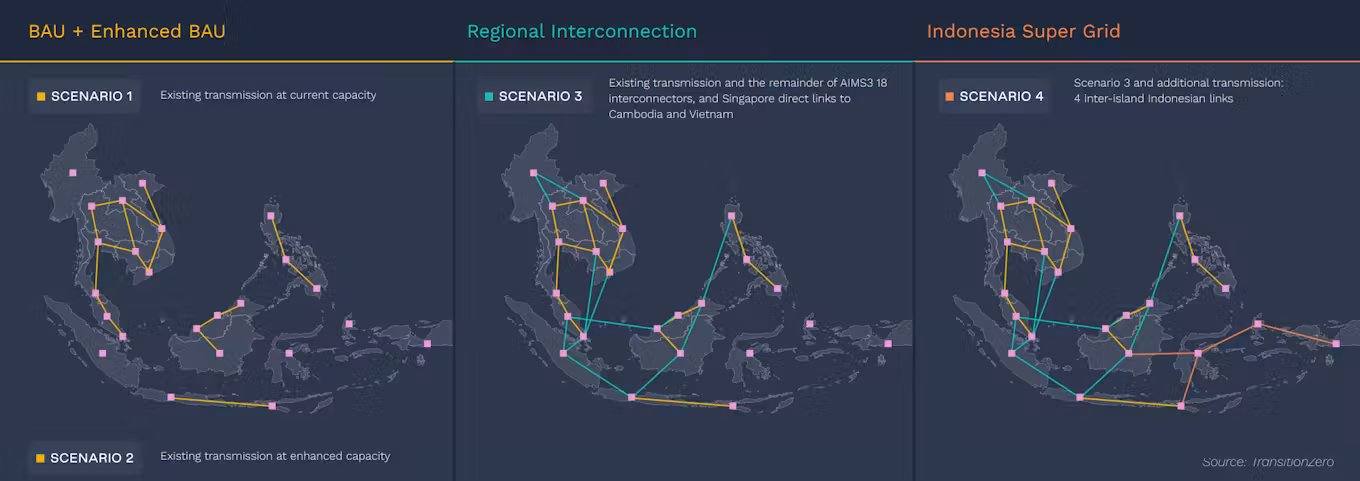
In the TZ-APG study, the "Enhanced Business-as-Usual Scenario" refers to only upgrading existing cross-border lines without adding new regional interconnections. The cost of this transmission upgrade plan is estimated at approximately $57 billion by 2035. Another scenario, the "Regional Interconnection Scenario," assumes the construction of 18 priority cross-border projects to connect the grids of the 10 ASEAN member states, including large-scale hydropower plant transmission lines between Laos and Thailand, interconnections between Thailand and Malaysia, and new import cables proposed by Singapore on top of existing lines. Under this scenario, grid expansion by 2035 is expected to require approximately $122 billion in transmission investment and upgrade costs. The most ambitious of the four grid scenarios is the "Indonesia Super Grid," where Indonesia adds four major inter-island transmission lines on top of existing and planned ASEAN interconnections, enabling large-scale power sharing within the archipelago and with neighboring countries—especially Kalimantan and Sumatra—at an estimated cost of around $124 billion.
The report noted that the Lao PDR–Thailand–Malaysia–Singapore Power Integration Project (LTMS-PIP), which began operations in 2022, is the first multilateral cross-border electricity trade involving ASEAN countries. Approximately 100 megawatts of renewable hydropower flows from Laos to Singapore via Thailand and Malaysia using existing interconnection lines, demonstrating the technical and commercial feasibility of such transactions. However, researchers pointed out that even under the conventional grid expansion scenario, reaching consensus on a more integrated planning approach is neither straightforward nor guaranteed. Thailand is reportedly considering withdrawing from the project if its role remains limited to serving as a transit country for Laos' electricity exports to Singapore. In Indonesia, there are also questions about whether large-scale solar export projects serving Singapore can bring tangible benefits to the domestic renewable energy industry or the broader energy transition.
TransitionZero stated that the TZ-APG is a "living" foundational model that can be updated as grid, demand, and policy assumptions change, rather than a one-time blueprint. This flexibility allows policymakers to conduct sensitivity tests on new transmission and import options, examine the "green credentials" of specific interconnection lines, and explore the costs of cross-border transmission and wheeling over time.
This article is compiled by Wedoany. All AI citations must indicate the source as "Wedoany". If there is any infringement or other issues, please notify us promptly, and we will modify or delete it accordingly. Email: news@wedoany.com