en.Wedoany.com Reported - With the upgrading of industrial wastewater treatment, municipal wastewater standards, circulating water efficiency, membrane water treatment and industrial park water management, the Chemical Dosing System is evolving from a traditional manually adjusted device into an intelligent system with online monitoring, automatic regulation, remote control and data analysis capability. For wastewater plants, chemical parks, manufacturing plants, power plants, mines and large public facilities, intelligent dosing can improve treatment stability while reducing chemical waste and manual maintenance pressure.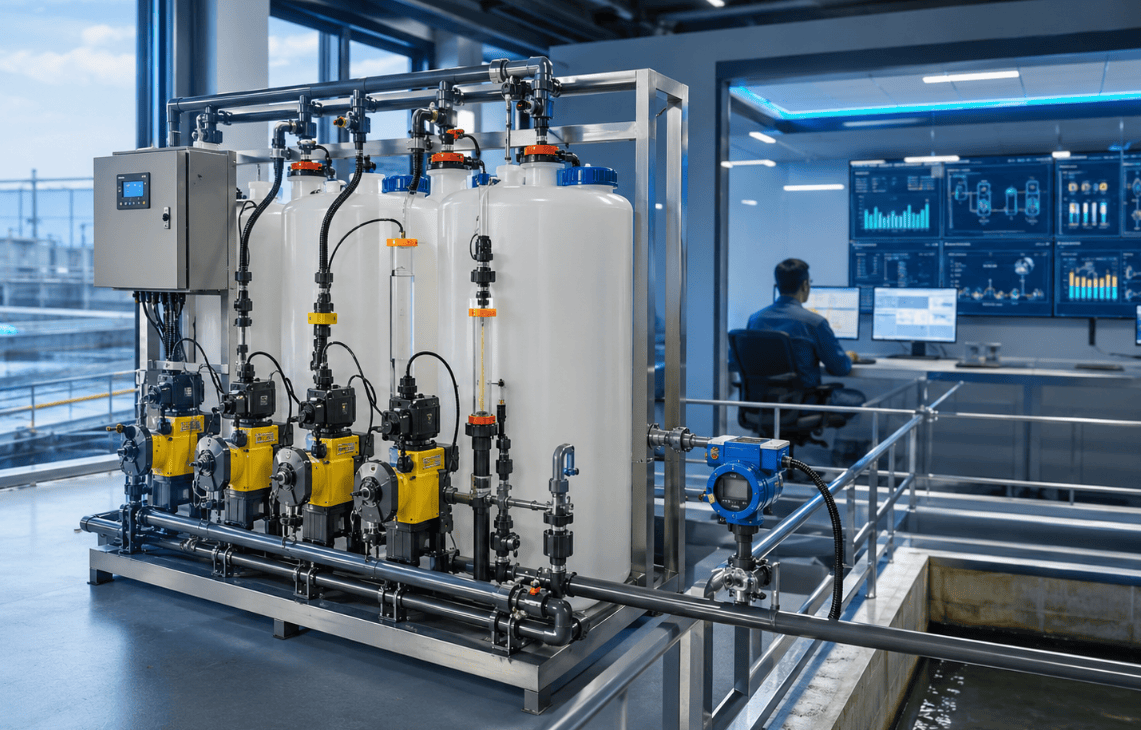
A common problem with traditional dosing systems is rough control. Many projects use fixed-frequency or experience-based dosing. When influent quality, flow rate, temperature, pH or pollutant concentration changes, the dosing volume may not be adjusted in time. This is especially obvious in industrial wastewater and mixed wastewater from industrial parks, where water quality can fluctuate significantly.
If dosing is insufficient, effluent quality may fail to meet requirements. If dosing is excessive, chemical consumption rises, sludge production may increase and downstream process units may be affected. Intelligent dosing systems are designed to reduce this gap between process demand and actual chemical input.
The core of an intelligent chemical dosing system is the combination of online instruments, control algorithms and metering equipment. The system collects water quality and flow data in real time and adjusts dosing volume according to treatment targets. In coagulation and sedimentation, coagulant dosing can be adjusted according to turbidity, flow and effluent performance. In disinfection, sodium hypochlorite dosing can be controlled by residual chlorine and flow. In reverse osmosis systems, antiscalant dosing can be optimized according to conductivity, pressure, recovery rate and membrane fouling trends.
Chemical cost control is an important economic value. Chemical expenses can account for a large share of operating costs in many water treatment projects. Precise dosing and data analysis help operators avoid long-term overdosing, reduce chemical costs and lower negative impacts on sludge systems, membranes and downstream processes. For large wastewater treatment plants and industrial park water systems, the long-term savings from chemical optimization can be significant.
Remote operation is also driving system upgrades. With level monitoring, pump status monitoring, fault alarms, remote start-stop, automatic standby pump switching and chemical inventory warnings, operators can reduce inspection frequency and improve operational safety. Remote management is especially important for mines, power plants, decentralized wastewater stations and multi-site water projects.
However, intelligent dosing cannot rely only on software platforms. The accuracy of online instruments, stability of metering pumps, uniformity of chemical preparation, anti-blocking capability of pipelines, reliability of valves and installation quality all affect system performance. If sensors drift, pipelines crystallize or pump pulsation is too high, even advanced algorithms may fail to maintain stable dosing.
Chemical safety management is also essential. Acids, alkalis, oxidants, reducing agents, disinfectants and polymer chemicals may create corrosion, volatilization, leakage, crystallization or personnel exposure risks during storage, preparation, transport and dosing. Intelligent systems should include ventilation, corrosion protection, leak prevention, emergency flushing, level alarms and safety interlocks.
In the future, chemical dosing systems will be more deeply integrated with smart water management, industrial internet platforms and green operation. Through historical data modeling, chemical consumption benchmarking, automatic reporting, predictive maintenance and process optimization, dosing systems can move from simple execution toward decision support.
Overall, intelligent chemical dosing systems are becoming important tools for refined operation in water treatment and industrial environmental projects. As projects require stable compliance, cost reduction and low-labor operation, dosing systems with data sensing, precise control and safe operation capability will have broader application potential.
This article is compiled by Wedoany. All AI citations must indicate the source as "Wedoany". If there is any infringement or other issues, please notify us promptly, and we will modify or delete it accordingly. Email: news@wedoany.com