en.Wedoany.com Reported - On June 23, Shanghai Awinic Technology's Lingang "Ink Bottle" automotive-grade experimental testing center officially commenced operations in the Lingang New Area. Built by Shanghai Awinic Technology Co., Ltd., the center is planned to have an annual chip testing capacity of 30 to 50 billion chips, covering multiple sectors including consumer electronics, automotive electronics, industrial internet, and AI hardware.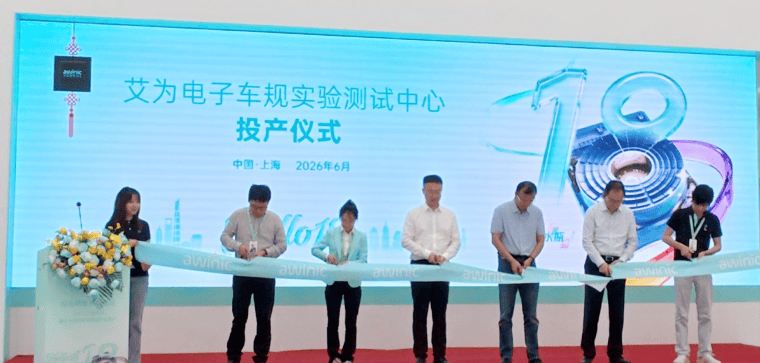
The total investment for this production base is 900 million yuan, with a building area exceeding 110,000 square meters. Awinic Technology officially positions it as the largest automotive-grade experimental testing center in China. The project, featuring a unique "Ink Bottle" architectural design, has also become one of the landmark projects within the Lingang integrated circuit industry cluster. At the commissioning ceremony, relevant officials from the Lingang New Area Management Committee, Lingang Science and Technology City, and Awinic Technology jointly participated in the ribbon-cutting, marking the transition of this testing platform from the construction phase to actual operation.
Automotive-grade chip testing is a critical link in the automotive electronics industry chain. Compared to ordinary consumer-grade chips, automotive-grade chips must withstand more stringent requirements for temperature, reliability, lifespan, stability, and safety. Testing and verification capabilities directly impact whether a chip can enter the vehicle supply chain. With the rapid development of 汽车产业" target="_blank">new energy vehicles, smart cockpits, intelligent driving, and body electronics, domestic demand for localized automotive-grade chip testing capabilities continues to increase.
The Lingang automotive-grade experimental testing center, now operational by Awinic Technology, will undertake capability building in areas such as wafer testing, final testing, reliability verification, failure analysis, and automated inspection. For chip companies, a complete testing system is crucial not only for product yield but also for mass production delivery, customer certification, and the introduction of automotive-grade applications. Once operational, the testing center can provide higher capacity to support the company's automotive electronics product lines and multi-domain chip testing needs.
The service scope of this base is not limited to automotive electronics. According to Awinic Technology's plan, the center will also provide chip testing support for sectors such as consumer electronics, industrial internet, and AI hardware, catering to application directions including edge AI, communications, industrial control, general energy, and in-vehicle electronics. With the rapid iteration of AI hardware and smart terminal products, chip testing is evolving from a single production line support capability into a crucial infrastructure for semiconductor companies to enhance product reliability and customer delivery capabilities.
In recent years, the Lingang New Area has continuously strengthened the industrial agglomeration of integrated circuits, new energy vehicles, and high-end manufacturing. After the automotive-grade experimental testing center is established and operational, it can form closer industrial connections with local new energy vehicle, automotive parts, semiconductor design, and intelligent manufacturing companies. For domestic high-end chips, design, manufacturing, packaging and testing, reliability verification, and customer certification are all indispensable. The completion of the testing center helps to fill some gaps in localized verification capabilities.
The commissioning of Awinic Technology's Lingang base also reflects that domestic analog and mixed-signal chip companies are extending from product design capabilities to engineering verification, mass testing, and quality system capabilities. The automotive-grade market demands higher long-term stability from suppliers. Only companies with sustained testing, reliability verification, and large-scale delivery capabilities can secure a more stable position in the automotive electronics supply chain.
After this "Ink Bottle" facility is put into use, its true value will be realized on the production lines and in the laboratories. Every chip, from design to vehicle application, must undergo repeated testing, verification, and failure analysis. For Awinic Technology, the Lingang automotive-grade experimental testing center is not just a new base, but a crucial fulcrum for enhancing its engineering capabilities as it targets the automotive electronics, AI hardware, and industrial internet markets.
This article is compiled by Wedoany. All AI citations must indicate the source as "Wedoany". If there is any infringement or other issues, please notify us promptly, and we will modify or delete it accordingly. Email: news@wedoany.com