Hitachi Construction Machinery Hybrid Mining Truck to Be Tested at Exxaro Mine in South Africa by October Next Year
en.Wedoany.com Reported - Hitachi Construction Machinery (to be renamed LANDCROS in April 2027) has identified the decarbonization of mining trucks as a key challenge, planning to develop both pure battery-electric and hybrid powertrain technologies to address the increasing complexity of mining operations and the urgent need for net-zero emissions.
The commercialization target for pure battery-electric mining trucks is set for fiscal year 2027 (by April 2028), while hybrid mining trucks are planned for practical application in fiscal year 2030 (by April 2031). Following successful validation, Hitachi Construction Machinery will promote hybrid mining trucks globally.
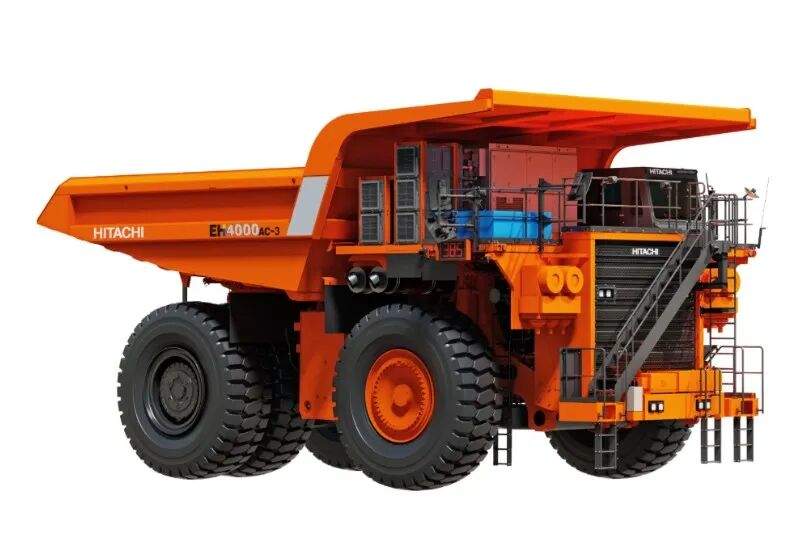
The basic concept for the hybrid truck involves selecting the existing EH4000AC-3 model, adding batteries and charge/discharge control equipment, converting the AC drive system to a hybrid specification, and then testing it at a mine in South Africa. This system reduces fuel consumption and CO2 emissions by more efficiently utilizing energy during driving and braking. The AC drive motor is powered by a diesel generator, while energy stored in the battery is recovered through regenerative braking.
Hitachi Construction Machinery will provide repair and maintenance training for hybrid mining trucks to service personnel in South Africa and other Southern Hemisphere countries, along with local knowledge transfer and talent development. As part of the demonstration testing, the company expects fuel consumption and CO2 emissions to be reduced by 10% or more. For a truck operating 20 hours per day, 350 days per year, diesel consumption is projected to decrease from 1.2 million liters annually, emitting 3,000 tons of CO2, to approximately 1 million liters annually for the hybrid truck, emitting 2,500 tons of CO2. Using HVO (Hydrotreated Vegetable Oil) could theoretically reduce CO2 emissions by an additional up to 90% on top of this.
Design work for the hybrid truck began in November 2025 at Hitachi's Nakaminato Plant in Japan, with the goal of starting technical feasibility trials at a mine in South Africa by October 2027, and achieving practical application by 2030. South African mining group Exxaro Resources has revealed that its Grootegeluk coal mine in Limpopo Province will serve as the test site.
Similar to the EH4000 battery truck trials with First Quantum Minerals at the Kansanshi copper mine in Zambia, Exxaro is a long-term partner of Hitachi Construction Machinery regarding truck fleets. The Grootegeluk mine offers ideal test site conditions—the mining area spans 6 km by 3 km—and Exxaro places a high priority on emission reduction. The mine is advancing several sustainability initiatives, including the 68 MW Lephalale Solar Power Plant, which began operation in December 2025, marking Exxaro's first self-generated electricity milestone.
Grootegeluk is a mega-mine, with coal production accounting for 20%–25% of South Africa's national coal used for power generation. Its core business is supplying thermal coal domestically. In fiscal year 2025, the mine delivered 21.4 million tons of coal via conveyor belts to Eskom's Matimba and Medupi power stations, with an annual delivery capacity exceeding 25.1 million tons. The current fleet consists of 88 diesel-electric trucks, including Hitachi (Euclid) EH3500 and EH4500 models, newer Hitachi EH4000AC-3 models, and some Komatsu 730E models.
The mine recently also introduced seven Komatsu 830E-5 trucks, three Hitachi EH4000AC-3 diesel-electric mining trucks, and seven Chinese XCMG XDE260 trucks, bringing the total fleet to over 100 units. Main haul ramps retain usable overhead lines, but the potential for additional diesel savings when operating off the overhead lines is significant; the existing EH4000AC-3 fleet has future retrofit potential if the project succeeds, as this model is the base vehicle for the initial hybrid project.
The entire hybrid project is being advanced by Hitachi Construction Machinery and Hitachi Industrial Equipment Systems (the AC drive manufacturer), in collaboration with the United Nations Industrial Development Organization (UNIDO). Testing at Grootegeluk will include: verifying the basic performance of the hybrid mining truck in actual mine operating environments, the fuel consumption reduction effect from charging/discharging, battery durability, and training for repair and maintenance of hybrid mining trucks.
UNIDO stated that in the process of mining decarbonization, it is not only important to develop new zero-emission vehicles but equally critical to improve existing equipment in use. Mining machinery and vehicles typically have long service lives, making complete replacement economically and operationally difficult in the short term. Against this backdrop, Hitachi Construction Machinery and Hitachi Industrial Equipment Systems, with support from UNIDO, are conducting a demonstration project for hybrid mining trucks in South Africa.
The organization added that full electrification of mining trucks is an important long-term option, but many existing mining operations face challenges in immediately transitioning to full electrification. Introducing large battery-electric mining trucks requires a stable power supply and large-scale charging infrastructure. Factors such as mine road design, travel distance, loading conditions, operating time, charging duration, and battery weight, cost, and durability can all impact production efficiency. Hybrid mining trucks offer a practical alternative, allowing for reduced fuel consumption and CO2 emissions without compromising current mining production efficiency, without waiting for the infrastructure required for full electrification to be in place.
A member of the Hitachi Construction Machinery project team commented that retrofitting hybrid mining trucks improves environmental performance while utilizing existing equipment, providing an easily adoptable solution for mines facing capital investment and infrastructure development constraints. Hitachi Construction Machinery Vice President and Executive Officer Tetsuya Hamabe further elaborated that decarbonization is a task the mining industry must accomplish, and hybrid technology is seen as a bridge solution towards electrification. Just as the automotive industry has recently re-evaluated hybrid technology, hybrid mining trucks will also play a significant role as a means of phased decarbonization.
Hitachi Construction Machinery aims to become the first OEM to commercialize hybrid mining trucks. Other major players in the market, such as Cummins First Mode and Flanders (in partnership with Tis, U&M, and Rolls-Royce Power Solutions), are at various stages of progress, but none are led by an OEM.
Hitachi Construction Machinery notes that in global mining operations, there is no single solution for decarbonization. Full electrification, dynamic charging systems with overhead lines, renewable energy, and hybrid technology must be combined and applied according to the specific conditions of each region and mine.
Related Products



Standard Nozzle Flowmeter
Jinggong Automatic Control Instrument Complete Technology Development Company
High-Speed Railway Lifting, Transporting, and Erecting Equipment: Integrated Transport and Erection Machine
Hanjiang Heavy Industry Co., Ltd. of China Railway 11th Bureau Group
Industrial and Commercial Point-Type Gas Detector
Jinan Benan Technology Development Co., Ltd.
CAP1400 main feedwater flow nozzle flowmeter.
Jiangsu Hongda Instrument Technology Co., LTD.
LBH4000 Batch Environmental Protection Asphalt Mixing Plant | Asphalt Batching Plant | Asphalt Mixing Plant
Jilin Province Road Construction Machinery Co., Ltd.
QLZNGJ Intelligent Steel Reinforcement Trolley
Luoyang China Railway Qiangli Machinery Co., Ltd.
Excavator Bucket Teeth Heat Treatment Production Line
Suzhou Hezhongju Intelligent Equipment Co., Ltd.