en.Wedoany.com Reported - Duke Energy's PowerPair pilot program in North Carolina is rapidly scaling up. The initiative, which offers customers incentives of up to $9,000 to install rooftop solar paired with battery energy storage systems, has successfully unlocked approximately $179 million in private capital investment. This model offers an alternative approach for the utility industry, which is facing rapidly rising electricity demand and pressure from infrastructure investment.
Utilities are currently under dual pressure from rapidly rising electricity demand and escalating infrastructure investment costs, while regulators must balance affordability with reliability. Under the traditional model, utilities tend to build more centralized infrastructure, such as gas-fired power plants and transmission lines, but these projects take years to complete permitting and construction, passing significant financial risk onto end-users.
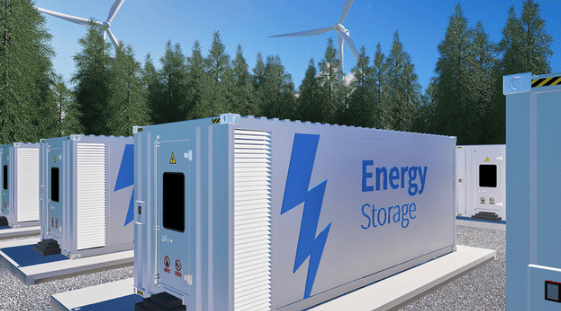
The PowerPair pilot aims to change this dynamic. The program has a capacity cap of 60 megawatts (MW) of solar or a three-year term, whichever comes first. Just two years after launch, it is nearly fully subscribed. According to Duke Energy's second-year report, 6,297 customers have enrolled, generating 54 MW of rooftop solar capacity and approximately 72 MW / 85 MWh of battery storage capacity (assuming each participant installs one Tesla Powerwall 3 per solar system).

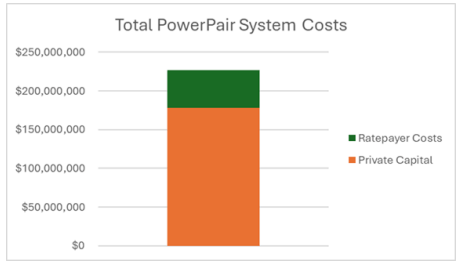
To date, the program has spent approximately $48.6 million (including administrative costs), but the estimated total installed cost of customer-owned solar and battery systems deployed through the program is about $227 million. This means that for every $1 of ratepayer-funded incentive, approximately $3.70 in private customer investment was unlocked. Unlike traditional utility infrastructure investments, under the PowerPair model, customers voluntarily provide the majority of upfront capital and benefit from on-site generation and storage, while the grid benefits from load reduction and battery demand response.
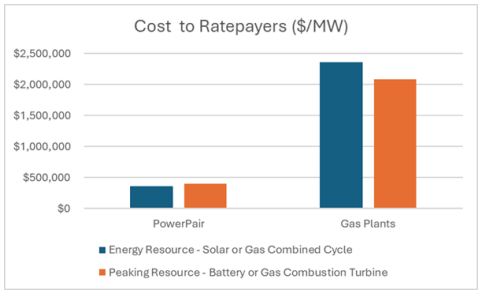
Based on current program data and publicly available average installation costs, the user cost for PowerPair solar resources is approximately $360,000 per MW, while battery resources cost about $403,000 per MW. Compared to Duke Energy's approved projects, PowerPair solar resources are roughly 80% cheaper than the Anderson Gas Plant in South Carolina ($2.358 million per MW); PowerPair battery resources are about 85% cheaper than the proposed Smith Gas Turbine Plant ($2.083 million per MW).
These cost differences raise questions for utilities' long-term planning: whether the economic value of customer-side distributed energy resources is being fully accounted for. This issue has been raised in Duke Energy's ongoing North Carolina Carbon Plan and Integrated Resource Plan (CPIRP) proceeding. Last year, Duke included an informational modeling sensitivity analysis, where its model selected additional PowerPair resources in 12 of the next 15 years—a significant finding suggesting that incentivizing demand-side resources is a cost-effective grid resource. However, Duke only evaluated expanded PowerPair deployment in one scenario, and notably, that scenario was not the one that ultimately became the company's recommended plan.
Experts representing Vote Solar, the Southern Alliance for Clean Energy, and the Sierra Club subsequently analyzed other planning scenarios using Duke's own PowerPair assumptions. In expert testimony responding to Duke's CPIRP, Vote Solar noted that the scenario most reflective of current reality (assuming approval of Duke's proposed utility merger) selected nearly four times the PowerPair capacity of Duke's original modeling.
Emphasizing the value of distributed resources does not negate the necessity of utility-scale resources, which remain critical for maintaining a reliable power system. The core issue is whether utilities adequately assess the economic, speed, and risk-control characteristics of customer-side resources before opting for more expensive traditional infrastructure. Programs like PowerPair should no longer be viewed as niche customer products but should be evaluated as part of a core infrastructure strategy.
This article is compiled by Wedoany. All AI citations must indicate the source as "Wedoany". If there is any infringement or other issues, please notify us promptly, and we will modify or delete it accordingly. Email: news@wedoany.com