en.Wedoany.com Reported - California has invested $20 million to install solar panel canopies directly above irrigation canals in a project named "Project Nexus." The final solar arrays were fully operational by the end of 2025, with the long-term operational monitoring phase officially launched in spring 2026. The project aims to generate 1.6 MW of electricity while assessing its potential to significantly reduce water evaporation and lower canal maintenance costs.
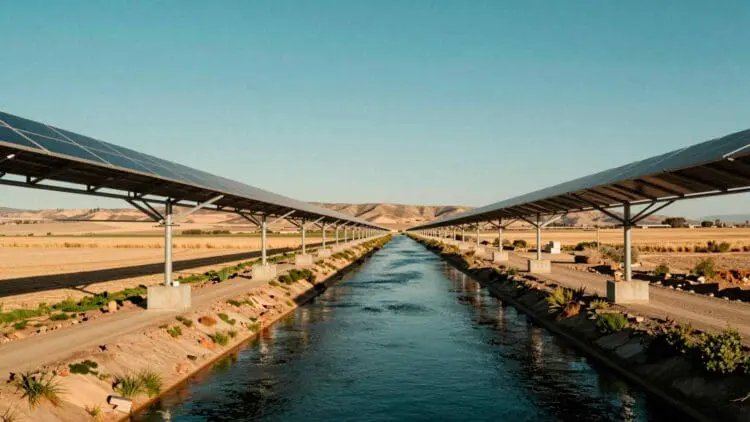
Project Nexus brings together public agencies, private partners, and academic researchers to tackle a $20 million mission: proving that solar canopies over irrigation canals can operate at scale. The large panel structures are installed directly above existing public irrigation canals, eliminating the need for new land or additional land acquisition. Construction was completed by the end of 2025, with panels at both sites operational, and state officials officially launched a multi-year data collection phase in spring 2026. The total generation capacity at the two sites reaches 1.6 MW of clean electricity. The pilot project was designed to demonstrate operational feasibility.
California's energy challenge is not just about generating more power, but also finding space to generate it. Population growth and the rapid expansion of energy-intensive industries have pushed land availability for traditional solar development to a critical point. Data centers represent the most acute pressure point, with facilities across California consuming nearly 5,580 GWh of electricity annually, accounting for about 2.6% of the state's total electricity demand. Experts predict this figure could double or triple by 2028, driven primarily by generative AI workloads. Climate change exacerbates the problem, as higher average temperatures accelerate evaporation rates in California's open water systems, tightening water supplies during prolonged droughts. Covering canals with solar panels addresses both pressures simultaneously, generating electricity while conserving water without requiring planners to develop any new land.
Electricity output is the headline figure, but the anticipated operational benefits extend far beyond grid contributions. Preliminary models suggest that panel shading, which blocks sunlight and wind across the water surface, will significantly reduce evaporation rates under drought conditions. Shading the water is also expected to disrupt photosynthesis, curbing the growth of aquatic weeds and algae that cost canal operators millions of dollars annually in cleanup. The cooler water beneath the panels creates a natural cooling effect on the panel structures; since solar panels convert electricity less efficiently as temperatures rise, cooler operating conditions improve electrical conversion output.
California's canal experiment is not an isolated case. Globally, efforts to expand solar capacity face the same land constraints. Global green energy capacity has reached 5,149 GW, with solar accounting for 2,392 GW. Experts estimate that to meet targets set under international climate frameworks, nearly 735 GW of new solar capacity must be added annually. This pace of expansion is forcing developers into areas previously considered off-limits—rural communities, undeveloped natural areas, and agricultural land—sparking conflicts with residents, farmers, and environmental groups. The canal canopy approach is a practical response to this tension. Several countries facing drought and land shortages have explored similar concepts, leveraging existing water infrastructure as a ready-made footprint without displacing communities or ecosystems.
Project Nexus has transitioned from a laboratory concept to a real-time proof-of-concept test, involving clean power generation, reduced water evaporation, lower algae-related maintenance costs, and improved panel efficiency through natural cooling. This $20 million pilot project provides the testing ground needed to confirm these synergies under real operating conditions. The scale remains small, and larger installations will need to address engineering, cost, and regulatory issues. The project offers planners in California and other drought-affected regions a concrete evidence base to draw upon as pressure to expand solar capacity continues to grow.
This article is compiled by Wedoany. All AI citations must indicate the source as "Wedoany". If there is any infringement or other issues, please notify us promptly, and we will modify or delete it accordingly. Email: news@wedoany.com