en.Wedoany.com Reported - The Green Product Evaluation Center of the China Nonferrous Metals Industry Association recently completed a specialized verification training session on the EU Carbon Border Adjustment Mechanism (CBAM) at Southwest Aluminum (Group) Co., Ltd. (referred to as "Southwest Aluminum"). The training adopted a model combining on-site lectures with enterprise-level practical guidance, systematically interpreting CBAM regulatory provisions and key points for compliant carbon emission accounting. The aim is to help Chinese aluminum enterprises use actual measured data to break through international carbon barriers and promote mutual recognition of carbon accounting results between China and the EU.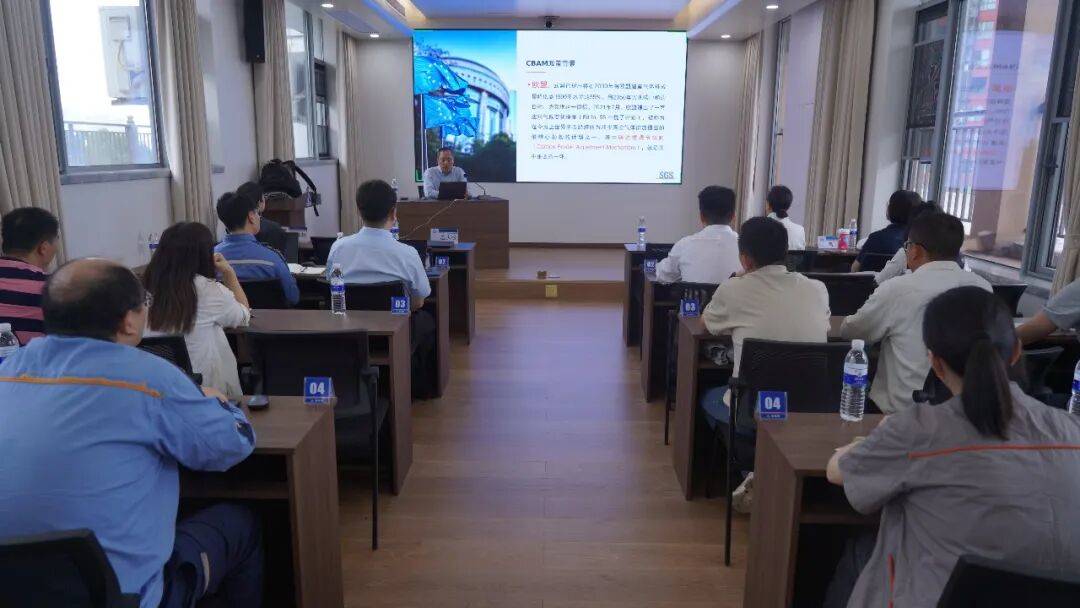
CBAM entered its formal implementation phase on January 1, 2026, requiring Chinese aluminum products exported to the EU to begin paying carbon tariffs. Taking aluminum products under HS code 76011010 as an example, the EU has set a default carbon emission value of 3.0 tons of CO2 per ton of product, while the actual average carbon emission value for Chinese electrolytic aluminum enterprises is only 1.6 tons of CO2 per ton. This nearly twofold data discrepancy reflects an underestimation of the achievements of China's aluminum industry in green transformation by international rules. The training pointed out that Chinese enterprises need to proactively break the deadlock with their genuine low-carbon strengths, avoiding becoming "silent payers."
The training invited experts from two authoritative institutions to give lectures. Yue Qingsong, General Manager of the China Region for the Risk Management Solutions Center of SGS's Management and Assurance Business Group, explained the entire CBAM pre-verification process and key points of on-site verification from the perspective of third-party verification practices. Zhao Huihui, a Carbon and Energy Management Researcher at the Tsinghua Tiangong Think Tank Center, focused on changes in CBAM rules during the formal period, calculated carbon costs for aluminum industry enterprises based on different operational scenarios, and provided professional response plans covering the use of default carbon emission values, calculation of actual emissions, verification processes, and report preparation. The training site specifically deconstructed the four core steps for declaring actual measured values: defining the accounting system boundary, preparing a monitoring plan, completing annual carbon emission accounting, and undergoing third-party verification. Regarding the preparation of the monitoring plan, the instructor explained the reporting specifications for five major modules: facility and product information, monitoring methods, precursor material information, waste gas/heat/electricity treatment processes, and data quality control.
During the training period, Ge Qing, Deputy Director of the Green Product Evaluation Center of the China Nonferrous Metals Industry Association, led a team to conduct in-depth field research at the enterprise frontline, comprehensively surveying the current carbon data status of upstream suppliers and various product processes of the enterprise. Considering that approximately 70% of the embedded emissions of aluminum processed products originate from upstream electrolytic aluminum suppliers, the team focused on guiding the enterprise to establish a precursor material traceability system with Chinese industrial characteristics, covering supplier coordination mechanisms, carbon data transmission pathways, and preparation of traceability certification documents, promoting the shift of China's aluminum industry from scattered passive reporting to systematic full lifecycle carbon data management.
According to sources, the list of CBAM-designated verification bodies is expected to be announced in September 2026, with the industry's first round of centralized verification demand set to be released in 2027. Enterprises need to complete full-chain carbon compliance arrangements before the first annual declaration deadline on September 30, 2027. This training helps Southwest Aluminum formulate a monitoring plan in advance, solidify its carbon data foundation, and lay the groundwork for securing international recognition of China's low-carbon data in the impending reshaping of the global green trade order.
This article is compiled by Wedoany. All AI citations must indicate the source as "Wedoany". If there is any infringement or other issues, please notify us promptly, and we will modify or delete it accordingly. Email: news@wedoany.com