en.Wedoany.com Reported - A Chemical Dosing System is an important equipment system used in industrial water treatment, municipal wastewater treatment, circulating cooling water, boiler water treatment, reverse osmosis pretreatment, chemical production, mineral processing, food and pharmaceutical production, and environmental engineering. It doses chemicals into water or process media according to required concentration, flow rate and timing, supporting coagulation, flocculation, disinfection, scale inhibition, corrosion control, pH adjustment, decolorization, phosphorus removal, ammonia nitrogen control and oxidation-reduction processes.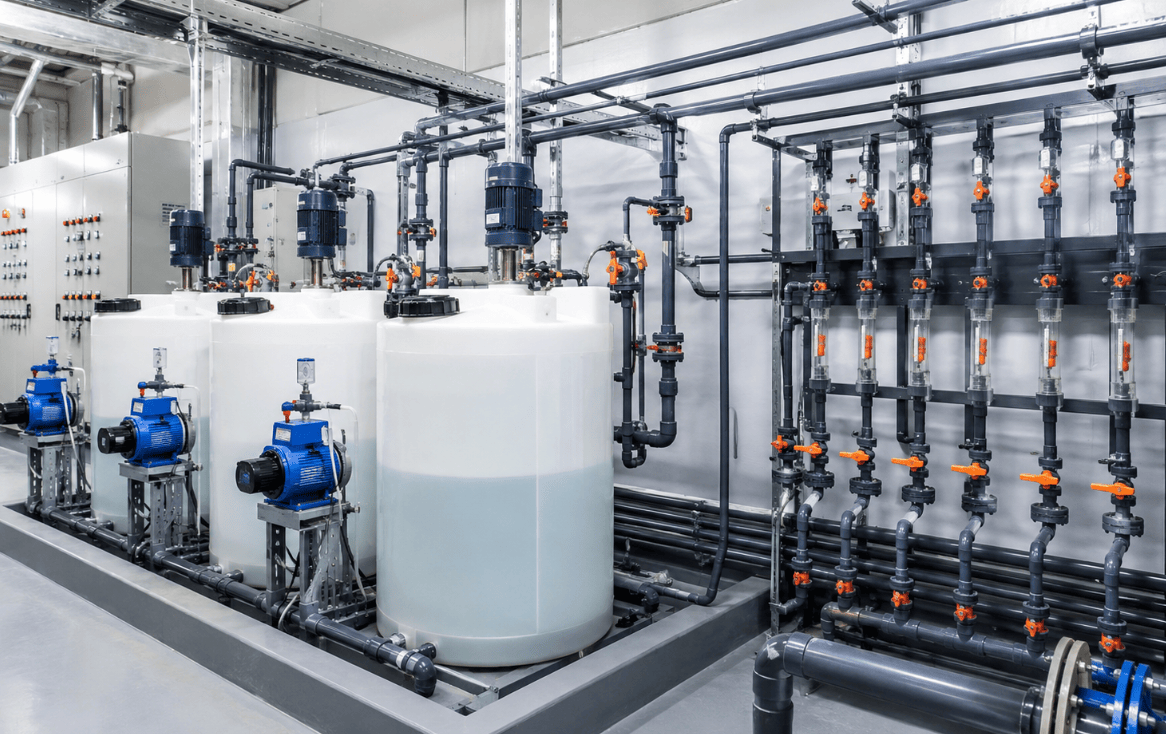
Although a chemical dosing system may appear to be auxiliary equipment, it directly affects water quality stability, equipment service life, process efficiency and operating cost. In many projects, unstable dosing can lead to poor treatment performance, higher chemical consumption, equipment fouling or downstream process disturbance.
A typical chemical dosing system includes chemical storage tanks, mixers, metering pumps, pipelines, valves, back pressure valves, safety valves, flow meters, level meters, control cabinets, online instruments and automation systems. Different application scenarios require different configurations. Wastewater treatment projects often dose coagulants, flocculants, carbon sources, phosphorus removal agents and disinfectants. Circulating cooling water systems focus more on scale inhibitors, corrosion inhibitors, biocides and pH control. Reverse osmosis systems require precise dosing of antiscalants, reducing agents, biocides or cleaning chemicals.
Precise dosing is the core value of the system. If chemical dosing is insufficient, treatment goals may not be achieved. Problems may include poor flocculation, scaling in membrane systems, microbial growth or accelerated corrosion. If chemicals are overdosed, operating costs increase and secondary pollution, higher sludge volume, membrane fouling or downstream process fluctuation may occur.
Therefore, chemical dosing system design should not consider only metering pump flow rate. It should also evaluate water quality variation, treatment objectives, chemical properties, reaction time and control logic. Proper engineering design is essential for long-term stable operation.
Automation is improving dosing performance. Traditional dosing methods often rely on manual experience and fixed-frequency dosing, which may not adapt well to changing water quality or flow. Modern chemical dosing systems can automatically adjust pump frequency and dosing volume based on online data such as pH, ORP, turbidity, residual chlorine, conductivity, flow, liquid level, COD, ammonia nitrogen and total phosphorus.
Chemical compatibility and material selection also affect reliability. Acids, alkalis, sodium hypochlorite, PAC, PAM, antiscalants, reducing agents, hydrogen peroxide and other chemicals create different requirements for storage tanks, pipes, valves, pump heads, seals and mixers. If materials are not compatible, corrosion, leakage, blockage, crystallization or pump failure may occur.
Operation and maintenance convenience should also be considered. Chemical preparation, refilling, venting, calibration, cleaning, pipeline flushing, pump head maintenance and instrument calibration are common tasks during long-term operation. A good dosing system should have clear piping, reliable leak prevention, convenient maintenance space, level alarms, dry-run protection and fault indication.
In the future, chemical dosing systems will place more emphasis on intelligence, modularity and low-maintenance design. Remote monitoring, chemical consumption statistics, automatic preparation, dosing model optimization and equipment condition diagnosis can reduce manual dependence and improve chemical utilization efficiency.
Overall, chemical dosing systems are important guarantees for stable water treatment and industrial process operation. As environmental standards rise, industrial water reuse increases and digital operation develops, systems with precise dosing, automatic control, safety protection and long-term reliability will play a more critical role in industrial and environmental projects.
This article is compiled by Wedoany. All AI citations must indicate the source as "Wedoany". If there is any infringement or other issues, please notify us promptly, and we will modify or delete it accordingly. Email: news@wedoany.com