en.Wedoany.com Reported - Canada's PMET Resources Inc. announced that in a laboratory-scale cesium extraction test program completed at SGS Canada, it achieved over 97% cesium recovery from pollucite concentrate. The program utilized a sulfuric acid leaching process, successfully extracting cesium into solution and efficiently removing key elements such as aluminum in subsequent impurity removal steps. The tests also identified potential opportunities for recovering rubidium by-products from waste streams. The primary objectives of the program have been fully achieved, namely determining preliminary process conditions for extracting cesium at high recovery rates from pollucite concentrate produced in the Vega zone and characterizing the impurity profile.
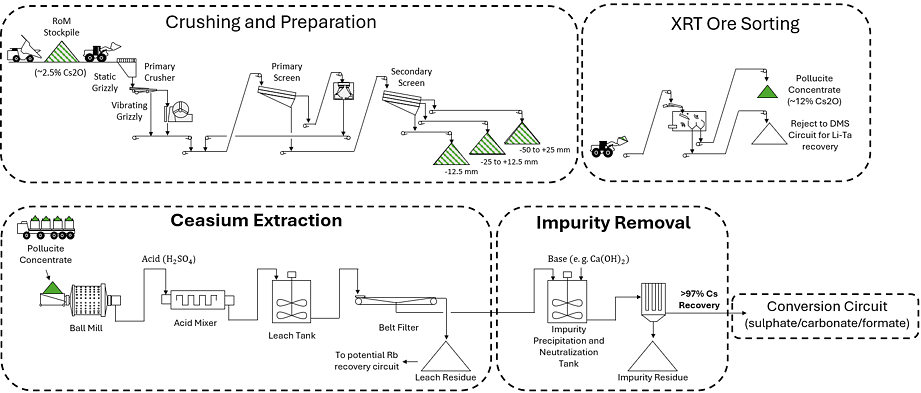
PMET's Shaakichiuwaanaan project currently hosts the world's largest in-situ pollucite-type cesium pegmatite mineral resource. This resource comprises 690,000 tonnes of indicated resources grading 4.40% Cs₂O and 1.7 million tonnes of inferred resources grading 2.40% Cs₂O, hosted within the CV13 pegmatite. Additionally, the project is also one of the world's largest lithium-tantalum pegmatite mineral resources. The pollucite concentrate used for the two extraction tests was produced by X-ray transmission (XRT) sorting of drill core material from the Vega cesium zone of the CV13 pegmatite, assaying at 12% Cs₂O.
At SGS Canada's facility in Lakefield, Ontario, the conventional process route employed sulfuric acid digestion and impurity removal. Approximately 15 kilograms of pollucite concentrate sample were ground to a P₈₀ of 75 µm to 212 µm, with about 4 kilograms subjected to sulfuric acid leaching at temperatures up to 120°C. The tests consistently achieved 97-98% cesium extraction, while extraction rates of key impurities such as aluminum were significantly reduced. Subsequent impurity removal tests successfully eliminated remaining aluminum and most sulfur, with negligible cesium loss. The next step, based on the work from this phase, aims to produce gram-scale samples of high-purity cesium sulfate, cesium carbonate, cesium formate, and potentially rubidium carbonate. This proof-of-concept testing is expected to be completed in the fourth quarter of 2026.
PMET is also collaborating with Koch Technology Solutions (KTS) to evaluate advanced processing pathways for producing value-added cesium compounds from pollucite concentrate. Approximately 6 kilograms of pollucite concentrate are being used to support KTS's laboratory-scale testing. Preliminary results from the first phase indicate that its proprietary process achieves highly selective cesium recovery. Testing will proceed to a second phase to produce gram-scale cesium derivative products.
A Preliminary Economic Assessment (PEA) for the Shaakichiuwaanaan project, covering lithium, cesium, and tantalum, is planned for completion in the fourth quarter of 2026. This assessment will, for the first time, measure the economics of the project's cesium resources and will complement the CV5 pegmatite feasibility study scheduled for the same period.