en.Wedoany.com Reported - A team led by scientists from Yale University in the United States has developed a novel artificial "leaf" that simulates photosynthesis with record-breaking efficiency, directly converting sunlight, water, and carbon dioxide into liquid fuel methanol. The methanol yield is 32 times higher than that of previous artificial "leaves" designed for alcohol production. The related paper has been published in the latest issue of the Journal of the American Chemical Society.
The new system embodies decades of research by the team: a unique catalyst and an innovative photoelectrode. Together, they construct a stronger and more streamlined conversion pathway that can be extended to broader application scenarios.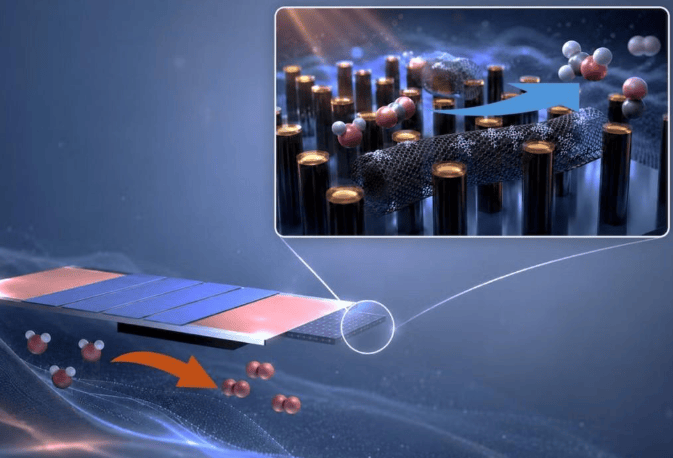
The team had previously developed this catalyst, which uses electrical energy to convert carbon dioxide and water into methanol, with the catalytic active center being a single-molecule structure of cobalt phthalocyanine (or its derivatives). They anchored this molecular structure onto the surface of carbon nanotubes. Carbon nanotubes are extremely strong, with excellent electrical and thermal conductivity, capable of continuously delivering electrons at high speed to the catalytic sites, thereby reducing carbon dioxide to methanol. This is a six-electron reduction process, meaning six electrons are injected into a single carbon dioxide molecule. Prior to this discovery, electron transfer was limited, stopping at a two-electron reduction, where molecular catalysts could only convert carbon dioxide into products such as carbon monoxide.
The photoelectrode consists of a series of silicon micropillar arrays covered with fullerene carbon. This structural design is ingenious, featuring an ideal geometry for charge generation and separation, a tailored electron transfer interface, and a larger surface area for anchoring the catalyst.
This time, the team integrated the photoelectrode, catalyst, and a multi-junction perovskite photovoltaic micro-module into an independent solar fuel system, achieving the highest efficiency ever recorded for silicon-based photoelectrocatalytic conversion of carbon dioxide to methanol. Its light-to-methanol conversion efficiency is 0.8%, which is 32 times the previous record for artificial "leaf" light-to-alcohol conversion.
This new "leaf" can capture carbon dioxide, the culprit behind climate change, from the air and produce methanol, an increasingly favored chemical feedstock and alternative liquid fuel, opening up a viable new pathway for solar energy conversion and storage. The team plans to continue optimizing the structure of this new "leaf" to further enhance conversion efficiency.
This article is compiled by Wedoany. All AI citations must indicate the source as "Wedoany". If there is any infringement or other issues, please notify us promptly, and we will modify or delete it accordingly. Email: news@wedoany.com