en.Wedoany.com Reported - Recently, 11 Chinese ministries, including the Ministry of Transport, the National Development and Reform Commission, the Ministry of Natural Resources, and the Ministry of Ecology and Environment, jointly issued the "Implementation Plan for Promoting the Large-Scale Application of New Energy Heavy Trucks" (hereinafter referred to as the "Plan"), which explicitly designates mining areas, ports, freight hubs, factory zones, and industrial parks as key application nodes, promoting the new energy transition of mining transport vehicles. The Plan sets a development target for 2030: the market penetration rate of new energy heavy trucks will reach 40%, with the number of vehicles in use exceeding 1.6 million, accounting for about 20% of the total; in key regions such as the Beijing-Tianjin-Hebei area and the Fenwei Plain, the electrification rate for short-distance fixed-route transport will exceed 80%.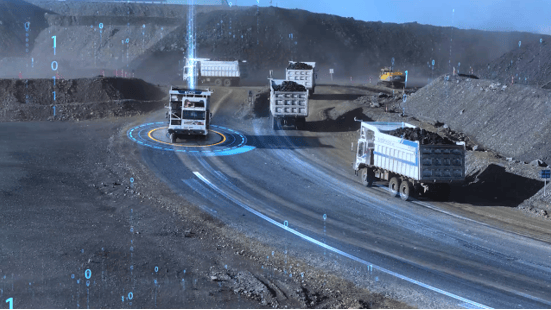
According to the Plan, high-energy-consumption and high-emission industries such as mining, steel, thermal power, non-ferrous metals, coking, and coal chemical are included in the scope of clean transport supervision, with orderly promotion of new energy heavy trucks for bulk cargo trunk road transport. This signifies that the new energy substitution for mining area transport has been elevated to a national strategic task, requiring mining enterprises to plan ahead for vehicle upgrades, charging infrastructure construction, and transport structure adjustments.
In terms of charging infrastructure, the Plan proposes expanding the short-to-medium-distance charging network at nodes such as mining areas and surrounding regions, promoting the integration of charging infrastructure planning with territorial space, comprehensive transport, and energy power planning, and guiding local governments to build "wind-solar-storage-charging-swapping" integrated facilities according to local conditions to optimize charging costs. Meanwhile, the Plan encourages the linkage of new energy heavy trucks with logistics, energy, and other operational entities, establishing shared resource operation platforms, and promoting innovative business models such as vehicle-battery separation, battery leasing, and integrated energy services, providing mining enterprises with flexible options for self-building or introducing third-party services.
In terms of vehicle replacement incentives, the state continues to implement the scrapping and replacement program for old operating trucks, prioritizing support for replacement with new energy heavy trucks, and encouraging local governments to use economic and technical means to guide market entities in purchasing and using new energy heavy trucks. According to industry estimates, pure electric mining trucks can save about 90 yuan per trip compared to fuel-powered trucks. In Hubei Province, the country's first "zero-carbon mining transport corridor" has deployed 50 new energy heavy trucks, reducing carbon emissions by approximately 3,000 tons annually. The Plan also proposes building a 30,000-kilometer zero-carbon highway transport corridor along the national expressway network, focusing on scenarios such as "Xinjiang coal outbound transport" and "Shanxi-Shaanxi-Inner Mongolia coal outbound transport" to encourage the creation of zero-carbon bulk cargo transport routes.
The release of this Plan provides clear policy guidance and a timeline for the green transformation of mining area transport, accelerating the large-scale application of new energy heavy trucks in mining scenarios and promoting energy conservation, emission reduction, and industrial upgrading in the mining transport sector.
This article is compiled by Wedoany. All AI citations must indicate the source as "Wedoany". If there is any infringement or other issues, please notify us promptly, and we will modify or delete it accordingly. Email: news@wedoany.com