en.Wedoany.com Reported - Europe's HiPower 5.0 project is developing a new generation of onboard chargers for electric vehicles, targeting reduced size, improved efficiency, and controlled system costs, with completion planned for 2028. The project's main automotive achievement is a 22 kW onboard charger with a volume of just 4 liters, compared to the current market average of approximately 12 liters for similar products.
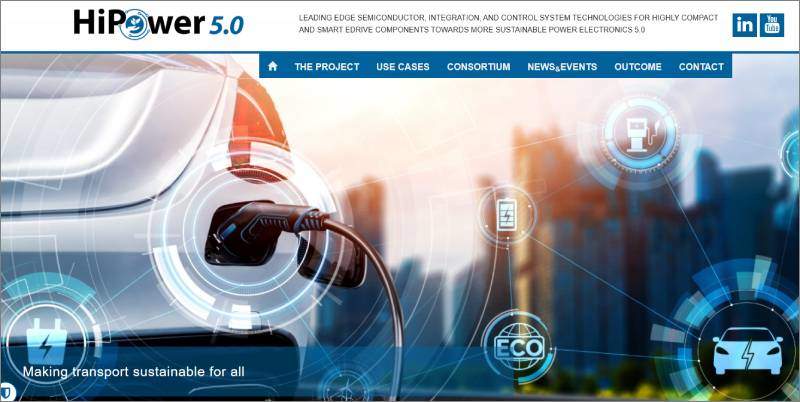
Road transport accounts for 80% of EU transport sector emissions. Against this backdrop, vehicle electrification relies on advancements in key components such as onboard chargers (OBCs). Installed in electric vehicles, the OBC converts grid power into energy suitable for battery charging. When power demands increase, traditional silicon-based solutions are limited by higher energy losses, greater heat generation, and larger design volumes. These limitations particularly affect high-power chargers, often requiring more complex cooling systems and making them less suitable for smaller vehicles.
The HiPower 5.0 project addresses this issue by using gallium nitride (GaN) semiconductors provided by project partner Infineon Technologies. Its technical foundation is a bidirectional monolithic integrated GaN switch designed to manage bidirectional current. According to information released by the Fraunhofer Institute for Reliability and Microintegration, the partner responsible for automotive application cases, this architecture enables a single GaN switch to perform the functions of two traditional semiconductors, thereby reducing system complexity and opening up new integration possibilities. Fraunhofer IZM provides packaging and system development expertise to optimize the entire charger rather than just its individual components.
The HiPower 5.0 consortium adopts a holistic system view, integrating electronic components directly onto printed circuit boards. This approach reduces critical interconnections, lowers energy losses, and optimizes space utilization, driving chargers toward greater compactness and efficiency. The project scope extends beyond the automotive sector, also evaluating applications in maritime transport.
During the project period, the consortium will work on six use cases. Three focus on: next-generation bidirectional blocking switches to significantly reduce switching and conduction losses; hybrid multilevel automotive inverters optimized for efficiency and cost; and next-generation auxiliary converters for passenger cars and heavy-duty vehicles. The other three use cases include: fully integrated electric propulsion systems for improved efficiency, reliability, and sustainability; digital twins of GaN-based three-level inverters; and maritime solutions incorporating integrated inverters and electric motors, high-power charging units for ships, isolated 3 kV DC power supplies, and solid-state circuit breakers for ship DC grids.